• HOME
  • NEWS
  • EXPLORE
    • CAREER
      • Companies
      • Jobs
    • EVENTS
    • iGEM
      • News
      • Team
    • PHOTOS
    • VIDEO
    • WIKI
  • BLOG
  • COMMUNITY
    • FACEBOOK
    • INSTAGRAM
    • TWITTER
Monday, May 11, 2026
BIOENGINEER.ORG
No Result
View All Result
  • Login
  • HOME
  • NEWS
  • EXPLORE
    • CAREER
      • Companies
      • Jobs
        • Lecturer
        • PhD Studentship
        • Postdoc
        • Research Assistant
    • EVENTS
    • iGEM
      • News
      • Team
    • PHOTOS
    • VIDEO
    • WIKI
  • BLOG
  • COMMUNITY
    • FACEBOOK
    • INSTAGRAM
    • TWITTER
  • HOME
  • NEWS
  • EXPLORE
    • CAREER
      • Companies
      • Jobs
        • Lecturer
        • PhD Studentship
        • Postdoc
        • Research Assistant
    • EVENTS
    • iGEM
      • News
      • Team
    • PHOTOS
    • VIDEO
    • WIKI
  • BLOG
  • COMMUNITY
    • FACEBOOK
    • INSTAGRAM
    • TWITTER
No Result
View All Result
Bioengineer.org
No Result
View All Result
Home NEWS Science News Chemistry

Mechanics, chemistry and biomedical research join forces for noninvasive tissue therapy

Bioengineer by Bioengineer
May 6, 2019
in Chemistry
Reading Time: 3 mins read
0
IMAGE
Share on FacebookShare on TwitterShare on LinkedinShare on RedditShare on Telegram

IMAGE

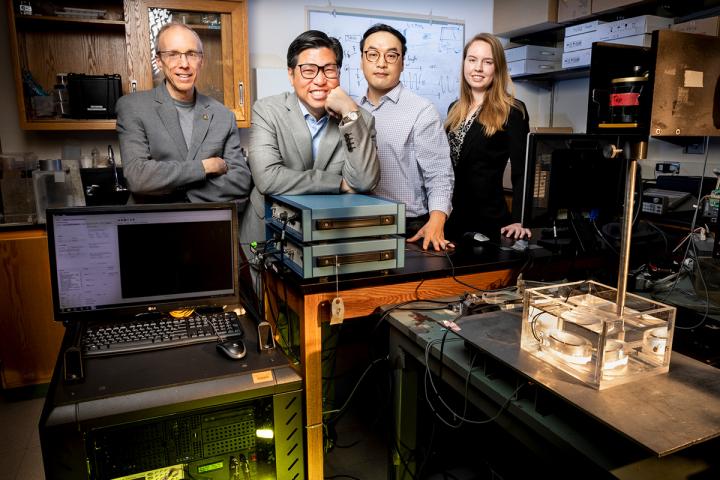
Credit: Photo by Fred Zwicky

CHAMPAIGN, Ill. — A fortuitous conversation between two University of Illinois scientists has opened a new line of communication between biomedical researchers and the tissues they study. The new findings, reported in the Proceedings of the National Academy of Sciences, show that high-intensity focused ultrasound waves can penetrate biological tissue to activate molecules able to perform specific tasks.

The research, conducted in vitro and in mice, addresses the challenges of noninvasive access to deep tissue for therapeutic purposes without causing permanent damage. The study successfully demonstrates the ability to trigger chemical reactions on demand, in a very targeted manner while using a technology already approved for medical use.

“In the broadest sense, we are trying to develop remote-controlled systems that can eventually be used in biomedical applications,” said King Li, the dean of the Carle Illinois College of Medicine, a researcher at the Beckman Institute for Advanced Science and Technology at Illinois and a study co-author.

“I learned that King was interested in finding a way to remotely activate genes using light – a field called optogenetics,” said Jeffrey Moore, the director of the Beckman Institute, a chemistry professor and a study co-author. “This presented a great opportunity to tell him about my research in synthetic polymer chemistry and mechanics.”

Moore studies synthetic molecules called mechanophores that respond to force by changing color or generating light – something he believed could harness the mechanical force of an ultrasound wave and trigger a chemical reaction that emits light. The concept is exactly what Li was seeking.

Light cannot travel through opaque material, but ultrasound waves – which have a well-documented safety record – can, the researchers said.

“Light has a limited penetration range in opaque materials, including living tissues,” Li said. “The ability to use ultrasound to penetrate opaque materials and then trigger mechanophores to produce light deep within these materials will open up many possibilities for applications such as gene activation.”

Although the researchers have successfully demonstrated remote generation of light in biologic tissue without causing damage, the intensity of that light is still not enough for optogenetic applications.

“We are getting close,” Moore said. “When we completed the study, we were within about a factor of 10 of the light intensity needed to switch on genes, but now we are closer to a factor of two.”

The interdisciplinary team of study co-authors, which includes electrical and computer engineering professor Michael Oelze and Beckman Institute researchers Gun Kim, Vivian Lau and Abigail Halmes, continues to refine the technique and seek other biomedical applications.

“This combination of high-intensity focused ultrasound and mechanophores can be utilized for many applications, and light production is only the beginning,” Li said. “We are already actively exploring other applications.”

###

Editor’s notes:

To reach Jeffrey Moore, call 217-244-5289; [email protected].

To reach King Li, call 217-300-5700; [email protected]

The paper “High-intensity focused ulatrasound-induced mechanochemical transduction in synthetic elastomers” is available from the U. of I. News Bureau.

Media Contact
Lois Yoksoulian
[email protected]

Original Source

https://news.illinois.edu/view/6367/782438

Tags: Biomedical/Environmental/Chemical EngineeringBiotechnologyGene TherapyMedicine/HealthPolymer Chemistry
Share12Tweet8Share2ShareShareShare2

Related Posts

Miniature Sensor Uses Light to Detect Touch — Chemistry

Miniature Sensor Uses Light to Detect Touch

May 8, 2026
Iron Minerals Determine Whether Dissolved Organic Matter Fuels Microbes or Becomes Long-Term Carbon Storage — Chemistry

Iron Minerals Determine Whether Dissolved Organic Matter Fuels Microbes or Becomes Long-Term Carbon Storage

May 8, 2026

Kate Evans Appointed Associate Lab Director for Biological and Environmental Systems Science at ORNL

May 8, 2026

Advancing Multiscale Modeling and Overcoming Operational Challenges in Autothermal COâ‚‚-to-Methanol Reactors

May 8, 2026
Please login to join discussion

POPULAR NEWS

  • Research Indicates Potential Connection Between Prenatal Medication Exposure and Elevated Autism Risk

    840 shares
    Share 336 Tweet 210
  • New Study Reveals Plants Can Detect the Sound of Rain

    727 shares
    Share 290 Tweet 181
  • Salmonella Haem Blocks Macrophages, Boosts Infection

    61 shares
    Share 24 Tweet 15
  • Breastmilk Balances E. coli and Beneficial Bacteria in Infant Gut Microbiomes

    57 shares
    Share 23 Tweet 14

About

We bring you the latest biotechnology news from best research centers and universities around the world. Check our website.

Follow us

Recent News

New Post-Hoc Analysis Explores Daily Oral Orforglipron Use in Adults Over 65 with Obesity, Regardless of Diabetes Status

Evaluating Digoxin Use in Patients with Symptomatic Rheumatic Heart Disease

Evaluating the Effectiveness and Safety of Digitalis Glycosides in Treating Heart Failure

Subscribe to Blog via Email

Enter your email address to subscribe to this blog and receive notifications of new posts by email.

Join 82 other subscribers
  • Contact Us

Bioengineer.org © Copyright 2023 All Rights Reserved.

Welcome Back!

Login to your account below

Forgotten Password?

Retrieve your password

Please enter your username or email address to reset your password.

Log In
No Result
View All Result
  • Homepages
    • Home Page 1
    • Home Page 2
  • News
  • National
  • Business
  • Health
  • Lifestyle
  • Science

Bioengineer.org © Copyright 2023 All Rights Reserved.