Researchers have built a detailed mathematical model of how gold nanoparticles suspended in blood would carry heat and mass through a narrowed, stenosed artery, using a formulation that replaces the classical Fourier law of heat conduction with the more modern Cattaneo-Christov heat flux model. The study, published in Discover Fluid Mechanics, is a theoretical and numerical investigation rather than an experiment on living tissue: it solves a set of transformed equations describing steady, two-dimensional, incompressible Casson nanofluid flow near a stenosed arterial surface, and reports how various dimensionless parameters shape the velocity, temperature and concentration profiles that emerge.
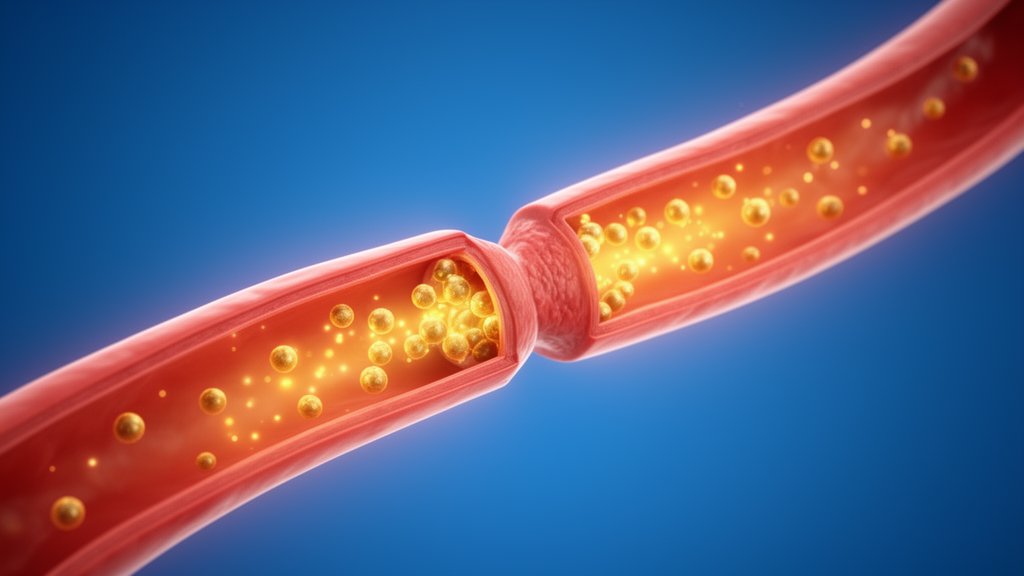
The work was carried out by G. K. Tejaswini, K. Vinutha, C. G. Jagannatha, K. C. Jagadeesha and J. K. Madhukesh, who set out to fill what they describe as a gap in the literature. According to the authors, no previous study had combined the Dufour and Soret effects, thermophoresis, Brownian motion and a porous medium in a Casson nanofluid model of a stenosed artery. The stenosis itself is represented by a cosine-shaped narrowing of the vessel radius, evaluated locally at a chosen axial location, with the artery’s curvature retained through a dedicated curvature parameter. The fluid is driven by a prescribed axial wall velocity rather than an external pressure gradient, so the model describes a local, pressure-free, wall-driven flow through the arterial lumen.
Blood is modelled as a Casson fluid, a non-Newtonian constitutive relation that captures yield stress behaviour and is commonly used to approximate blood rheology. Gold nanoparticles, sized within the conventional 1 to 100 nanometre range of nanofluid research, are dispersed in the base fluid, and standard expressions are used for the nanofluid’s density, dynamic viscosity, thermal conductivity and specific heat. The momentum equation includes a Darcy resistance term representing a porous medium, while the energy and concentration equations incorporate thermophoresis and Brownian motion alongside the Soret effect, in which a temperature gradient drives mass flux, and the Dufour effect, in which a concentration gradient drives heat flux.
The Cattaneo-Christov model is central to the formulation. First proposed as a modification of Fourier’s law to resolve the heat conduction paradox, it introduces a thermal relaxation time, meaning the heat flux does not respond instantaneously to temperature gradients. In the present axisymmetric, steady flow, the model reduces to a relation between the heat flux vector, its upper convected derivative and the temperature gradient, and it feeds a set of additional terms into the energy equation that couple the temperature field to the velocity field.
Using suitable similarity transformations, the governing partial differential equations are converted into nondimensional ordinary differential equations, which the authors solve numerically with the Runge-Kutta-Fehlberg fourth-fifth order method combined with a shooting technique. The computations use default parameter values including a porous parameter of 0.1, a Casson parameter of 1, a curvature parameter of 0.5, a thermal relaxation parameter of 0.01, thermophoresis and Brownian motion parameters of 0.1, Dufour and Soret numbers of 0.01, and a Schmidt number of 0.8, with a step size of 0.001 and an error tolerance of ten to the minus six. A grid independence test, using a reference solution at a grid size of 1600 over a computational domain extending to a similarity variable of 10, showed that the computed skin friction, Nusselt number and Sherwood number remained essentially unchanged across tested grids, with maximum deviations on the order of ten to the minus thirteen percent, and a grid size of 400 was chosen for the main computations.
The results trace a consistent physical picture. Increasing the Casson parameter lowers the velocity profile, because the parameter is inversely related to yield stress and greater yield stress behaviour increases the fluid’s resistance to deformation. Raising the porous parameter also suppresses velocity, as the solid matrix of the porous medium obstructs the flow and adds drag, thinning the momentum boundary layer. In contrast, increasing the curvature parameter raises the velocity profile, and it also elevates both the temperature and concentration profiles, reflecting enhanced heat and mass transfer near the curved surface.
The thermal and concentration fields respond in distinct ways to the remaining parameters. A larger thermal relaxation parameter reduces the temperature profile, since a higher relaxation time delays the response of heat flux to the temperature gradient and limits thermal diffusion. The temperature profile rises with the thermophoresis parameter, the Brownian motion parameter and the Dufour number, as these mechanisms redistribute thermal energy through nanoparticle movement and concentration-driven heat flux. On the concentration side, the profile increases with the thermophoresis parameter and the Soret number, but decreases with the Brownian motion parameter, which spreads nanoparticles more rapidly from regions of high concentration near the surface into the surrounding fluid.
Among the engineering quantities, skin friction decreases as the solid volume fraction and porous parameter increase, with the porous matrix restricting flow circulation. The Nusselt number rises with both the solid volume fraction and the thermal relaxation parameter, while the Sherwood number declines as the Soret number and solid volume fraction increase. Streamline patterns computed for the wall-driven flow show no closed contours, which the authors interpret as an absence of flow separation within the considered model, and isothermal line plots show closely spaced contours near the heated surface, indicating a strong local thermal gradient.
A headline quantitative result concerns the heat transfer benefit of adding nanoparticles. Using a defined heat penetration coefficient, the authors calculate that adding 3 percent nanoparticles by volume enhances the Nusselt number by approximately 2.2530 to 6.5922 percent relative to the base fluid, with the maximum enhancement of 6.5922 percent occurring at a Brownian motion parameter of 0.2. Increasing the curvature parameter from 0 to 2 raises this enhancement from 4.6023 to 6.3845 percent, whereas increasing the Dufour number and the Soret number reduces it, from 4.6057 to 4.2715 percent and from 4.1679 to 2.2530 percent respectively. The authors conclude that Brownian motion and surface curvature are the most influential mechanisms for improving the rate of thermal distribution in their model.
The authors are careful to frame the scope of the work. The model is limited to two-dimensional, steady, incompressible Casson nanofluid flow through a stenosed artery, treated as a cylinder, with the specified physical effects and boundary conditions, and it provides theoretical insight into local momentum, heat and mass transport near a stenosed arterial surface rather than clinical measurements. They suggest the findings may inform future work on gold nanoparticle-assisted vascular imaging, localized photothermal treatment and targeted drug delivery techniques, and they note that the framework could be extended to different Newtonian and non-Newtonian fluids, other nanoparticle types, alternative numerical methods, artificial neural network approaches and different boundary conditions. Because the analysis is entirely computational, grounded in similarity solutions and dimensionless parameters, its value lies in mapping how each governing parameter steers velocity, temperature and concentration in this idealized geometry, offering a quantitative baseline that experimental and clinical studies on nanofluid behaviour in narrowed vessels could subsequently test and refine.
Subject of Research: A mathematical model of Casson gold-blood nanofluid flow with Cattaneo-Christov heat transport, Soret and Dufour effects near a stenosed artery
Article Title: Cattaneo Christov heat transport and Soret Dufour effects in wall-driven Casson gold blood nanofluid flow near a stenosed artery
Article References: Tejaswini, G. K., Vinutha, K., Jagannatha, C. G., Jagadeesha, K. C., & Madhukesh, J. K. (2026). Cattaneo Christov heat transport and Soret Dufour effects in wall-driven Casson gold blood nanofluid flow near a stenosed artery. Discover Fluid Mechanics, 2(1), Article 14. https://doi.org/10.1007/s44369-026-00018-2
Image Credits: AI Generated
DOI: 10.1007/s44369-026-00018-2
Keywords: nanofluid, stenosed artery, Cattaneo-Christov heat flux, Soret effect, Dufour effect, Casson fluid, gold nanoparticles, thermophoresis, Brownian motion, porous medium, Nusselt number, blood flow modeling
News Source: Reid Dalton. (October 28, 2026). Mathematical model probes gold nanoparticle heat transport in a narrowed artery. Scienmag.