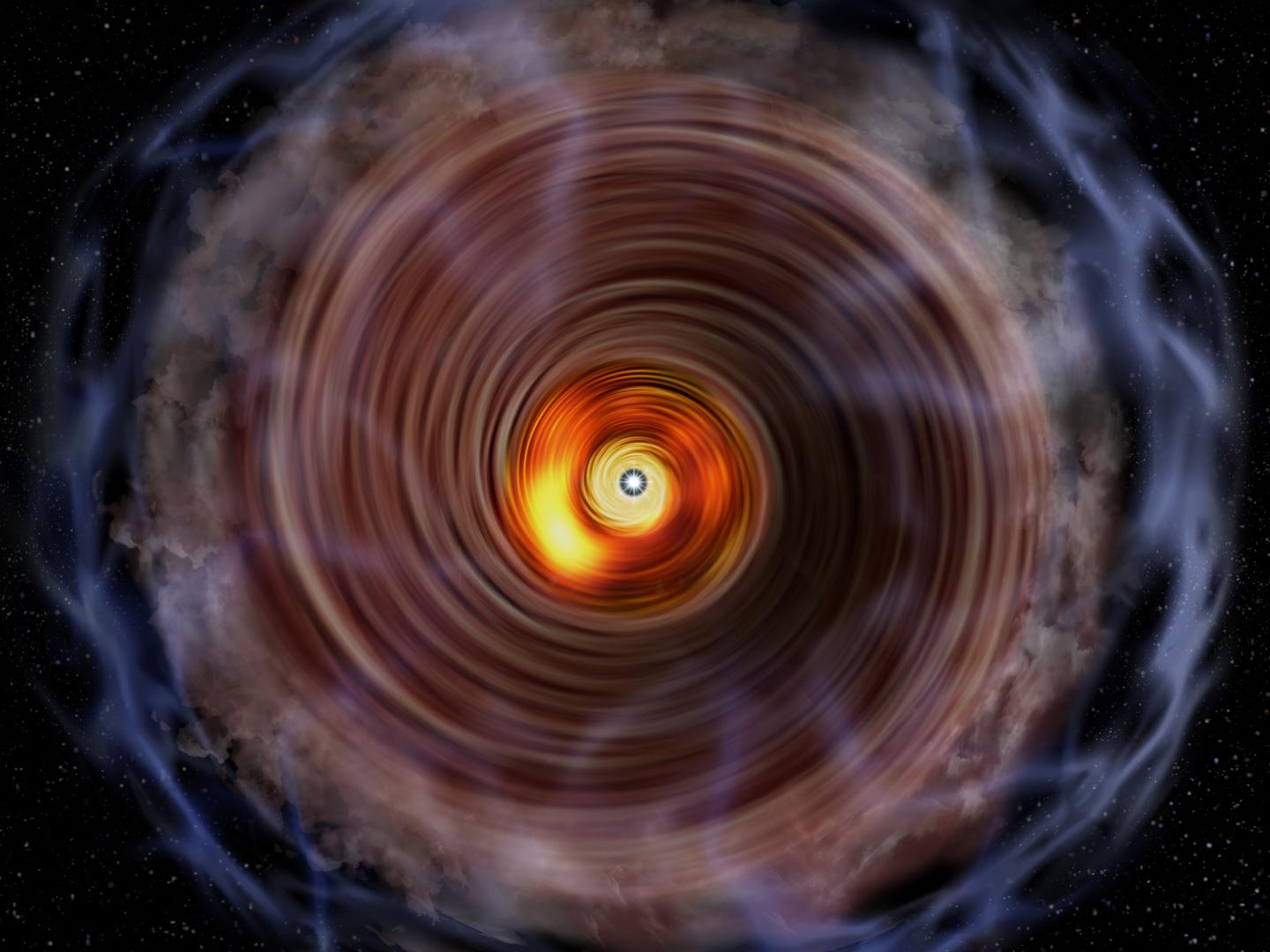
Credit: National Astronomical Observatory of Japan
Astronomers obtained the first detailed face-on view of a gaseous disk feeding the growth of a massive baby star. They found that it shares many common features with lighter baby stars. This implies that the process of star formation is the same, regardless of the final mass of the resulting star. This finding paves the way for a more complete understanding of star formation.
A protostar, a baby star still in the process of forming, is fed by a surrounding disk of gas falling towards the center. The details of the process, such as why stars form with a wide range of masses, are still unclear. Low mass stars are being formed in the vicinity of the Solar System, allowing astronomers to see the process up-close. On the other hand, massive protostars are rare, and even the nearest are located quite far away from us.
Kazuhito Motogi, an assistant professor at Yamaguchi University, Japan, and his team used the Atacama Large Millimeter/submillimeter Array (ALMA) to observe a massive protostar called G353.273+0.641 (hereafter G353). Located 5500 light-years away in the constellation Scorpius, G353 has a mass 10 times larger than the Sun, and is still growing. It is a unique target among massive protostars because we can see its gaseous disk from straight above. ALMA has revealed detailed views of several other massive infant stars, however, most of them are in edge-on configurations, making it difficult to see the inner regions of the disks.
ALMA observations captured a rotating disk around G353 with a radius eight times larger than the orbit of Neptune. This sounds huge, but it is one of the smallest disks yet found around a massive protostar. ALMA also found that the disk is surrounded by an envelope of gas three times larger than the disk.
“We measured the gas infall rate from the outer envelope to the inner disk,” says Motogi. “This helps us to estimate the age of the baby star. Surprisingly it is only 3000 years old, the youngest among known massive protostars. We are witnessing the earliest phase of the growth of a giant star.”
Interestingly, the disk is not uniform; the south-eastern side of the disk is brighter than other parts. This is the first time astronomers have seen an asymmetric disk around a massive protostar. The team also found that the disk is highly unstable and going to fragment. The uneven disk might be caused by this instability. These features are often seen around smaller protostars, suggesting that the essential physical processes are the same in low-mass and high-mass star formation.
“Previous studies had implied that the formation process might be different for stars of different masses,” says Motogi. “Our new observations show the similarity. This is an important step to understand how massive protostars gain mass from the surroundings.”
###
The research team members are:
Kazuhito Motogi (Yamaguchi University), Tomoya Hirota (National Astronomical Observatory of Japan/SOKENDAI), Masahiro N. Machida (Kyushu University), Yoshinori Yonekura (Ibaraki University), Mareki Honma (National Astronomical Observatory of Japan/SOKENDAI), Shigehisa Takakuwa (Kagoshima University), and Satoki Matsushita (Academia Sinica Institute of Astronomy and Astrophysics)
The Atacama Large Millimeter/submillimeter Array (ALMA), an international astronomy facility, is a partnership of the European Organisation for Astronomical Research in the Southern Hemisphere (ESO), the U.S. National Science Foundation (NSF) and the National Institutes of Natural Sciences (NINS) of Japan in cooperation with the Republic of Chile. ALMA is funded by ESO on behalf of its Member States, by NSF in cooperation with the National Research Council of Canada (NRC) and the Ministry of Science and Technology (MOST) and by NINS in cooperation with the Academia Sinica (AS) in Taiwan and the Korea Astronomy and Space Science Institute (KASI). ALMA construction and operations are led by ESO on behalf of its Member States; by the National Radio Astronomy Observatory (NRAO), managed by Associated Universities, Inc. (AUI), on behalf of North America; and by the National Astronomical Observatory of Japan (NAOJ) on behalf of East Asia. The Joint ALMA Observatory (JAO) provides the unified leadership and management of the construction, commissioning and operation of ALMA.
Yamaguchi University is a comprehensive national university with over 10,000 students in 9 faculties and 8 graduate schools. The university traces its origins back to Yamaguchi Kodo, a private school started in 1815. Yamaguchi University has put these values to words in our motto: “Discover it. Nourish it. Realize it. A Place of Wisdom,” and contributes to local development and to the development of Japanese and international society through the three fields of education, research, and social contribution.
Media Contact
Masaaki Hiramatsu
[email protected]
Original Source
https:/
Related Journal Article
http://dx.