In a comparative poultry nutrition study, researchers found that supplementing broiler diets with marula (Sclerocarya birrea) oil and fulvic acid produced carcass characteristics, meat quality, and sensory attributes comparable to the synthetic antibiotic growth promoter Olaquindox. The feeding trial showed that dietary treatments had no statistically significant effect on most carcass traits, including dressing percentage, cold carcass weight, hot carcass weight, and individual commercial cuts including wings, thighs, and drumsticks. However, dietary formulations caused significant differences in backlength and muscle pH at slaughter. Broilers fed diets with marula oil achieved significantly longer backlength than those on the control diet, with birds on pure marula oil reaching 29.2 centimetres compared to 27.9 centimetres in the control group. Slaughter pH also differed across treatments, registering lowest in birds fed fulvic acid alone and highest in those fed marula oil, whereas subsequent twenty-four-hour pH, water-holding capacity, drip loss, and cooking loss showed no significant differences among treatments. The authors noted that identifying effective non-antibiotic dietary additives is increasingly important for sustainable animal production and food safety.
The investigation addressed challenges in commercial poultry production, which has expanded rapidly worldwide to satisfy rising demand for animal-derived protein. Broiler production systems have traditionally used antimicrobial growth promoters to optimize performance, but consumer apprehension regarding antibiotic residues and resistance has accelerated the search for natural alternatives. Phytogenic plant extracts and organic acids have emerged as primary candidates to support wholesome meat production. Plant extracts supply dietary antioxidants, including phenolic compounds, flavonoids, tocopherols, and phytosterols, which protect muscle tissues against lipid peroxidation by scavenging free radicals, helping preserve meat color stability and fatty acid profiles. Simultaneously, organic acids serve as feed additives and preservatives that form complexes with minerals such as calcium, phosphorus, magnesium, and zinc, enhancing mineral digestion and reducing nutrient excretion while improving lipid metabolism. Evaluating marula seed oil alongside fulvic acid provided empirical data on whether natural botanicals and organic biostimulants could deliver broiler yields matching conventional antibiotic regimens.
The feeding trial was conducted at the Henderson Poultry Research Station, situated thirty kilometres north of Harare, Zimbabwe, in agro-ecological region IIb between longitude 17°35′ South and latitude 30°58′ East, an area receiving average annual rainfall of approximately 870 millimetres. The experiment lasted forty-two days from 23 August 2024 to 4 October 2024, divided into starter (days one to fourteen), grower (days fifteen to twenty-eight), and finisher phases (days twenty-nine to forty-two). Housing preparation began fourteen days prior to bird arrival, when technicians emptied the poultry facility, washed all equipment with detergent, and removed dust from all surfaces. Ceilings, walls, and concrete floors were disinfected, and insecticide was applied along floor perimeters, wall junctions, and support posts. Wood shavings were spread across pens at depths between five and ten centimetres. Ambient temperature and relative humidity were stabilized at least twenty-four hours before chick placement.
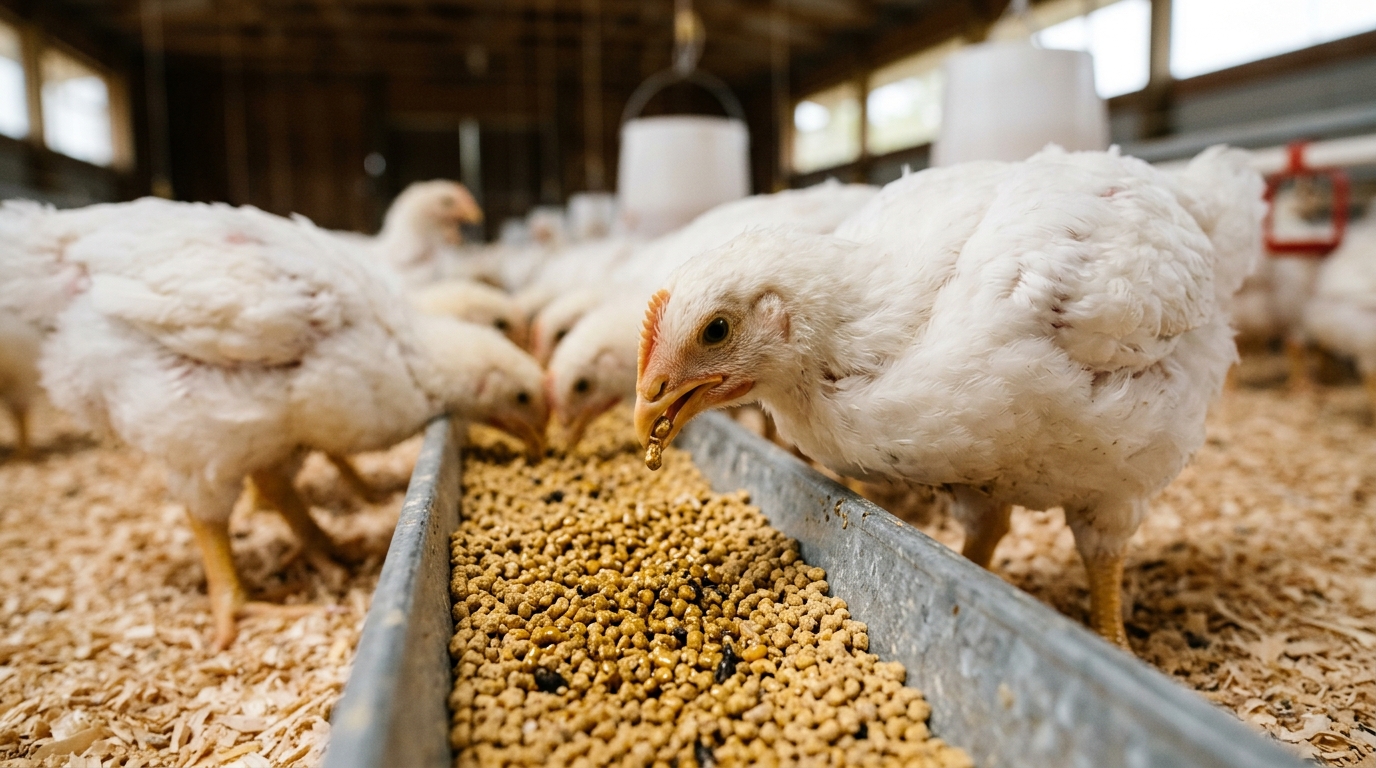
The experiment utilized 320 unsexed day-old Cobb 500 broiler chicks purchased from Irvines, a commercial hatchery supplier in Zimbabwe. The birds were randomly distributed across thirty-two pens measuring 2.1 by 1.5 by 1.7 metres, designed to satisfy broiler welfare standards. The study employed a completely randomized design with four dietary treatments, each replicated in eight pens containing ten birds per pen, with each pen serving as an experimental unit. Diets were formulated to be isocaloric and isonitrogenous following National Research Council nutrient specifications. The control diet was an experimental mash containing the antibiotic Olaquindox. The CFF diet contained two grams of fulvic acid per kilogram of feed without antibiotic. The CFFM diet contained 1.4 grams of fulvic acid and 0.6 grams of marula oil per kilogram of feed without antibiotic. The CFM diet contained two grams of marula oil per kilogram of feed without antibiotic.
Marula essential oil was obtained from the Mwenezi Marula processing plant facility in Zimbabwe, where oil is extracted from marula fruit kernels. Analysis of this Mwenezi marula oil extract revealed a fatty acid composition of 68 percent oleic acid, 14.7 percent palmitic acid, 5.3 percent linoleic acid, and 0.94 percent stearic acid. Fulvic acid was sourced from Valugen Private Limited as a biostimulant substance. Basal feed mixtures across starter, grower, and finisher phases included fine yellow maize, prime yellow gluten, full-fat soya, local soybean meal, fine limestone powder, monocalcium phosphate, fine salt, sodium bicarbonate, and choline powder. Essential amino acids were balanced using lysine, L-threonine, and methionine, alongside commercial phase premixes containing phytase enzymes. Anticoccidial protection was provided by Coxistac across all diets, while experimental growth promoters, including Olaquindox, marula oil, and fulvic acid, were dosed based on known bioactive properties and fatty acid thresholds.
Management protocols maintained regulated environmental conditions throughout the forty-two-day growing period. Enclosure temperatures were maintained between 32.5 and 33.0 degrees Celsius during the first three days of brooding using suspended infrared lights, and oral stress packs were administered to chicks during this initial period. Ambient housing temperatures were progressively lowered to 26.0 degrees Celsius by day fourteen, at which point supplementary infrared heating was discontinued. Feed and water were offered ad libitum across the starter, grower, and finisher phases, and flock mortality was monitored and recorded daily. Experimental procedures were formally approved under the Zimbabwe Animal Act, Chapter 19:12, License number L629 (Scientific Experiments on Animal Act, 1963;01–2025-14). Following completion of the forty-two-day feeding trial, all broilers were subjected to a thirteen-hour fasting period to ensure complete crop clearance before being transported to the research station abattoir for slaughter.
At the Henderson Poultry Research Station abattoir, birds were grouped by dietary treatment and placed in a metal rack for stunning. Chickens were slaughtered by severing the jugular vein with a sharp knife and allowed to bleed for up to two minutes. Birds were processed through a mechanical de-feathering machine, eviscerated, and weighed immediately to determine hot carcass weight. Three birds per replicate pen were dissected, providing twenty-four birds per treatment. Weights of eviscerated carcasses, breasts, wings, thighs, and drumsticks were recorded, dressing percentage was calculated, and pectoralis major breast muscles were vacuum-packed and stored at minus twenty degrees Celsius.
Analysis of carcass characteristics demonstrated that dietary treatments did not significantly affect most cut weights or dressing proportions, though significant variations emerged in slaughter weight and backlength. Broilers on the Olaquindox control diet reached a slaughter weight of 2022 ± 46.7 grams, statistically comparable to CFF (1912 ± 61.4 grams) and CFFM (1981 ± 11.1 grams), but significantly higher than CFM at 1866 ± 122 grams (P = 0.00001). Hot carcass weights showed no significant variation (P = 0.197), averaging 1668 ± 143 grams for control, 1574 ± 195 grams for CFF, 1554 ± 188 grams for CFFM, and 1535 ± 96.7 grams for CFM. Cold carcass weights were similarly non-significant (P = 0.204), registering 1657 ± 148 grams, 1567 ± 193 grams, 1543 ± 187 grams, and 1526 ± 3.4 grams. Dressing percentages showed no significant differences (P = 0.632), ranging from 78.4 ± 9.53 percent in CFFM to 82.8 ± 9.23 percent in CFM. Wing, drumstick, and thigh weights and lengths were all statistically equivalent (P > 0.05). Conversely, backlength differed significantly (P = 0.001), measuring 27.9 ± 1.0 centimetres in control, 28.9 ± 0.84 centimetres in CFF, 29.1 ± 1.46 centimetres in CFFM, and 29.2 ± 1.13 centimetres in CFM.
Meat quality evaluations on breast muscle revealed that diets produced no significant differences in twenty-four-hour pH, water-holding capacity, drip loss, or cooking loss, but did affect slaughter pH. Muscle pH at slaughter was 6.49 ± 0.06 in the control group, 6.38 ± 0.11 in CFF, 6.50 ± 0.16 in CFFM, and 6.54 ± 0.08 in CFM, with the CFM value significantly higher than CFF (P = 0.011). At twenty-four hours post-mortem, pH values equilibrated to 6.25 ± 0.13 in control, 6.19 ± 0.07 in CFF, 6.26 ± 0.10 in CFFM, and 6.30 ± 0.11 in CFM (P = 0.079). Water-holding capacity, measured in duplicate on fresh meat under sixty kilograms of pressure using the filter-paper press method, ranged between 80.4 ± 4.55 percent in CFF and 84.3 ± 7.04 percent in control (P = 0.505). Drip loss of breast muscle suspended at minus four degrees Celsius for seventy-two hours was 6.19 ± 3.01 percent in control, 7.13 ± 1.52 percent in CFF, 8.31 ± 6.91 percent in CFFM, and 8.25 ± 2.98 percent in CFM (P = 0.698). Cooking loss after boiling at 180 degrees Celsius for thirty minutes ranged from 20.4 ± 2.77 percent in CFFM to 22.3 ± 3.08 percent in CFF (P = 0.514).
Sensory evaluation of cooked breast meat was conducted by ten trained and ten untrained panelists using a seven-point hedonic scale. Breast samples were cooked in an oven at 180 degrees Celsius for thirty minutes and evaluated for texture, juiciness, flavor, and overall acceptability in randomized order under unique codes. Sensory evaluation revealed significant differences in organoleptic properties between broiler meat from diets supplemented with marula oil and fulvic acid compared to the antibiotic control diet. All experimental data were analyzed using the General Linear Model procedure and Proc Corr of SAS software, setting significance at P < 0.05. The researchers concluded that Sclerocarya birrea oil and fulvic acid can be successfully utilized as alternative growth promoters in broiler chicken diets. Their complementary effects on carcass traits, meat quality, and sensory attributes proved comparable to those obtained with conventional antibiotic growth promoters, providing a viable nutritional pathway to reduce agricultural antibiotic reliance.
Subject of Research: Effects of dietary marula oil and fulvic acid on broiler chicken carcass characteristics and meat quality
Article Title: Effects of Sclerocarya birrea oil and fulvic acid growth promoter in broiler diets on carcass characteristics, meat quality, and sensory attributes
Article References: Nhara, R. B., Sengwe, E., & Baloyi, J. J. (2026). Effects of Sclerocarya birrea oil and fulvic acid growth promoter in broiler diets on carcass characteristics, meat quality, and sensory attributes. Frontiers in Animal Science, 7, Article 1983084. https://doi.org/10.3389/fanim.2026.1983084
Image Credits: AI Generated
DOI: 10.3389/fanim.2026.1983084
Keywords: broiler chickens, marula oil, fulvic acid, poultry nutrition, meat quality, carcass characteristics, growth promoters, Olaquindox, Effects, Sclerocarya, birrea, fulvic
News Source: Drew Townsend. (November 6, 2026). Marula Oil and Fulvic Acid Show Promise as Broiler Feed Additives. Scienmag.