Washington University ranks seventh in the world for its number of highly-cited researchers
Credit: Washington University in St. Louis
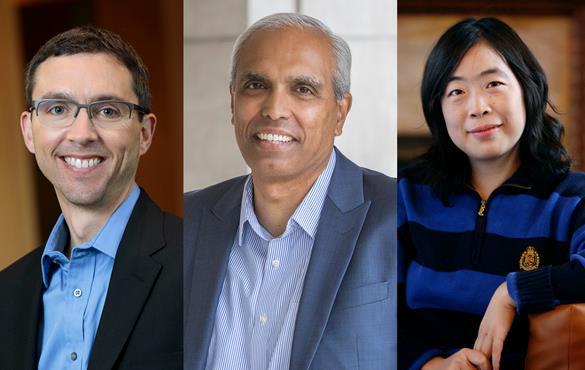
Randall Martin, Rohit Pappu and Lan Yang, all professors in the McKelvey School of Engineering at Washington University in St. Louis, have been named among the most highly-cited researchers in the sciences by the Institute for Scientific Information.
Martin, professor of energy, environmental & chemical engineering; Pappu, professor of biomedical engineering; and Yang, professor of electrical & systems engineering, were among 55 faculty from Washington University named to the list, which recognizes researchers worldwide who have demonstrated significant and broad influence reflected in their publication of multiple papers, highly cited by their peers over the course of the last decade. These papers rank in the top 1% by citations for these fields and year in Web of Science.
Washington University ranks seventh in the world for its number of highly-cited researchers. For 2019, 6,216 researchers made the overall list.
Martin’s research focuses on characterizing atmospheric composition to inform effective policies surrounding major environmental and public health challenges ranging from air quality to climate change. He leads a research group at the interface of satellite remote sensing and global modeling, with applications that include population exposure for health studies, top-down constraints on emissions, and analysis of processes that affect atmospheric composition. He serves as co-model scientist for a leading global atmospheric model (GEOS-Chem), leads a global fine particulate matter network (SPARTAN) to evaluate and enhance satellite-based estimates of fine particulate matter, and on multiple science teams for satellite instruments including MAIA, TEMPO and GEMS. Data from his group are relied upon for a large number of assessments, including for the OECD Regional Well-Being Index, for World Health Organization estimates of global mortality due to fine particulate matter, for the Global Burden of Disease Project to examine the risk factors affecting global public health and for a wide range of health studies.
Martin joined McKelvey Engineering in 2019 from Dalhousie University in Halifax, Nova Scotia, Canada, where he had been on the faculty since 2003. He was named professor in 2011 and Arthur B. McDonald Chair of Research Excellence in 2016. Since 2003, he also has been a research associate at the Harvard-Smithsonian Center for Astrophysics, where he also was a postdoctoral fellow. He serves on a variety of task forces, advisory boards and working groups as an expert on air quality. His professional honors include a Steacie Memorial Fellowship and selection to the Royal Society of Canada.
Pappu’s research focuses on intrinsically disordered proteins (IDPs), specifically their roles in transcriptional regulation, receptor mediated cell signaling and cellular stress response. The Pappu lab has pioneered the combined use of polymer physics theories, novel homegrown computational methods, and experiments to probe the functional and phenotypic impacts of IDPs. Pappu’s lab also has a large focus on neurodegeneration in Huntington’s and Alzheimer’s diseases. The central goal is to understand how protein aggregation and protein homeostasis pathways collude to give rise to neuronal death as a function of aging.
Pappu joined Washington University in St. Louis in 2001. He earned a doctorate in biological physics from Tufts University and completed two biophysics postdoctoral fellowships at Washington University and Johns Hopkins University Schools of Medicine. Pappu is the director of the Center for Science and Engineering of Living Systems, co-director of the Center for High-Performance Computing, and a member of the Hope Center for Neurological Disorders.
Yang is a fellow of IEEE and of The Optical Society. Her research interests include fabrication, characterization and fundamental understanding of advanced nano/micro photonic devices with outstanding optical properties or novel features for unconventional control of light flow. Her group focuses on the silicon-chip-based, ultra-high-quality micro-resonators and their applications for sensing, lasing, nonlinear optics, environmental monitoring, biomedical research and communication. Her Laboratory of Micro/Nano Photonics Research Group has demonstrated the first on-chip micro-resonator-based particle sensors that can achieve not only detection but also size measurement of single nanoparticles one by one. Different materials with tailored chemical compositions and nanostructures are used in her research to achieve advanced micro/nano photonic devices with desired properties, such as nonreciprocal light transmissions in a parity-time-symmetric optical resonator system, an all-optical analog of an electronic diode that allows current flow in one direction.
Yang joined the faculty at Washington University in 2007. In 2010, she earned a National Science Foundation CAREER Award and in 2011, she was honored by President Barack Obama with a Presidential Early Career Award for Scientists and Engineers (PECASE). The early career award is the highest honor bestowed by the United States government on science and engineering professionals in the early stages of their independent research careers.
###
Media Contact
Brandie Jefferson
[email protected]
401-743-0810
Original Source
https:/