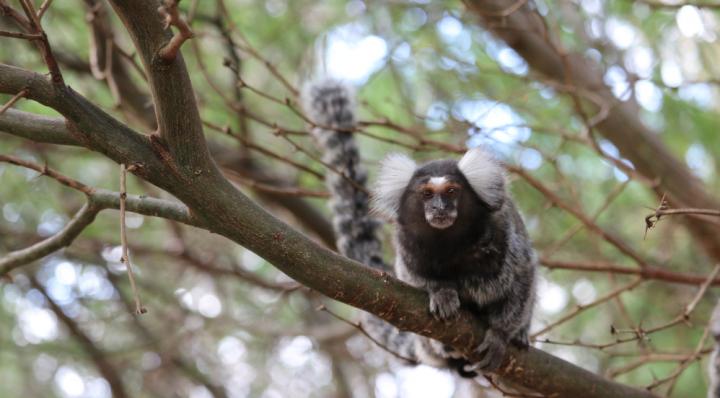
Credit: © Vedrana Šlipogor
In humans, differences in personalities have been evident since the ancient times. Personality in animals has long been ignored, but recently this question has received increasing research interest as it has been realized that personality has evolutionary and ecological significance. An international team of behavioral biologists from Austria, Brazil and the Netherlands, with Vedrana Å lipogor from the University of Vienna as leading author of the study, designed a set of tasks to assess personality of common marmosets. These results have just been published in American Journal of Primatology.
Marmosets are small highly social New World monkeys that parallel humans in their social organization, as they live in cohesive family units, where parents act as breeders and their offspring help them raise the young. The researchers showed that captive monkeys living in Austria as well as those monkeys living under natural conditions in semi-arid Caatinga forests of Northeastern Brazil show consistent differences in their personalities, similarly to humans.
In the personality tasks, the monkeys could explore and engage with a familiar environment, new foods, new objects, and situations mimicking a predatory situation (e.g. encountering a plastic toy snake or a strange-looking object). The researchers carefully observed these monkeys’ reactions in the tasks, for instance when trying a piece of jackfruit or engaging with a colorful rattle shaped toy. Some individuals were fast to approach any novelty, while others were more careful; hereby showing a similar pattern to humans: for instance, some humans enjoy trying out new restaurants, whereas others prefer to eat in their favorite restaurant. What is more interesting, when comparing personality traits of monkeys in Austria across four years, the authors found that these monkeys are quite consistent in their personality traits (e.g., those that are explorative when they are younger, stay similarly explorative four years afterwards). The only exception to this rule were monkeys who changed their breeding status in the family units.
“We have found that those monkeys who became breeders, that is, dominant individuals in the group, also became bolder”, says Vedrana Šlipogor, a postdoctoral fellow at the University of Vienna. “In humans and other non-human animals we see a similar pattern. People effective in leading positions often show higher levels of extraversion, as well as some other traits (e.g., high agreeableness and conscientiousness and low neuroticism). In homing pigeons, it has been shown that bolder individuals have a higher rank in the hierarchy and are likely to influence direction of collective movement, and subordinate field crickets who change their status to dominant, also show an increase in boldness, exploration and activity.”
It is especially interesting that this is the first time that researchers captured personality in wild marmoset monkeys. “We adapted our test battery from the well-controlled captive setting to the unpredictable conditions in the wild. In the wild, monkeys have plenty of things to do in their day-to-day lives, however, and in exchange for some bananas, they decided to participate in these tasks. We were pleased to discover that wild monkeys show a very similar personality structure as those in captivity”, says Thomas Bugnyar, Professor of Cognitive Ethology at the University of Vienna and senior author of the study. “This gives further support that consistent variation in individuals can be reliably assessed with our personality test battery, both in captive and wild settings. It also gives us more confidence that we provide the best possible conditions to our monkeys in Austria, as they show such striking similarity to the marmosets in Brazil”.
###
Publication in American Journal of Primatology:
Šlipogor, V., Massen, J.J.M., Schiel, N., Souto, A., Bugnyar, T. Temporal consistency and ecological validity of personality structure in common marmosets (Callithrix jacchus): A unifying field and laboratory approach. American Journal of Primatology, 2021; e23229.
https:/
Media Contact
Dr. Vedrana Šlipogor
[email protected]
Related Journal Article
http://dx.