A comprehensive triangulated review of two decades of date palm agricultural research in the United Arab Emirates reveals a mature and collaborative scientific field hindered by disciplinary fragmentation and limited on-farm technological adoption. Conducted by researchers evaluating scholarly progress between 2005 and 2026, the investigation assesses how studies have addressed intensifying environmental, biological, and postharvest pressures confronting Phoenix dactylifera L. within hyper-arid environments. While the research corpus has expanded steadily, demonstrating advanced scientific capacity in pest containment, genetic sequencing, water conservation, and biomass conversion, inquiries have developed largely in parallel rather than as integrated components of sustainable farming systems. The synthesis highlights that despite extensive documentation of technical innovations, critical omissions persist in translating laboratory and pilot-scale discoveries into scalable practice. To resolve these bottlenecks, the analysis emphasizes the urgent necessity of unifying precision agronomy, digital tracking platforms, and socio-technical frameworks to support long-term climate resilience.
Cultivated for more than six thousand years across the Arabian Peninsula, Phoenix dactylifera represents a foundational pillar of regional food security, rural livelihoods, and cultural heritage, with archaeobotanical evidence from Dalma Island in Abu Dhabi dating palm agriculture back to 5,290–4,540 Cal B.C. Botanically, the date palm is a dioecious monocotyledonous perennial of the Arecaceae family, characterized by a single unbranched trunk reaching twenty to thirty meters and large pinnate leaves four to six meters long. Following national unification in 1971, visionary development programs expanded the domestic palm population from approximately 1.5 million trees to over forty million today. Annual production now reaches 400,000 to 450,000 metric tonnes across major agricultural hubs like Al Ain, Liwa, and Al Dhafra, placing the UAE among the top ten global date producers. Over one hundred and twenty cultivars contribute to national diversity, led by the golden Khalas variety, which constitutes twenty to thirty percent of total output.
The species withstands severe desert conditions through a multi-layered suite of morphological, physiological, and rhizospheric adaptations, including thick pinnate foliage coated with waxy cuticles, compact canopies, and extensive roots accessing deep groundwater. Dynamic stomatal regulation, cellular osmotic adjustment, and the accumulation of compatible solutes like proline and soluble sugars maintain hydration under drought. Cellular sodium-hydrogen antiporters regulate ion transport, excluding and compartmentalizing salt ions in marginal soils. Moreover, date palms maintain photosynthetic efficiency up to forty-five degrees Celsius through heat shock proteins and molecular chaperones. However, intensifying climate variability, chronic groundwater depletion, and acute soil salinization increasingly threaten production longevity. These environmental constraints are exacerbated by severe biological threats, most notably infestations of the red palm weevil, Rhynchophorus ferrugineus, the rhinoceros beetle, Oryctes agamemnon, and the red mite, Raoiella indica. Pathogenic fungi also inflict severe damage, particularly Fusarium solani causing Sudden Decline Syndrome and Thielaviopsis punctulata causing Black Scorch disease.
To systematically analyze the structure and trajectory of UAE date palm research, the authors applied a sequential mixed-methods framework conforming to PRISMA guidelines. Systematic searches conducted in Scopus and Web of Science for peer-reviewed journal articles and reviews published between January 2005 and February 2026 retrieved 216 records. Following duplicate removal using the bibliometrix package in RStudio, 124 unique publications across ninety-four scientific sources formed the common analytical corpus. Textual units consisting of concatenated titles and abstracts were preprocessed to normalize terms while preserving domain-specific terminology without stemming. Latent Dirichlet Allocation topic modelling was then implemented using Gibbs sampling across 2,000 iterations with symmetric priors, testing candidate models from five to twenty topics. A ten-topic solution was selected based on semantic coherence, stability, and interpretability. Finally, a comprehensive systematic literature review cataloged methodologies and empirical findings from all 124 full-text articles to substantiate and interpret the computationally derived themes.
Bibliometric assessment revealed a well-established, highly collaborative research landscape comprising 467 contributing authors, with an average of 4.76 co-authors per document and only twenty-six single-authored works. An international co-authorship rate of 36.29 percent confirmed strong integration into global research networks addressing arid-zone agricultural sustainability. Scientific output expanded at an annual rate of 3.36 percent, yielding an average citation rate of 23.11 citations per document and an average document age of 7.69 years across 452 author keywords. Mathematical life-cycle modeling showed an initial exploratory phase from 2005 to 2012, followed by rapid acceleration after 2013 that peaked around 2021 with a coefficient of determination of 0.581. A complementary sigmoidal cumulative growth curve indicated that publication volumes are approaching ninety and ninety-nine percent asymptotic thresholds. This saturation trajectory does not reflect diminishing practical relevance, but rather indicates that the field is transitioning from exploratory output toward consolidated, specialized, and problem-driven interdisciplinary research.
The ten algorithmically identified topics form an interconnected scientific architecture that authors synthesized into three broader conceptual domains. The first domain, crop production and resilience, unites Date Palm Diseases and Control, Water Management and Agriculture, and Plant Growth and Salinity Stress to optimize orchard productivity under climatic stress. The second domain, food quality and value addition, links Phytochemical and Nutritional Analysis with Bioactive Compounds Extraction to examine compositional profiles and functional food applications. The third domain, sustainable resource utilization, integrates Biomass Pyrolysis and Bioenergy with Carbon Materials and Green Extraction to support circular bioeconomy models converting agricultural residues into value-added materials and energy. Four additional clusters—Genetics, Genomics and Molecular Studies, Remote Sensing and GIS Applications, Soil Science and Microbial Ecology, and Archaeological and Historical Studies—reinforce this structure. Together, these domains illustrate that UAE research has progressed from traditional agronomy toward technological valorization across the entire agricultural value chain.
The systematic review identified Date Palm Diseases and Control as the most prolific cluster, encompassing thirty-three articles focused on pest surveillance and pathogen management. Field investigations evaluated acoustic sensing, trap coloration, and bait chemistry for early detection of red palm weevils, while microbiological studies confirmed the biocontrol potential of native Beauveria bassiana and rhizosphere actinobacteria against fungal pathogens. Concurrently, Phytochemical and Nutritional Analysis characterized fruit and seed composition using high-performance liquid chromatography, spectroscopy, and antioxidant assays. Date fruits provide approximately 277 kilocalories per hundred grams, containing primarily glucose and fructose alongside six to eight percent dietary fiber, potassium, magnesium, and iron. Polyphenols such as ferulic acid and catechins generate antioxidant capacities reaching 15,000 micromoles of Trolox equivalents per hundred grams. Clinical and experimental inquiries linked these compounds to carbohydrate-digesting enzyme inhibition and improved glucose uptake, substantiating the therapeutic value of dates as functional foods and nutraceutical products across national markets.
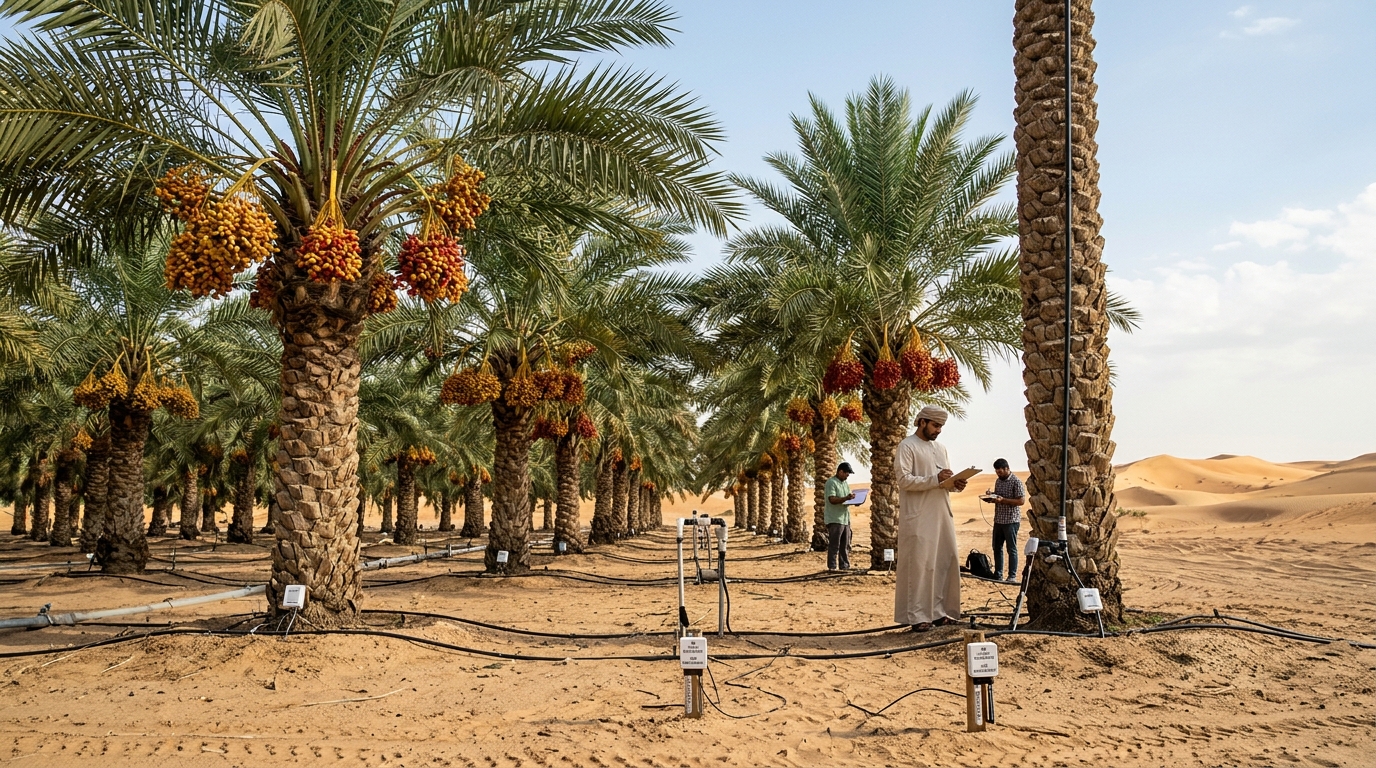
In water management, experimental trials demonstrated that data-driven deficit irrigation, sap flow quantification, and canopy light interception modeling can decrease orchard water application by twenty-five to fifty percent without significant yield penalties. Parallel research assessed blended saline groundwater, treated sewage effluents, and grey water footprints to mitigate root-zone salt accumulation. Within genomics, high-continuity nuclear and plastid assemblies for elite cultivars such as Mejhoul utilized PacBio HiFi sequencing and chromatin conformation capture, complementing molecular marker studies that documented genetic polymorphism rates of seventy to ninety percent across UAE germplasm. Concurrently, remote sensing research utilized WorldView-3 satellite imagery and unmanned aerial platforms paired with Vision Transformers and YOLO-v5 convolutional neural networks to automate palm inventory mapping, monitor salinity stress, and calculate biomass carbon storage. These advances confirm the feasibility of data-driven monitoring, establishing precision agriculture as a vital foundation for environmental resilience in hyper-arid date palm production systems throughout the country.
Biomass valorization studies established significant technical potential for agricultural residues through thermochemical conversion, green extraction, and carbon material engineering. Pyrolysis experiments using thermogravimetric analysis and fluidized bed reactors revealed that co-pyrolyzing date seeds with other residues reduces activation energy, producing stable biochar and aromatic-rich bio-oil. Techno-economic evaluations indicated that thermochemical conversion of lignin yields superior payback periods and net present values compared with biochemical bioethanol pathways. Furthermore, activated carbons synthesized from palm fronds exhibited high adsorption efficiency for wastewater purification, pharmaceutical pollutant removal, and sodium-ion battery anodes. Green extraction methods employing natural deep eutectic solvents alongside ultrasound or microwave energy improved antioxidant and pectin yields while reducing hazardous organic solvent use. Despite these technical successes, value chains remain vulnerable beyond the farm gate, where fifteen to twenty-five percent of date produce is lost postharvest due to inadequate cold storage, manual handling, and absent digital traceability throughout domestic distribution corridors.
To bridge persistent gaps between technical innovation and practical implementation, the authors proposed an IoT-Blockchain Enabled Integrated Value Chain System as the primary research frontier. This conceptual framework integrates distributed Internet of Things sensors, aerial surveillance, and machine learning analytics into centralized farm dashboards, while recording operational events and cold-chain metrics onto immutable ledgers to generate verifiable provenance passports. However, successful realization requires moving beyond isolated engineering studies to investigate the socio-economic determinants of technology adoption. High capital costs, uneven digital literacy among growers, institutional fragmentation, and a lack of supportive policy mechanisms currently impede the adoption of precision irrigation, biological controls, and smart logistics. Overcoming these barriers demands participatory transdisciplinary partnerships between agronomists, systems engineers, agricultural economists, extension personnel, and farmers. By integrating technical advances with viable business models and policy incentives, the UAE can transform scientific knowledge into resilient farming systems, safeguarding its historical date sector against future climate stress.
Subject of Research: Triangulated knowledge mapping of UAE date palm agricultural research and climate resilience
Article Title: Toward climate-resilient date palm agriculture in the United Arab Emirates: a strategic triangulated knowledge mapping
Article References: Safeer, S., Basile, G. N., Maqsood, S., & Pulvento, C. (2026). Toward climate-resilient date palm agriculture in the United Arab Emirates: a strategic triangulated knowledge mapping. Agriculture & Food Security, 15(1), Article 64. https://doi.org/10.1186/s40066-026-00652-6
Image Credits: AI Generated
DOI: 10.1186/s40066-026-00652-6
Keywords: Phoenix dactylifera, date palm, United Arab Emirates, climate resilience, bibliometric analysis, topic modelling, pest management, precision irrigation, Toward, climate-resilient, date, palm
News Source: Alan Morgan. (November 6, 2026). Mapping Two Decades of Date Palm Research for Climate-Resilient UAE Agriculture. Scienmag.