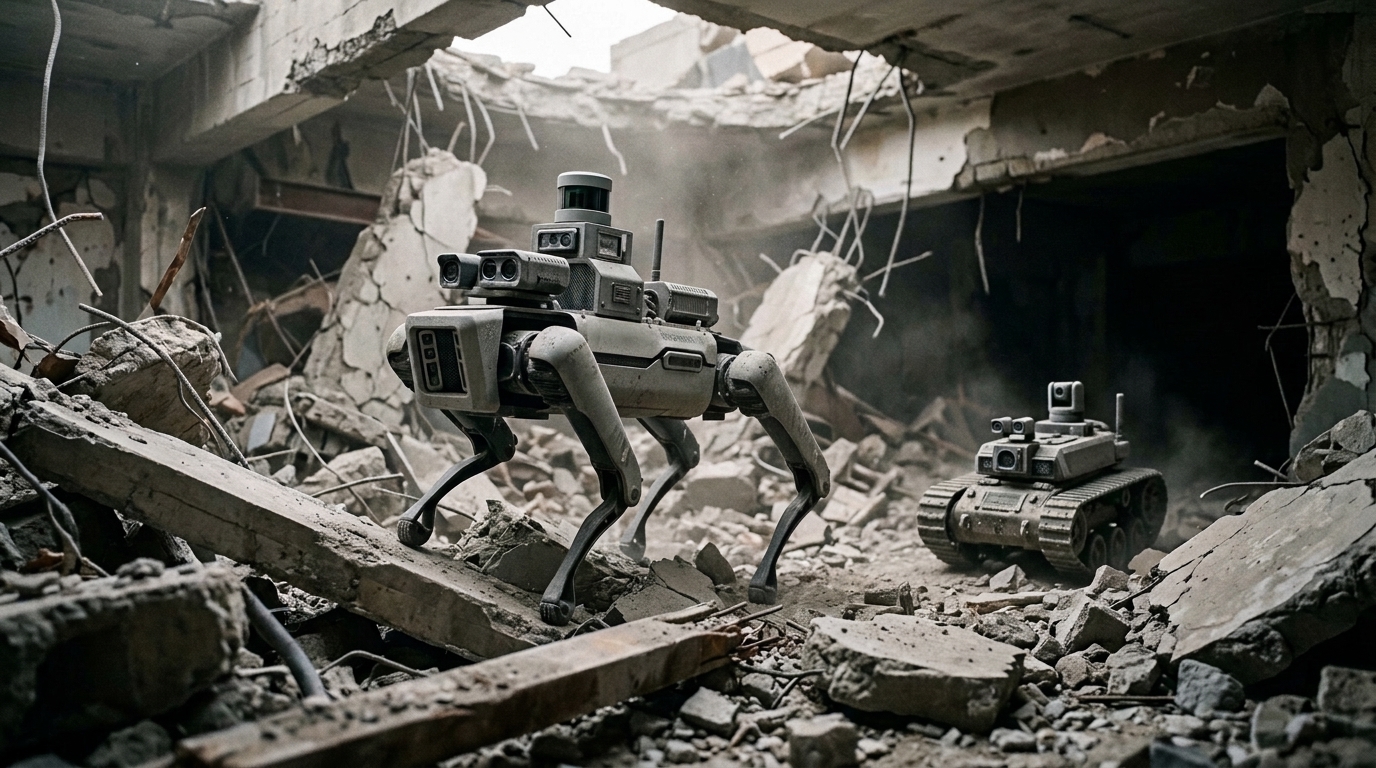
Search and rescue robotics is moving toward systems in which robots learn from humans, exchange knowledge with each other, and report their findings back to human operators, according to a structured narrative review of learning-enabled collaborative intelligence in the field. The review, published in Frontiers in Robotics and AI, organizes the literature around three learning paradigms: human-to-machine (H2M), machine-to-machine (M2M), and machine-to-human (M2H) learning, and argues that treating them as interdependent layers of a single collaborative pipeline reveals architectural gaps that single-paradigm analyses tend to miss.
The stakes are considerable. The review notes that since 1990, disasters have affected more than 4.4 billion people, caused roughly 1.3 million deaths, and produced losses exceeding $2.97 trillion. Robotic assistance already spans ground robots for debris removal and logistics, aerial drones for damage assessment, survivor identification and hazard mapping, and aquatic robots for water rescues. Advances in machine learning, deep learning and large language models (LLMs) now support autonomous perception, navigation and coordination, reducing human exposure to danger while improving situational awareness. Yet the authors stress that robust, reliable, real-time autonomy in highly dynamic disaster environments remains an unsolved problem, motivating hybrid AI frameworks that combine sensor fusion, federated learning, uncertainty-aware modeling and explainable AI.
On the human-to-machine side, the review surveys supervised learning, learning from demonstration (LfD) and reinforcement learning (RL). Supervised object detection frameworks such as YOLO, Faster R-CNN and SSD have been evaluated on aerial, terrestrial and thermal imagery for survivor detection, object recognition and structural damage assessment, with trade-offs among accuracy, inference speed and robustness in cluttered scenes. A recurring finding is that detection accuracy degrades more sharply under thermal noise, smoke and structural occlusion than under simple lighting variation, suggesting that domain-specific training data and modality selection matter more for deployment reliability than architectural choices alone. LfD lets robots copy expert behavior for navigation and manipulation, but its practical ceiling is set less by algorithmic sophistication than by the quality and safety of the demonstration environment, a constraint that becomes acute when expert operators are unavailable, fatigued or working under the same hazardous conditions the robot must navigate.
Reinforcement learning enables adaptive task allocation, exploration and navigation through interaction with uncertain surroundings, and RL-based frameworks using satellite imagery, GNSS-denied multi-drone coordination and goal-driven aerial localization have shown greater efficiency and adaptability than heuristic methods. The review’s synthesis, however, is pointed: RL is most reliable in SAR when the deployment environment resembles the training simulation, a condition rarely guaranteed in real disasters. Reward shaping and sim-to-real transfer, not policy architecture, are identified as the field’s most pressing unsolved problems. In practice, the authors conclude, hybrid pipelines that combine supervised perception with RL-based decision layers, or demonstrations that initialize rules later refined through interaction, are often advantageous.
Machine-to-machine learning is presented as the backbone of scalable, distributed SAR robotics. Federated learning allows robots to share learned models while protecting raw data, and peer-to-peer architectures boost robustness without centralized infrastructure, but the review identifies aggregation instability under non-IID data distributions as the central deployment limitation: when aerial and ground robots observe fundamentally different environments, globally averaged model updates may benefit neither robot type. Multi-agent reinforcement learning supports synchronized decision-making in partially observable settings, yet most MARL frameworks assume agents can exchange observations frequently enough to maintain joint policy coherence, an assumption that collapses when communication is intermittent, asymmetric or lost entirely at the moments coordination matters most. Knowledge distillation transfers perceptual and cognitive functions from large models to lightweight versions suitable for resource-constrained onboard hardware, though the benefit holds only if distillation preserves performance under the distributional shifts, sensor noise and partial observability of real disasters rather than the clean benchmarks on which most distilled models are evaluated. Bio-inspired swarm intelligence offers decentralized coordination and adaptive path planning, but algorithms designed for homogeneous agents do not transfer straightforwardly to mixed fleets of aerial drones, ground rovers and aquatic robots.
A significant portion of the review addresses the growing role of LLMs and vision-language models in M2M knowledge acquisition. Fine-tuning multimodal models with region-language supervision, retrieval-augmented generation (RAG) with ontology-guided structure, and few-shot prompting each offer distinct advantages: fine-tuning produces the most robust domain-specific representations but demands substantial annotation and compute, RAG facilitates knowledge reuse while remaining vulnerable to retrieval inconsistency and knowledge drift, and prompting offers lightweight adaptability at the cost of sensitivity to prompt design and hallucination. The authors caution that deploying LLM-enabled components in safety-critical disaster environments introduces practical risks around reliability, grounding and real-time constraints, since LLMs may generate plausible yet incorrect outputs. They recommend treating LLM outputs as hypotheses validated against sensor-derived evidence, grounding critical assertions such as victim detections in measurable confidence signals, adopting hybrid cloud-edge strategies that keep time-critical decisions onboard, and maintaining detailed logs of prompts, evidence, uncertainty scores and human approvals for accountability.
The review also catalogs the operational constraints that shape multi-robot collaboration in disaster zones. Communication bandwidth limitations restrict continuous sharing of sensor data, maps and model updates, prompting interest in semantic communication and edge processing in which robots transmit compressed semantic summaries rather than raw data. Intermittent connectivity caused by infrastructural damage, signal disruption or collapsed and subterranean terrain forces systems to support asynchronous updates and delay-tolerant communication. Synchronization and consistency challenges arise when robots observing the same victim from different perspectives produce contradictory interpretations due to sensor noise or obstructions, requiring consensus-driven learning, confidence-aware knowledge integration and decentralized decision protocols. The authors further flag a newer threat: adversarial prompt injection, in which a compromised agent disseminates maliciously constructed semantic prompts designed to corrupt peer robots’ reasoning, and they call for semantic firewalls that authenticate incoming natural language prompts against operational protocols before processing.
On the machine-to-human side, the review frames M2H learning as the interpretability interface between autonomous systems and operators. Human-readable knowledge translation converts internal representations into text, annotated images or scene summaries using LLMs and VLMs, while explainable AI techniques, including SHAP and LIME feature attribution, saliency maps and Grad-CAM visualizations, and symbolic rule-based explanations, convey robotic reasoning under time constraints. The review notes that evidence indicates explanations do not consistently improve decision accuracy or calibrated trust, and that highly detailed explanations such as SHAP introduce latency, whereas attention-based or saliency-based approaches offer faster but less interpretable output. Proactive AI agents that anticipate risks before explicit commands are issued must balance autonomy against operator workload, since excessive low-priority notifications contribute to alert fatigue. Interactive communication through natural language interfaces, visual dashboards and augmented reality displays improves trust and coordination, but the review concludes that effective communication is fundamentally a problem of confidence calibration rather than communication volume, requiring interfaces that let operators quickly distinguish validated observations from uncertain predictions.
Looking forward, the review outlines future directions including geo-structured symbolic communication for lightweight, privacy-preserving M2M transfer, hybrid integration of language with structured representations such as spatial-temporal graphs and domain ontologies, on-device low-latency reasoning for real-time M2H interaction, self-verifying and trust-aware knowledge transfer mechanisms, memory-aware continual learning with semantic provenance tracking, and standardized prompt schemas analogous to software APIs. It also calls for semantic fidelity benchmarks to quantify how accurately meaning survives robot-to-robot prompting, noting that current benchmarks emphasize mission outcomes such as time-to-rescue rather than the precision of information sharing. The authors are candid about the field’s limits: many reviewed approaches are validated primarily in simulation or custom experimental environments, and the gap between LLM performance in controlled settings and reliable operation in real disaster environments remains substantial. No current LLM-enabled SAR system, they write, has been validated at operational scale against burning structures with intermittent connectivity, degraded sensors, minute-scale time pressure and cognitively overloaded operators. The review’s contribution, the authors state, is not to suggest that LLM-integrated SAR systems are ready for deployment, but to map the trajectory of a rapidly moving field while identifying the gaps, including robust hallucination suppression under sensor degradation, guaranteed response latency under communication loss, and validated human-robot trust calibration under acute stress, that must be closed before it arrives.
Subject of Research: Learning-enabled collaborative intelligence frameworks across human-to-machine, machine-to-machine and machine-to-human learning paradigms in search and rescue robotics
Article Title: Learning-enabled collaborative intelligence in search and rescue robotics: a survey of paradigms, models, and challenges
Article References: R. Shuvo, M. I., Fime, A. A., Ashraf, R., Alam, N., & Kim, J.-H. (2026). Learning-enabled collaborative intelligence in search and rescue robotics: a survey of paradigms, models, and challenges. Frontiers in Robotics and AI, 13, Article 1832982. https://doi.org/10.3389/frobt.2026.1832982
Image Credits: AI Generated
DOI: 10.3389/frobt.2026.1832982
Keywords: search and rescue robotics, collaborative intelligence, human-to-machine learning, machine-to-machine learning, machine-to-human learning, federated learning, multi-agent reinforcement learning, knowledge distillation, large language models, explainable AI, swarm intelligence, sim-to-real transfer
News Source: Denise Maddox. (November 6, 2026). Robots that learn from each other could transform disaster rescue, review finds. Scienmag.