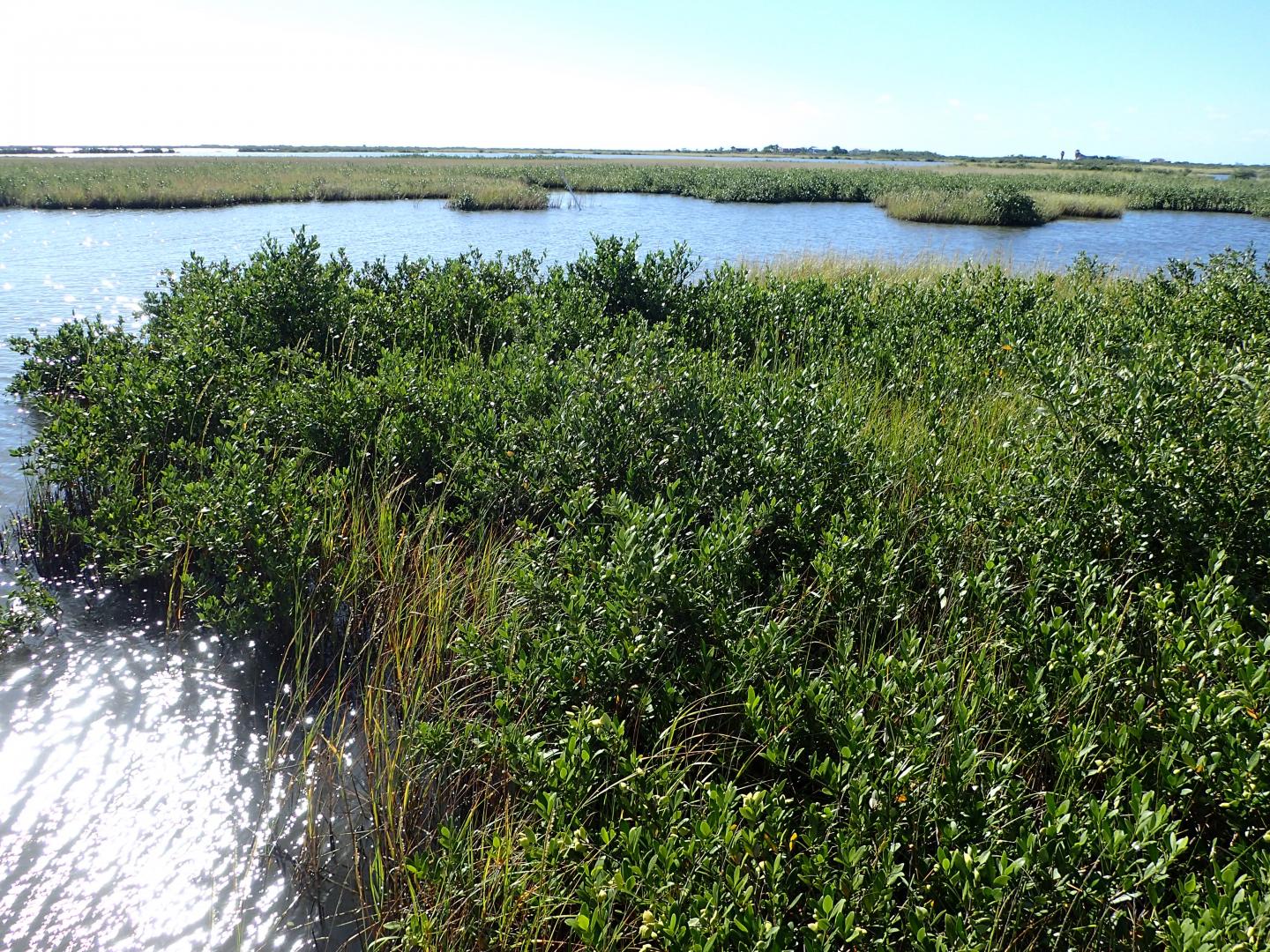
Credit: MIke Polito, LSU
BATON ROUGE – Mangroves are tropical forests that thrive in salt water and are found in a variety of coastal settings from deltas to estuaries to weathered reefs and limestone rocks worldwide. Mangroves can store greater amounts of carbon than any other terrestrial ecosystem, which helps reduce the amount of carbon dioxide and greenhouse gases in the atmosphere. When carbon is stored in the ocean or coastal ecosystems, including mangrove forests, it is called blue carbon. However, a more precise estimate of how much blue carbon is stored by mangroves around the world has not been available until recently. This research was published today in Ecological Society of America's journal Frontiers in Ecology and the Environment.
"While past estimates of blue carbon have done a remarkable job in delivering first order estimates of how ecosystems mitigate carbon enrichment in the atmosphere, we noted that the omission of unique coastal characteristics, such as tides and river flow, reduced the accuracy of global predictions, especially concerning how carbon storages may vary from one country to the next," said lead author Robert Twilley, who is a professor in the LSU College of the Coast & Environment's Department of Oceanography & Coastal Sciences and the executive director of the Louisiana Sea Grant College Program.
Twilley and colleagues overlaid a high-resolution map of mangrove forest cover over the various types of nearshore coastal environmental systems to calculate a more accurate estimate of the amount of carbon stored by mangroves in its soil.
They found that blue carbon has been underestimated by up to 50 percent in coasts with limestone rock, such as those found on the southern tip of Florida and in the Caribbean. They also found that blue carbon has been overestimated by up to 86 percent in coastal deltas in previous studies. In addition, this study provides new estimates for about 57 countries that lack blue carbon data.
"We have developed a roadmap for ecological investigations on the global scale, highlighting that there may be patterns that govern how mangroves store carbon from the atmosphere," said co-author Andre Rovai, who is a postdoctoral researcher in the LSU College of the Coast & Environment's Department of Oceanography & Coastal Sciences.
Having this roadmap is critical given how fast development and land-use changes are occurring around the world. The scientists hope that planners will become more aware of the environmental value of their country's mangroves and take it into account before losing these ecologically important resources.
###
Funding support for this work was provided by the National Science Foundation Coastal SEES program, Frontiers of Earth Surface Dynamics, the Louisiana Sea Grant College Program and CAPES/CNPq Science without Borders.
Twilley will also give the opening plenary talk at the Ecological Society of America annual meeting on Sunday, Aug. 5, at 5 p.m. (CDT). His talk will be live streamed. He will also be presenting his research, The resilience of coastal deltaic floodplains, on Thursday, Aug. 9, at 10:10 a.m.
Additional Links:
Coastal morphology explains global blue carbon distributions, Frontiers in Ecology and the Environment: https://esajournals.onlinelibrary.wiley.com/journal/15409309
[doi: 10.1002/fee.1937]
Live stream to Ecological Society of America opening plenary talk titled "Ecosystem design approaches in a highly engineered landscape of the Mississippi River Delta" by Robert Twilley: https://www.youtube.com/watch?v=tN5U_pd4ZBY
Media Contact
Alison Satake
[email protected]
225-578-3870
@LSUResearchNews
http://www.lsu.edu
Original Source
https://www.lsu.edu/mediacenter/news/2018/08/02docs_twilley_frontiers.php