Each year, cancer claims millions of lives worldwide, but the geography of that suffering is starkly uneven. In 2022 alone, roughly 20 million people were diagnosed with cancer and 9.7 million died of the disease. While high-income countries have seen cancer mortality stabilise or even decline thanks to screening, early detection and effective treatment, low- and middle-income countries face a double burden: a rising tide of new cases and death rates that continue to climb. By 2030, three out of every four cancer deaths on the planet are projected to occur in these resource-constrained settings. A new study published in Supportive Care in Cancer argues that one of the most powerful—and most neglected—weapons against this unfolding humanitarian emergency is not a new drug or imaging machine, but the systematic development of palliative care woven into the very fabric of national health systems.
The research, conducted by an international team led by Seema Rajesh Rao of Manipal Academy of Higher Education in India alongside collaborators from the United Kingdom, the United States and Canada, was undertaken as part of the Lancet Oncology Commission on the human crisis of cancer. Its starting point is grim arithmetic. The Lancet Commission on Palliative Care and Pain Relief has estimated that more than 90 percent of patients dying from cancer experience serious health-related suffering, a term encompassing severe physical, psychological and social distress. The global burden of this suffering is projected to double by 2060, and while it may slow or plateau in wealthy nations by mid-century, the end of life in many poorer countries remains marked by unrelieved pain. Catastrophic out-of-pocket spending on cancer treatment deepens the damage, pushing families into poverty, reducing workforce participation and amplifying caregiver burden.
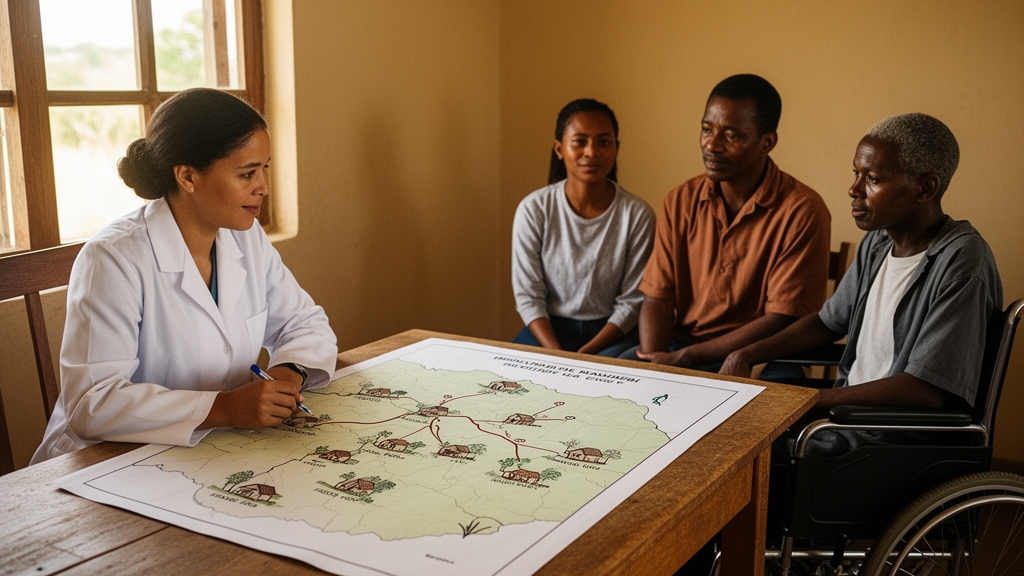
To chart a way forward, the team turned to a methodology borrowed from social policy and evaluation science: the theory of change framework. Rather than prescribing solutions from the top down, theory of change works backwards from a desired long-term goal, mapping the intermediate outcomes, preconditions, interventions and assumptions that must line up for that goal to be achieved. It is a technique designed for complex social problems, where simple cause-and-effect logic fails. The researchers convened 21 stakeholders from 12 countries across Asia, Africa and South America—physicians, nurses, public health experts and community participants, all with hands-on experience building or delivering palliative care in their regions. Over three months, the group took part in eight facilitated virtual workshops, each lasting more than two hours and devoted to a specific component of the causal pathway: impact, long-term outcomes, interventions, preconditions and assumptions.
The workshops were deliberately participatory. Facilitators presented evidence from a framework synthesis of palliative care in low-resource settings, existing models from around the world, and worked examples of theory of change maps, but the content itself was generated and refined by the stakeholders. Transcripts, chat logs, facilitator notes and email contributions were analysed iteratively and by consensus, with concepts sorted into the framework’s components and their relationships mapped into a causal diagram. The final product was a roadmap containing 14 preconditions, 21 interventions and 12 assumptions, all arranged along a pathway leading from concrete actions to a single, agreed impact: the development of comprehensive, sustainable and culturally relevant palliative care capable of easing cancer-related suffering in low- and middle-income countries.
One finding stood above all others: integration. The stakeholders concluded that palliative care cannot be built as a parallel, standalone service in settings where specialist teams are scarce and budgets are thin. Instead, it must be embedded within existing health systems, with core palliative care competencies distributed across primary care, oncology and other frontline services, while specialist teams support complex cases and provide systems leadership. This tiered model echoes evidence from high-income countries, where landmark randomised trials such as those led by Jennifer Temel and Camilla Zimmermann showed that early palliative care integrated alongside oncology treatment improves quality of life and, in some cases, even survival. But the study’s authors are careful to note that evidence from wealthy nations cannot simply be transplanted, because patient demographics, healthcare delivery models and societal values differ profoundly.
The systems thinking lens the researchers applied to their findings reveals why piecemeal interventions so often fail. Viewed as a complex adaptive system, palliative care development in poorer countries depends on a dense web of interacting factors: health beliefs, socioeconomic conditions, workforce capacity, medication access and health policy. Consider opioid access, one of the most glaring inequities in global cancer care. Restrictive opioid policies breed fear of opioids among clinicians and caregivers, which suppresses prescribing and consumption. With fewer people using these medicines, the access problem loses political salience, weakening the impetus for reform. The result is a self-reinforcing feedback loop in which restrictive policies perpetuate themselves. The study argues that meaningful change requires identifying and reconfiguring such feedback loops rather than tinkering with isolated components—a conclusion with implications far beyond pain management.
The roadmap’s architects also distinguished three attributes that any successful model must embody. Comprehensiveness means multidimensional, patient- and family-centred care enabled by timely referrals and seamless collaboration among oncology, palliative and primary care teams, together with equitable access to essential medicines, caregiver support and attention to the quality of death and dying. From a systems perspective, comprehensiveness is an emergent property: it arises only when policies, funding mechanisms, workforce capacity, referral systems and supply chains are structurally and functionally aligned. Sustainability, meanwhile, was described as the foundational backbone of the entire enterprise. Without robust national policies, budget allocations, effective governance and political and legal commitment at the macro level, interventions at the clinic and community levels remain vulnerable to collapse. Cultural relevance formed the third pillar, recognising that care must resonate with local values, health beliefs and community practices to be accepted at all.
Culture, in fact, emerged as an embedded determinant influencing system behaviour at every level. How people experience illness, make decisions, communicate prognosis, express grief and assign responsibility for caregiving is shaped by social norms and community practices. In many low- and middle-income countries, families and clinicians collude to withhold diagnoses from patients, a practice that obstructs advance care planning and early referral. Opiophobia is prevalent among both providers and the public, and beliefs in traditional or alternative medicine shape health-seeking behaviour. The study’s authors contend that for palliative care interventions to endure, they must be informed by local customs, delivered in culturally sensitive ways, championed by communities themselves and structured around local resource constraints. Notably, the resulting roadmap aligns closely with the World Health Organization’s six essential components of palliative care development—service integration, policy, education, medication availability, research and community empowerment—but extends that model by showing how the elements interact dynamically within real health and social systems.
The study is not without limitations. The virtual format may have dulled the quality of interaction, attendance was inconsistent, and South Asia was overrepresented relative to Eastern Europe and the Pacific. English proficiency was an inclusion criterion, introducing potential selection bias, and the sheer heterogeneity of low- and middle-income countries limits how far the findings can be generalised. Yet the participatory design, spanning three continents and multiple disciplines, produced a roadmap that its authors describe as contextually grounded, acceptable and actionable. The team situates its ceiling of accountability—the point beyond which external forces dominate—between long-term outcomes and ultimate impact, acknowledging that national policies, armed conflict, forced displacement, humanitarian emergencies, natural disasters and economic shocks all lie beyond the reach of any single intervention. The next step, the researchers say, is to test the roadmap’s feasibility, acceptability and impact across diverse settings. If it works, the payoff could be immense: a future in which a cancer diagnosis in the world’s poorest countries no longer condemns patients to a death defined by preventable pain.
Subject of Research: Palliative care development and health system integration to reduce cancer-related suffering in low- and middle-income countries
Article Title: Palliative care development as a solution to mitigate the human crisis of cancer in low- and middle-income countries: a theory of change approach
Article References: Rao, S. R., Atreya, S., Mathew, M., Rao, A. P., Walshe, C., Preston, N., Simha, S., Sullivan, R., Rosa, W. E., Rodin, G., & Salins, N. (2026). Palliative care development as a solution to mitigate the human crisis of cancer in low- and middle-income countries: a theory of change approach. Supportive Care in Cancer, 34(11), Article 1080. https://doi.org/10.1007/s00520-026-11306-5
Image Credits: AI Generated
DOI: 10.1007/s00520-026-11306-5
Keywords: palliative care, cancer, low- and middle-income countries, theory of change, health systems, serious health-related suffering, opioid access, systems thinking, global health equity, Lancet Oncology Commission, cultural relevance, health policy
News Source: Nathaniel Bowman. (October 9, 2026). Mapping a Way Out of Cancer Suffering: Scientists Build a Roadmap for Palliative Care in Poorer Nations. Scienmag.