There is an as-yet-unseen population of Jupiter-like planets orbiting nearby Sun-like stars, awaiting discovery by future missions
Credit: Alan Boss
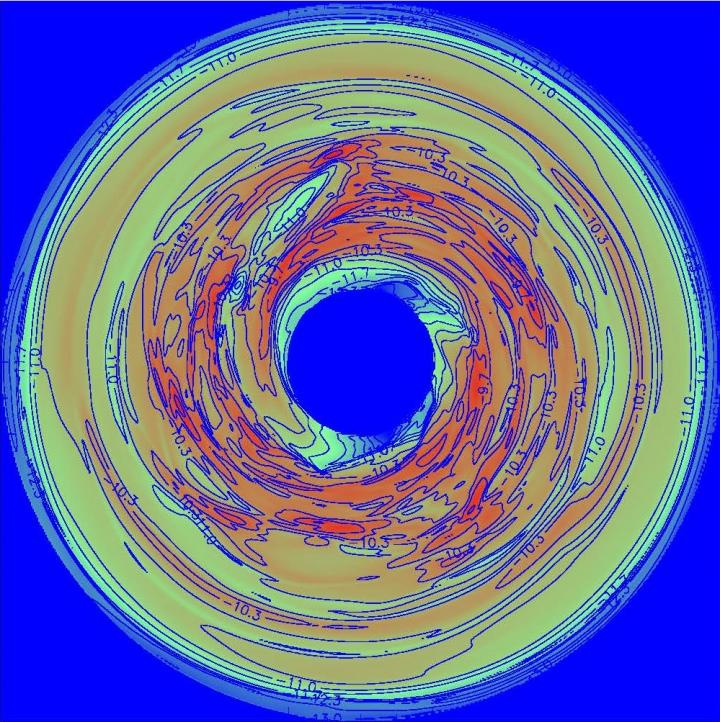
Washington, DC–There is an as-yet-unseen population of Jupiter-like planets orbiting nearby Sun-like stars, awaiting discovery by future missions like NASA’s WFIRST space telescope, according to new models of gas giant planet formation by Carnegie’s Alan Boss, described in an upcoming publication in The Astrophysical Journal. His models are supported by a new Science paper on the surprising discovery of a gas giant planet orbiting a low-mass star.
“Astronomers have struck a bonanza in searching for and detecting exoplanets of every size and stripe since the first confirmed exoplanet, a hot Jupiter, was discovered in 1995,” Boss explained. “Literally thousands upon thousands have been found to date, with masses ranging from less than that of Earth, to many times the mass of Jupiter.”
But there are still gaping holes in scientists’ knowledge about exoplanets that orbit their stars at distances similar to those at which our Solar System’s gas giants orbit the Sun. In terms of mass and orbital period, planets like Jupiter represent a particularly small population of the known exoplanets, but it’s not yet clear if this is due to biases in the observational techniques used to find them–which favor planets with short-period-orbits over those with long-period-orbits–or if this represents an actual deficit in exoplanet demographics.
All the recent exoplanet discoveries have led to a renewed focus on theoretical planet formation models. Two primary mechanisms exist for predicting how gas giant planets form from the rotating disk of gas and dust that surrounds a young star–bottom-up, called core accretion, and top-down, called disk instability.
The former refers to slowly building a planet through the collisions of increasingly larger material–solid dust grains, pebbles, boulders, and eventually planetesimals. The latter refers to a rapidly triggered process that occurs when the disk is massive and cool enough to form spiral arms and then dense clumps of self-gravitating gas and dust contract and coalesce into a baby planet.
While core accretion is considered the consensus planet-formation mechanism, Boss has long been a proponent of the competing disk instability mechanism, dating back to a seminal 1997 Science paper.
The just-published discovery by an Institute for Space Studies of Catalonia-led team of a star that’s a tenth the mass of our Sun and hosts at least one gas giant planet is challenging the core-accretion method.
The mass of a disk should be proportional to the mass of the young star around which it rotates. The fact that at least one gas giant–possibly two–was found around a star that’s so much smaller than our Sun indicates that either the original disk was enormous, or that core accretion does not work in this system. Orbital periods for lower mass stars are longer, which prevents core accretion from forming gas giants before the disk gas disappears, as core accretion is a much slower process than disk instability, according to Boss.
“It’s a great vindication for the disk instability method and a demonstration how one unusual discovery can swing the pendulum on our understanding of how planets form,” said one of the IEEC research team’s members, Guillem Anglada-Escudé, himself a former Carnegie postdoc.
Boss’ latest simulations follow the three-dimensional evolution of hot disks that start out in a stable configuration. On a variety of time scales, these disks cool down and form spiral arms, eventually resulting in dense clumps representing newborn protoplanets. Their masses and distances from the host star are similar to that of Jupiter and Saturn.
“My new models show that disk instability can form dense clumps at distances similar to those of the Solar System’s giant planets,” said Boss. “The exoplanet census is still very much underway, and this work suggests that there are many more gas giants out there waiting to be counted.”
###
The Carnegie Institution for Science (carnegiescience.edu) is a private, nonprofit organization headquartered in Washington, D.C., with six research departments throughout the U.S. Since its founding in 1902, the Carnegie Institution has been a pioneering force in basic scientific research. Carnegie scientists are leaders in plant biology, developmental biology, astronomy, materials science, global ecology, and Earth and planetary science.
Media Contact
Alan Boss
[email protected]