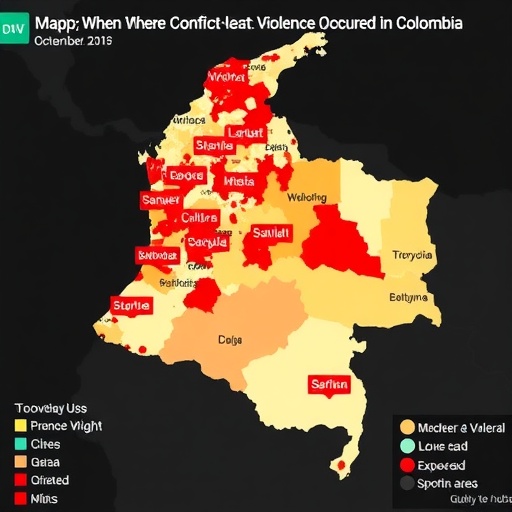
Conflict-related sexual violence in Colombia did not follow a uniform geographic or historical pattern, according to a new study that maps how reported incidents shifted across the country during decades of armed conflict. Published in Nature Health, the analysis by E. Pappa, A. Acosta-Ortiz, C. Constable Fernandez and colleagues examines sexual violence not as a collection of isolated crimes, but as a changing public-health phenomenon shaped by territory, time, armed control and the unequal visibility of survivors. Its central message is both scientific and urgent: where violence is recorded, when it intensifies and which communities appear in the data are all connected to the wider dynamics of conflict.
Colombia’s armed conflict created conditions in which sexual violence could be used to intimidate populations, punish alleged supporters of rival groups, enforce social control, displace communities and regulate everyday life. Yet these crimes have historically been among the least completely documented forms of violence. Survivors may face threats, stigma, financial barriers, distrust of institutions and the risk of retaliation. Some incidents are reported years after they occur, while others may never enter an official database. By studying the spatial and temporal structure of available records, the researchers seek to identify patterns that may remain invisible when cases are viewed one by one.
The term “spatiotemporal” describes the study’s key analytical perspective: it combines geography and time in a single framework. A conventional map might show where cases were recorded, while a timeline might show whether reports rose or fell. A spatiotemporal analysis asks a more demanding question: did particular locations experience unusually high concentrations during particular periods, and did those concentrations move, persist or disappear as the conflict changed? This approach can reveal clusters that would be missed by national averages, especially in a country as geographically diverse as Colombia, where remote rural areas, urban centres, border zones and regions affected by coca cultivation or illegal mining have experienced very different forms of armed activity.
The researchers’ findings point to a non-random distribution of conflict-related sexual violence. Reported cases were concentrated in specific territories and periods rather than being evenly spread across Colombia. Such concentrations matter because they can indicate more than a simple increase in criminality. They may reflect the presence of armed groups, territorial disputes, displacement routes, military operations, changing patterns of civilian control or periods when institutions became more capable of receiving complaints. A hotspot on a map is therefore not automatically proof that violence was intrinsically more common there than elsewhere; it is evidence that violence, exposure, reporting and detection intersected in that place and time.
This distinction is crucial for interpreting the study. Epidemiologists and public-health researchers often separate the underlying occurrence of an event from its observation in a dataset. In the case of sexual violence, the recorded number of incidents is shaped by a reporting process that can be severely incomplete. If a region shows few reports, that may indicate lower levels of violence, but it may also reflect inaccessible services, fear, social exclusion or the destruction of records. Conversely, an increase in reports can mean that violence intensified, that survivors gained safer ways to disclose what happened, or that truth-seeking and reparations programs encouraged retrospective testimony. The study’s geographic patterns must therefore be read as signals of risk and documentation, not as a perfect census of all crimes committed.
The value of the analysis lies in its ability to connect these records with the changing history of Colombia’s conflict. Armed confrontations, peace negotiations, demobilization processes and the fragmentation of armed organizations can alter who controls a territory and how civilians are targeted. When one armed group withdraws, another may compete for the same roads, communities or illicit economies. Violence can decline in one municipality while emerging in another, producing a shifting national landscape rather than a single continuous wave. Mapping these transitions allows researchers to investigate whether conflict-related sexual violence follows broader changes in armed activity or persists after formal military or political turning points.
The findings also challenge the idea that peace agreements alone can immediately eliminate conflict-related sexual violence. A reduction in large-scale fighting does not necessarily remove the local power structures, criminal economies or social hierarchies that make sexual violence possible. Survivors may continue to experience threats, forced relationships, sexual exploitation, trafficking or violence connected to displacement long after the most visible phase of the conflict has ended. In areas where new armed actors replace older organizations, patterns may change in form while remaining damagingly familiar. For public-health systems, this means that prevention and care must continue beyond ceasefires and demobilization deadlines.
From a technical perspective, spatial analysis can help governments and humanitarian organizations prioritize limited resources. If certain municipalities or corridors repeatedly appear as areas of elevated risk, authorities can strengthen confidential reporting mechanisms, survivor-centred medical care, psychosocial services, legal assistance and protection programs there. Temporal analysis can add another layer by identifying periods when communities may require additional support, such as after armed-group fragmentation, mass displacement or changes in territorial control. The results can also guide retrospective investigations, because clusters may indicate locations where testimonies, court records, health data and community archives should be compared.
However, the study also exposes the ethical hazards of mapping sexual violence. A map can transform suffering into a pattern, but it cannot fully represent the lives behind each point. Publishing highly precise locations could expose survivors or communities to further danger, particularly in regions where armed groups remain active. Responsible use of geospatial data requires anonymization, secure handling, community consultation and careful communication about uncertainty. It also requires avoiding language that portrays affected populations as passive or treats violence as an inevitable feature of rural life. The purpose of mapping should be to improve protection, accountability and care—not to create a spectacle of trauma.
For Colombia, the research offers a framework for linking public health with transitional justice. Health services may be among the first institutions to encounter survivors, making clinicians, counsellors and community workers essential participants in detection and support. Justice systems, meanwhile, need evidence that accounts for the organized and territorial nature of the violence, rather than treating each case as an isolated private act. Combining health records, victim testimonies, conflict databases and geospatial analysis could help reveal patterns of command, repeated abuse and collective targeting, while still protecting personal identities. The researchers’ broader contribution is to show that conflict-related sexual violence is measurable without being reducible to numbers: its patterns can be studied, but its human consequences must remain at the centre of the response.
The Colombian case also carries lessons far beyond Colombia. In any conflict-affected country, national statistics can conceal local crises, and apparent declines may reflect silence rather than safety. Spatiotemporal methods offer a way to detect changing risks, test explanations and direct support to communities that conventional surveillance overlooks. Their success, however, depends on better data, sustained survivor participation and institutions trusted enough to receive reports. The new study turns a fragmented record of violence into a dynamic map of risk, showing how geography and history can reveal the structures surrounding sexual violence—and why public-health action must continue wherever those structures survive.
Subject of Research: Conflict-related sexual violence in Colombia and its geographic and temporal patterns.
Article Title: Spatiotemporal patterns of conflict-related sexual violence in Colombia.
Article References: Pappa, E., Acosta-Ortiz, A., Constable Fernandez, C. et al. Spatiotemporal patterns of conflict-related sexual violence in Colombia. Nat. Health (2026). https://doi.org/10.1038/s44360-026-00187-x
Image Credits: AI Generated
DOI: https://doi.org/10.1038/s44360-026-00187-x
Keywords: Colombia, conflict-related sexual violence, public health, spatiotemporal analysis, armed conflict, geospatial epidemiology, survivors, gender-based violence, transitional justice, humanitarian research
Tags: armed conflict and sexual violencechallenges in documenting conflict-related crimescommunity impact and displacementConflict-related sexual violence in Colombiageographic and historical patternsinsurgent groups and sexual violencemapping sexual violence incidentspublic health perspective on violencespatial-temporal analysis of violence datasurvivor visibility and reporting barriersterritorial influence on violencetiming and escalation of sexual violence