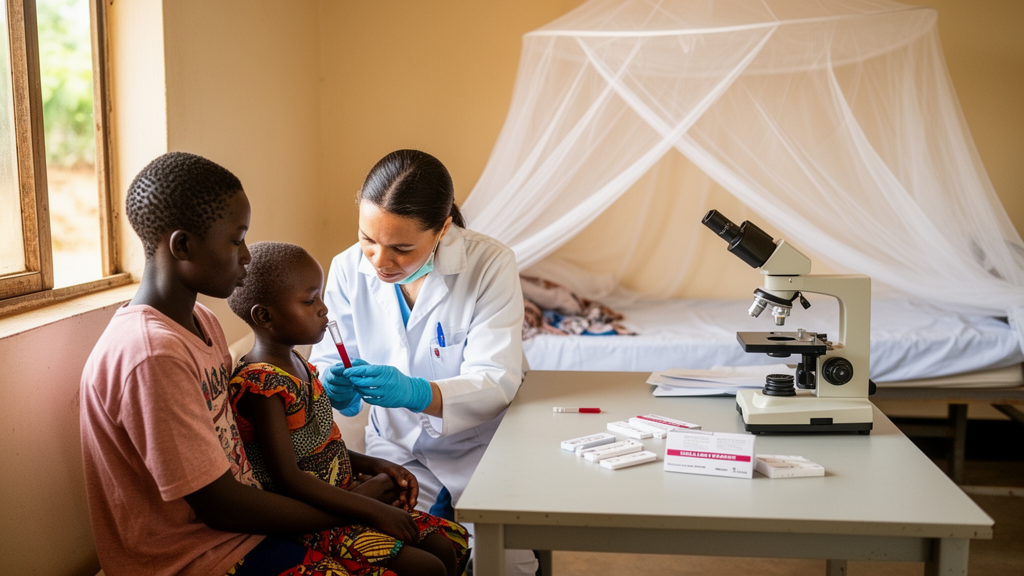
Malaria was associated with substantially higher odds of anemia among Tanzanian children, with the association strengthening as children grew older, according to a Bayesian analysis of four nationally representative Tanzania Demographic and Health Survey rounds covering 2007/08 through 2022. Across 28,151 children aged 6–59 months, 60.1% were anemic and 10.8% tested positive for malaria. Model-based estimates placed persistent high-risk clusters in western Tanzania, the Lake Zone and southern areas. The analysis also estimated that malaria contributed a time-varying portion of anemia burden, while identifying maternal education, household wealth, household size and younger maternal age as additional correlates of risk.
The study combined spatial and temporal modeling with survey-weighted causal estimation. Investigators linked children’s anemia and malaria test results to birth-history records, maternal characteristics and household information, then incorporated census-cluster coordinates, altitude and gridded climate variables. Anemia was defined as altitude-adjusted hemoglobin below 11.0 grams per deciliter, the World Health Organization threshold for children aged 6–59 months, while malaria status came from rapid diagnostic tests. The data covered 6,387 children in 2007/08, 7,606 in 2011/12, 9,161 in 2015/16 and 4,997 in 2022; 269 children without usable GPS coordinates were excluded from models requiring location or altitude.
At the center of the analysis was a Bayesian spatio-temporal geostatistical model fitted with Integrated Nested Laplace Approximation. A stochastic partial differential equation represented a spatially correlated latent field, and a first-order autoregressive process allowed anemia risk to persist and evolve over time. The model included nonlinear random-walk smooths for child age, maternal age, altitude, minimum and maximum temperature, precipitation and survey year, together with cluster and stratum random effects. Survey weights accounted for unequal sampling probabilities, while an SPDE mesh with 50-kilometer minimum interior edge length supported estimation of prevalence at unsampled locations. The temporal structure improved fit more than a static spatial field or a nonspatial alternative.
Out-of-sample evaluation used spatially blocked five-fold cross-validation, withholding whole geographic groups of clusters rather than isolated children. The model achieved an area under the receiver operating characteristic curve of 0.700, improved the Brier score by 11.5% relative to a no-skill baseline and was well calibrated in nine of ten probability deciles. It modestly underpredicted risk in the lowest decile, with a predicted mean prevalence of 0.31 compared with an observed 0.34. Overall, 93.3% of held-out cluster-rounds fell within their 95% binomial prediction intervals, although uncertainty was greater in sparsely sampled parts of central, western and southern Tanzania and increased in 2022.
Malaria emerged as the strongest individual predictor in the primary model. Children testing positive for malaria had 3.53 times the odds of anemia compared with malaria-negative children, with a 95% credible interval of 3.18–3.92. The association increased with age: the odds ratio was 2.89 for children aged 6–23 months, 3.17 for those aged 24–41 months and 4.08 for those aged 42–59 months. The ratio of the oldest to youngest age-specific odds ratios was 1.41, with a credible interval of 1.06–1.87. The authors note that early-life anemia has several concurrent causes, including depleted iron stores and dietary changes around weaning, whereas malaria made up a larger share of the remaining risk among older children in the analysis.
Social and household characteristics also tracked with anemia. Compared with children of mothers without formal education, those whose mothers had completed primary education had 16% lower odds of anemia, and those whose mothers had secondary education or more had 23% lower odds. Children in the middle, richer and richest wealth quintiles had lower adjusted odds than those in the poorest quintile, while the estimate for the poorer quintile was borderline and interpreted cautiously. Children in households with 6–10 members had 7% higher odds than those in smaller households, and those in households with more than 10 members had 23% higher odds. Risk was highest and least precisely estimated among children of very young mothers, declining through the twenties and reaching a reduced plateau at approximately 33–40 years. The model did not find credible independent associations for several sanitation and housing variables after adjustment.
The environmental results were nonlinear. Once malaria status and other covariates were included, precipitation showed essentially no independent association with anemia, and the maximum-temperature smooth was also compatible with no effect. Minimum temperature above approximately 18°C was associated with higher odds, with the estimated effect increasing toward the upper end of the observed range. Children in clusters at roughly 1,000–1,800 meters had lower odds of anemia, a pattern the authors said was compatible with reduced malaria transmission at intermediate elevations. These results describe adjusted associations rather than independent causal effects of temperature, rainfall or altitude, and estimates were less precise at sparsely sampled extremes.
Year-specific logistic models were used for the causal analysis because counterfactual prediction from the much larger spatial model was computationally impractical. The investigators applied G-computation, standardizing predictions over the empirical covariate distribution, to compare a hypothetical population in which malaria exposure was removed before it could affect hemoglobin with the observed exposure distribution. Under conditional exchangeability, positivity, consistency and temporality assumptions, the average causal effect of malaria was 0.155 in 2007/08, 0.197 in 2011/12, 0.266 in 2015/16 and 0.246 in 2022. Thus, the model estimated that malaria was associated with an average absolute increase of about 26.6 percentage points in anemia probability at the 2015/16 peak, but did not include spatial heterogeneity in its causal estimates.
The attributable fraction and preventive number needed to treat also varied by year. The estimated fraction of anemia cases attributable to malaria was 3.85% in 2007/08, 3.27% in 2011/12, 6.37% in 2015/16 and 3.22% in 2022. The corresponding number needed to prevent was 6.68, 5.11, 3.93 and 4.13 children, respectively, meaning that in 2015/16 the model estimated about four malaria-positive children would need to have been protected before infection to avert one case of anemia. These figures describe a hypothetical fully effective prevention scenario, not treatment of established malaria or anemia. The findings are consistent with a causal contribution from malaria, but cross-sectional measurements cannot verify that infection preceded the anemia being observed, and plausible shared causes such as dietary iron intake, sickle cell trait, recent antimalarial use and helminth infection were not fully observed.
Anemia prevalence fell from 68.8% in 2007/08 to 56.5% in 2011/12 and 57.4% in 2015/16 before rising to 59.7% in 2022, remaining well above the study’s cited threshold for a severe public health problem. Spatial predictions showed limited national progress through 2015/16 followed by renewed increases in parts of the west, south and Lake Zone by 2022. The results indicate that malaria is an important but incomplete explanation for Tanzania’s anemia burden and support combining geographically focused malaria prevention with broader attention to nutrition and socioeconomic conditions. The analysis is observational, however, and its causal estimates should not be interpreted as a direct evaluation of any specific prevention program.
Subject of Research: Spatio-temporal modeling of malaria, socioeconomic factors and childhood anemia in Tanzania
Article Title: Bayesian spatio-temporal modeling of childhood anemia in Tanzania: spatial distribution, determinants, and causal impact of malaria
Article References: Njotto, L. L., Senyoni, W., & Lutambi, A. M. (2026). Bayesian spatio-temporal modeling of childhood anemia in Tanzania: spatial distribution, determinants, and causal impact of malaria. Frontiers in Public Health, 14, Article 1919182. https://doi.org/10.3389/fpubh.2026.1919182
Image Credits: AI Generated
DOI: 10.3389/fpubh.2026.1919182
Keywords: childhood anemia, malaria, Tanzania, Bayesian geostatistics, causal inference, spatial epidemiology, children under five, household wealth, maternal education, survey modeling, Bayesian, spatio-temporal
News Source: Ophelia Keating. (October 25, 2026). Malaria’s anemia link is strongest in older Tanzanian children. Scienmag.