Common bean, one of Brazil’s most important staple crops, has long depended on generous applications of mineral nitrogen fertilizer to reach its yield potential. A new greenhouse experiment from the Federal University of Santa Maria’s Frederico Westphalen campus in Rio Grande do Sul suggests that a carefully balanced pairing of two organic and biological inputs can push the crop much further than either input alone. Researchers found that seed inoculation with the nitrogen-fixing bacterium Rhizobium tropici, combined with intermediate rates of swine wastewater compost, produced coordinated gains in stem diameter, biomass, root development, chlorophyll indices, nodulation, grain yield and grain protein content in the black-seeded cultivar IPR Urutau. Crucially, the benefits did not scale endlessly: beyond an optimal compost rate, chlorophyll indices declined, underscoring that the dose matters as much as the combination.
The study, published in Discover Plants, was designed as a 2 by 5 factorial experiment in a completely randomized layout. Seeds were either inoculated or left uninoculated, and each group received one of five swine wastewater compost rates: 0, 1.5, 3.0, 4.5 or 6.0 tonnes per hectare, applied as a single surface dose at sowing. Each treatment was replicated six times in 3.6-litre pots holding 4 kilograms of a sterilized Red Latosol and sand mixture. The compost itself was produced on site from screened and sedimented solid fractions of swine manure, windrow-composted for roughly 40 days, then ground and sieved. The inoculant was a peat-based formulation of the commercial strain SEMIA 4077, containing at least one billion viable cells per gram, applied two hours before sowing in a sucrose solution to help the bacteria adhere to the seed surface.
Sterilizing the soil was a deliberate methodological choice. By autoclaving the growing medium in two consecutive 30-minute cycles at 120 degrees Celsius, the team eliminated native rhizobia and other soil microorganisms, ensuring that any observed effects could be attributed specifically to the inoculant and the compost rather than to an uncontrolled background community. The trade-off, which the authors acknowledge openly, is that such conditions may overestimate inoculation responses relative to real fields, where indigenous strains compete with introduced ones. The results therefore describe what the combination can achieve under controlled conditions, not a validated field prescription.
The interaction between the two factors was significant for most of the variables measured, and the response patterns were strikingly consistent. In inoculated plants, stem diameter followed a quadratic curve against compost rate, peaking at an estimated maximum technical efficiency of 4.82 tonnes per hectare, where stems reached 2.18 millimetres, 27.5 percent thicker than in the non-inoculated treatment. Shoot dry mass in inoculated plants peaked at 3.55 tonnes per hectare of compost, accumulating 0.91 grams per plant, a 9 percent advantage over uninoculated plants. Non-inoculated plants, by contrast, showed linear increases in shoot biomass across the whole compost range, reaching 0.99 grams per plant at the highest rate of 6.0 tonnes per hectare.
Root responses told a similar story of synergy at moderate doses. Root dry mass in inoculated plants rose quadratically, peaking at 3.48 tonnes per hectare of compost with 0.75 grams of root biomass, a 44.2 percent increase over the zero-rate treatment, while non-inoculated plants increased linearly to 0.67 grams at the highest rate, a 28.8 percent gain. Specific root surface area in inoculated plants peaked at an estimated 3.95 tonnes per hectare. The authors link these patterns to the phosphorus supplied by the compost, which promotes early root elongation and branching, and to the rhizobia’s capacity to reshape root architecture through lateral root formation, improving the plant’s capacity to explore the soil for nitrogen, phosphorus and water.
Chlorophyll measurements, taken with a portable meter at the flowering stage across the lower, middle and upper leaf thirds, revealed the clearest evidence of an optimum. In inoculated plants, chlorophyll a, b and total chlorophyll indices peaked at compost rates of 4.0, 4.57 and 4.35 tonnes per hectare respectively, with increases of 6.3, 27.4 and 12.8 percent relative to the corresponding non-inoculated peaks. Beyond these intermediate rates, chlorophyll indices fell, a decline the researchers attribute to disruption of the soil’s chemical equilibrium: excessive nutrient availability can disturb osmotic balance, alter micronutrient availability and impair nodulation. Because the chlorophyll meter provides only an indirect, dimensionless estimate of pigment content rather than a direct measure of photosynthetic rate, these indices should be read as an approximation of physiological performance.
The yield data carried the most immediate agronomic weight. Grain yield in inoculated plants followed a quadratic response, with maximum technical efficiency estimated at 3.98 tonnes per hectare of compost, producing 3.98 grams of grain per plant, a 42.9 percent increase compared with the non-inoculated treatment. Non-inoculated plants also responded quadratically, peaking at 4.94 tonnes per hectare with a 28.9 percent gain over the zero rate. The number of grains per pod in inoculated plants peaked at 3.72 tonnes per hectare, reaching 4.5 grains per pod, 29 percent above the non-inoculated maximum of 3.49 grains. Plant height, root volume and pods per plant also showed significant interactions, with root volume climbing 98.5 percent above the zero-rate treatment at an estimated optimum of 5.2 tonnes per hectare, and pod number peaking at 5.3 tonnes per hectare with 4.7 pods per plant, a 71.7 percent increase.
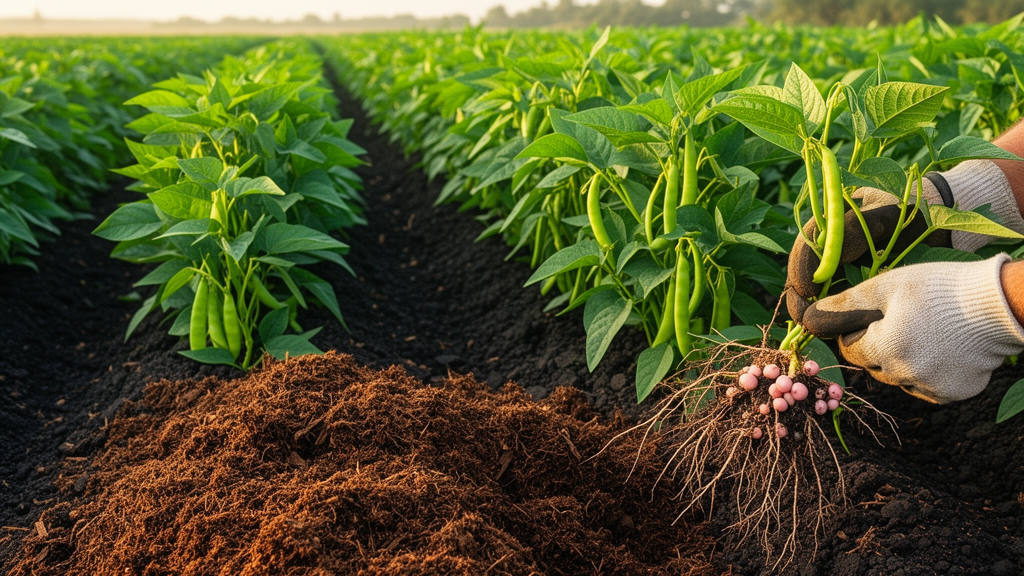
Nodulation data reinforced the picture of a compost-enhanced symbiosis. In inoculated plants, both nodule number and nodule dry weight rose quadratically with compost rate: nodule number peaked at an estimated 3.93 tonnes per hectare, 68 percent above the zero-rate treatment, and nodule dry weight peaked at 4.1 tonnes per hectare, 62 percent higher. The authors interpret this as evidence that organic fertilization improves the rhizosphere environment, supplying nutrients associated with nodule development and creating conditions in which the R. tropici symbiosis operates more efficiently. Biologically fixed nitrogen, in turn, sustains chlorophyll synthesis and photosynthetic metabolism, feeding a mutually reinforcing loop in which photosynthates support nodule activity and fixed nitrogen builds new pigment.
Grain quality responded differently from biomass, and the contrast is instructive. While growth variables peaked at intermediate compost rates, grain protein content increased linearly with compost application in both groups. Inoculated plants showed a protein content 25.9 percent higher at the highest compost rate than the non-inoculated treatment, and non-inoculated plants gained 24.9 percent relative to their own zero-rate control. The authors suggest that nitrogen absorbed beyond what growth requires is stored as protein, so the linear rise reflects continued conversion of absorbed nitrogen into amino acids and proteins until metabolic saturation. Nitrogen remobilization from vegetative tissues to grains during flowering and grain filling is a key determinant of protein accumulation, and symbiotically fixed nitrogen appears to have sustained that process.
A Pearson correlation analysis across all fifteen response variables found strong positive associations throughout, with coefficients ranging from 0.50 to 0.98 and no negative relationships. The strongest correlations linked stem diameter with grain protein content at r = 0.98 and stem diameter with chlorophyll b at r = 0.96, while chlorophyll indices correlated positively with nodule number and dry mass at values between 0.76 and 0.88. The authors are careful to note that such correlations indicate coordinated variation, not causation. Taken together, the findings point to an estimated optimum of roughly 3.9 tonnes of compost per hectare combined with R. tropici inoculation as the configuration that maximized pods per plant and grain yield under these greenhouse conditions. The authors recommend field validation before the strategy can be extended to commercial bean production, but the controlled results suggest that integrating biological nitrogen fixation with moderate organic amendment rates could reduce dependence on mineral nitrogen while giving swine manure a productive second life in legume-based cropping systems.
Subject of Research: Combined effects of Rhizobium tropici inoculation and swine wastewater compost on common bean growth and yield
Article Title: Effects of Rhizobium tropici inoculation and swine wastewater compost on common bean (Phaseolus vulgaris L.) growth and yield
Article References: dos Santos, R. P., Menegat dos Santos, V., Rosa, K. D., Jimlaki, T. C., da Rocha Giovenardi, A., da Silva, R. F., Da Ros, C. O., Afonso, T. F., & Andreazza, R. (2026). Effects of Rhizobium tropici inoculation and swine wastewater compost on common bean (Phaseolus vulgaris L.) growth and yield. Discover Plants, 3(1), Article 489. https://doi.org/10.1007/s44372-026-00961-x
Image Credits: AI Generated
DOI: 10.1007/s44372-026-00961-x
Keywords: common bean, Rhizobium tropici, biological nitrogen fixation, swine wastewater compost, organic amendments, grain yield, grain protein, nodulation, chlorophyll, sustainable agriculture, greenhouse study, Brazil
News Source: Alan Morgan. (October 25, 2026). Bean Plants Thrive When Rhizobium Inoculation Meets Moderate Swine Compost Rates. Scienmag.