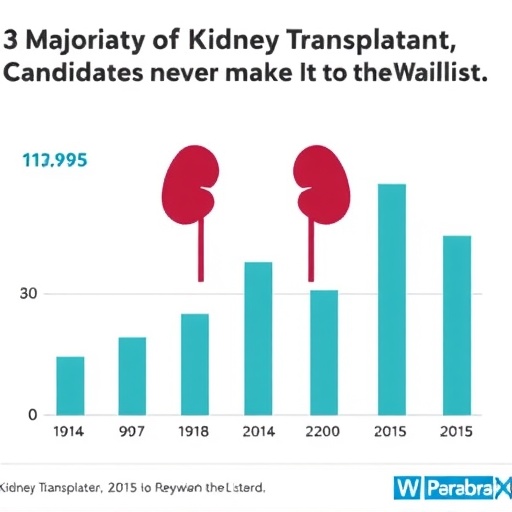
Nearly half of American patients diagnosed with kidney failure face a significant hurdle that remains largely unnoticed: the daunting path from referral for kidney transplantation to actually being listed as a transplant candidate. A groundbreaking national study spearheaded by researchers from NYU Langone Health reveals that only about 19 percent of these patients complete the rigorous evaluation process required to join the kidney transplant waitlist. Alarmingly, nearly 48 percent never even commence this critical phase, underscoring a systemic challenge within transplant medicine that urgently warrants comprehensive attention.
Kidney transplantation is widely regarded as the optimal treatment for end-stage renal disease, significantly enhancing both survival rates and quality of life over long-term dialysis. Despite extensive research focusing on outcomes and management once patients are waitlisted or transplanted, the early stages—particularly the transition from referral to evaluation—have remained remarkably underexplored. The new study addresses this knowledge gap by meticulously analyzing data that track patient progression (or dropout) through each sequential step: referral, evaluation, waitlisting, and transplantation.
Leveraging the formidable Epic Cosmos database, which aggregates over 300 million electronic health records from more than 1,850 medical institutions—including over a third of all U.S. transplant centers—the research team was able to follow 720,348 adult patients referred for kidney transplantation between 2014 and 2025. By applying advanced statistical modeling, the researchers dissected how variables such as demographic factors, socioeconomic status, geographic location, and medical complexities influence patient trajectories through the transplant pipeline.
One of the study’s most compelling revelations is the multifaceted nature of barriers patients face long before they arrive on the transplant waitlist. Particularly vulnerable are unmarried individuals, those categorized with severe obesity, and patients residing in rural areas. These groups demonstrated disproportionately lower rates of starting and completing the transplant evaluation. The researchers suggest that limited social support, compounded by logistical challenges in accessing transplant centers mostly concentrated in urban settings, profoundly affects these disparities.
Language barriers and poverty add further layers of complexity. Older patients, Spanish speakers, and economically disadvantaged populations exhibited reduced odds of progressing beyond referral. The evaluation process itself, demanding repeated visits for comprehensive testing—including hematologic assays, radiologic imaging like chest X-rays, and oncologic screenings—can extend over months. This prolonged and intricate schedule poses significant strain on patients, particularly those simultaneously managing frequent dialysis treatments.
Institutional factors also shape patient outcomes. Smaller transplant centers, often with constrained resources and fewer transplant slots, tend to adopt more conservative patient selection criteria. This resource scarcity may lead to heightened risk aversion, amplifying the likelihood that individuals are filtered out early in the process. In contrast, larger centers with expansive infrastructure appear better suited to support patients through the complex evaluation stages, enhancing access equity.
Beyond healthcare infrastructure, psychosocial elements emerge as crucial determinants. The study highlights the importance of marital status and social support networks, which facilitate navigating the exhaustive appointment schedule and the psychological burden of chronic illness management. Candidates lacking robust social backings are more susceptible to discontinuing the transplant workup, emphasizing that transplant candidacy extends beyond physiological suitability to encompass holistic patient contexts.
The authors underscore that the transplant evaluation pathway remains one of the most intricate and strenuous journeys in medical care, entailing multifaceted specialist consultations, laboratory testing, and patient education. Each phase demands adequate patient understanding, resource availability, and logistical feasibility, accentuating the necessity for patient-centered strategies to democratize access.
Conor Donnelly, MD, the study’s lead author and PhD candidate at NYU Grossman School of Medicine, reflects on the striking influence of non-medical factors, stating the interplay of geography, healthcare center characteristics, and social environment decisively shapes transplant waitlisting outcomes. He advocates for system-level reforms targeting these upstream barriers to broaden equitable transplant access.
Allan B. Massie, PhD, co-senior author, emphasizes the potential impact of tailored educational efforts and patient navigation services to demystify and streamline the evaluation process. By reducing administrative burden and fostering comprehensible pathways, health systems can meaningfully increase the number of patients transitioning from referral to active waitlisting.
Similarly, Michal A. Mankowski, PhD, co-senior author and assistant professor of surgery, notes this study paves the way for probing analogous barriers in other organ transplant domains, each characterized by distinct logistical and clinical considerations. Expanding this research is vital for holistic transplant equity improvements.
The research, published June 20, 2026, in the Journal of the American Society of Nephrology and presented at the American Transplant Congress, marks the most extensive analysis to date of the attrition points in the kidney transplant continuum. These insights hold profound implications for policy frameworks, patient advocacy, and healthcare delivery models.
Addressing the entrenched social and systemic impediments to kidney transplantation demands coordinated efforts involving healthcare providers, payers, policymakers, and community stakeholders. Streamlining referral and evaluation protocols, augmenting support services, and ensuring resource availability at smaller centers—particularly in underserved regions—stand as imperatives.
NYU Langone Health’s funding and multidisciplinary team underscore the critical priority of tackling kidney transplant disparities with data-driven precision and commitment, aspiring to ensure that the lifesaving promise of transplantation reaches every eligible patient without undue delay or discrimination.
Subject of Research: People
Article Title: Evaluating Barriers to Kidney Transplantation in the United States
News Publication Date: 20-Jun-2026
Keywords: Organ transplantation, Renal failure, Nephropathies, Health care delivery, Health disparity, Health equity
Tags: dialysis versus kidney transplantation outcomeselectronic health records in transplant researchend-stage renal disease treatment optionsEpic Cosmos database transplant studykidney failure patient referral challengeskidney transplant candidate dropout rateskidney transplant waitlist barrierskidney transplant waitlist statisticskidney transplantation evaluation processpatient progression in kidney transplantationsurvival rates post-kidney transplanttransplant medicine systemic issues