


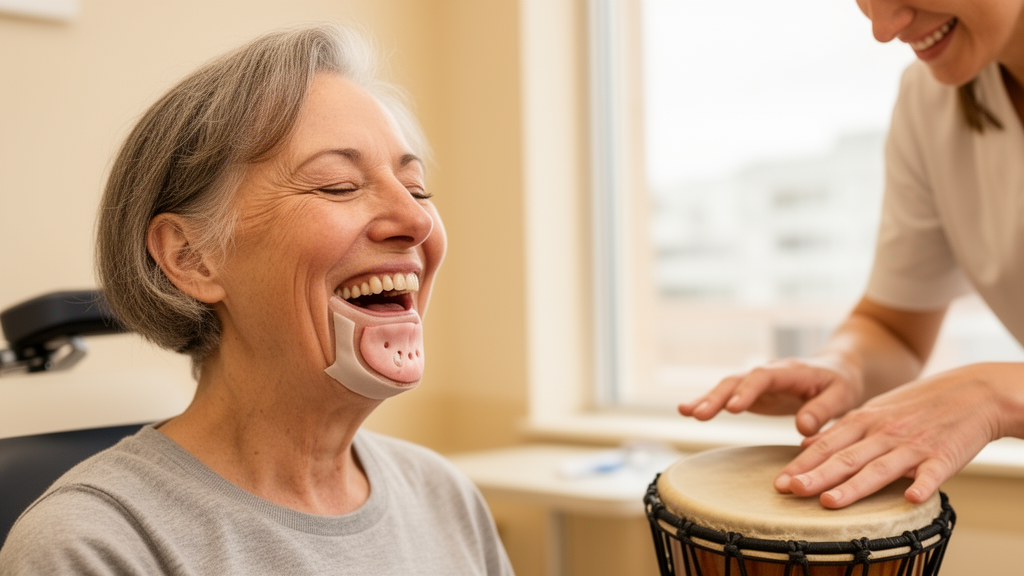
Patients whose jaws, lips, or tongues have been altered by cancer surgery or congenital conditions often struggle with basic oral tasks such as chewing, speaking, and swallowing. A small randomized trial from Japan now reports that a tablet-based exercise program built around music may help some of these patients regain measurable strength in the muscles that drive those functions. The study, conducted between December 2022 and June 2023 at the Clinic for Maxillofacial Prosthetics of Tokyo Medical and Dental University, found significant within-group improvements in lip pressure, maximum occlusal force, and oral diadochokinesis among participants who performed the music-and-exercise routine daily for three months, while a usual-care control group showed no significant changes.
The trial enrolled twenty patients with maxillofacial defects, a category that includes head and neck cancer survivors and people treated for cleft lip and palate. All had undergone maxillofacial surgery and had worn a definitive prosthesis for more than three months. After randomization in a one-to-one ratio, ten patients were assigned to the exercise group and ten to the control group, which received regular dental care alone. Seventeen participants completed the study: eight in the exercise group and nine in the control group. Four additional patients declined to participate after the program was introduced, and three dropped out during follow-up because they found it difficult to continue or to visit the clinic. The overall follow-up rate was 85 percent, and no adverse events or intervention-related complications were reported during the three-month period.
The intervention drew on the Yamaha Machikado Exercise, a music-based physical exercise program previously studied in elderly people. Each participant in the exercise group received an iPad loaded with an exercise application, a booklet of written and illustrated instructions, and guidance from an exercise instructor. The tablet’s camera recorded the exercises so movements could be corrected, and the software logged total training time. Participants were instructed to complete at least one training session per day and could choose among three courses lasting six, nine, or twenty-four minutes. All courses involved pronouncing the five vowels at different speeds and combinations against a musical rhythm; the longer courses added consonant articulation drills with repeated production of the syllables pa, ta, and ka, targeting lip closure, anterior tongue movement, and posterior tongue movement respectively. The twenty-four-minute course also included upper-extremity movements synchronized with the music, such as shoulder flexion, elbow extension, and rhythmic hand movements. Participants selected their preferred songs from a library of five pre-recorded tracks with standardized rhythmic accompaniment, and each session began and ended with a measurement of maximum phonation time.
The researchers assessed oral function at baseline, one month, and three months using a battery of instruments. Maximum occlusal force was measured with pressure-sensitive film placed between the dental arches during three seconds of maximum clenching. Lip pressure was recorded with a dedicated device that pulled a small button from the oral vestibule while participants resisted with lip muscle strength alone. Tongue pressure was measured by pressing a balloon against the hard palate for five seconds, and oral diadochokinesis was quantified by counting syllables produced per second over five-second repetitions of pa, ta, and ka. Additional assessments included the repetitive saliva swallowing test, the Simplified Nutritional Appetite Questionnaire, and a cough test using nebulized citric acid solution. Outcome assessors, clinicians, and statisticians were blinded to group allocation, although participants themselves could not be blinded.
The results showed a consistent pattern within the exercise group. Lip pressure rose from a baseline mean of 7.72 newtons to 8.95 newtons at one month and 9.17 newtons at three months, changes that reached statistical significance at both time points. Maximum occlusal force increased from 268.52 newtons at baseline to 417.42 newtons at three months, with the largest gain occurring between the one-month and three-month assessments. Oral diadochokinesis for the syllable pa improved from 5.44 to 5.93 syllables per second. In contrast, the control group showed no significant within-group improvements on any of these measures, and its mean maximum occlusal force actually declined numerically over the study period. Between-group comparisons of change scores revealed significant differences for maximum occlusal force between baseline and three months and for oral diadochokinesis of ta between baseline and one month.
Notably, the baseline maximum occlusal force values differed substantially between the two groups even before the intervention began: 430.77 newtons in the control group versus 268.52 newtons in the exercise group. Although this difference was not statistically significant, the authors caution that the magnitude of the gap, combined with the small sample size and substantial inter-individual variability, may have influenced the observed changes in occlusal force. The exercise group also had significantly more occlusal units without dentures at baseline, reflecting an imbalance that arose because randomization was stratified only by age and sex rather than by defect type, surgical extent, or treatment history. These baseline disparities complicate the interpretation of the between-group treatment effect and are a key reason the findings are framed as preliminary.
Beyond the group comparisons, the study found that greater total training time was positively correlated with larger improvements in several oral function measures. Spearman correlation coefficients reached 0.481 for maximum occlusal force, 0.713 for lip pressure, and 0.643 for oral diadochokinesis of pa, all statistically significant. Correlations for the ta and ka syllables and for the appetite questionnaire were also examined, with the ta and ka measures reaching significance. The authors emphasize that these correlations do not establish causality, given the exploratory design and the limited sample size, but they suggest that adherence to the daily routine may be linked to the degree of functional gain.
Several secondary measures told a more cautious story. Tongue pressure in the exercise group increased modestly from 24.35 kilopascals at baseline to 26.89 kilopascals at three months, but the change was not statistically significant, and values remained below the 30-kilopascal cutoff used in the Japanese Society of Gerodontology’s index of oral hypofunction. The clinical significance of this modest rise remains uncertain. On the swallowing screen, two participants were identified at baseline as having a high risk of dysphagia; after three months of exercise, the repetitive saliva swallowing test results for all patients in the exercise group became negative, while the authors report that the corresponding results in the control group declined over time. The cough test indicated no silent aspiration among participants. The authors note, however, that nutritional outcomes, quality of life, and other patient-reported outcomes were not evaluated in this study, so the functional improvements cannot yet be tied to broader health benefits.
The design of the trial limits what can be concluded about the role of music itself. Because there was no comparison group performing identical exercises without music, the specific contribution of the musical component cannot be isolated from that of the exercise. The intervention also combined multiple elements, including rhythmic vocalization, consonant articulation drills, singing, and synchronized limb movements, so the observed improvements should be attributed to the combined program rather than to music alone. Prior research cited by the authors suggests that rhythmic auditory stimulation can enhance motor timing and coordination, and that musical accompaniment may increase motivation and adherence to repetitive exercise, but testing those mechanisms in this population would require a dedicated exercise-only control arm.
The authors describe the work as an exploratory pilot randomized controlled trial and register the caveats explicitly. The calculated sample size was twenty-four participants, based on expected between-group differences in lip pressure and tongue pressure, but the original calculation did not allow for attrition, and only seventeen participants completed the study, reducing statistical power and raising the risk of a type II error. The per-protocol analysis, the inclusion of both head and neck cancer and cleft lip and palate patients, the self-selected exercise durations and songs, and the absence of detailed surgical and adjuvant treatment data all further constrain the conclusions. The team calls for larger multicenter pilot randomized controlled trials with adequate statistical power, intention-to-treat analyses, an exercise-only comparison group, stratified randomization by defect type and treatment characteristics, and longer follow-up periods to confirm whether music-assisted oral rehabilitation genuinely improves oral function in this patient population.
Subject of Research: Effects of a combined music-and-exercise program on oral function in patients with maxillofacial defects
Article Title: Impact of a music exercise on oral function in patients with maxillofacial defects: a pilot randomized controlled trial
Article References: Bai, Z., Sumita, Y., Hattori, M., Han, X., Miao, M., Pang, X., Tanabe, G., & Wakabayashi, N. (2026). Impact of a music exercise on oral function in patients with maxillofacial defects: a pilot randomized controlled trial. Frontiers in Oral Health, 7, Article 1786928. https://doi.org/10.3389/froh.2026.1786928
Image Credits: AI Generated
DOI: 10.3389/froh.2026.1786928
Keywords: maxillofacial defects, oral function, music exercise, randomized controlled trial, lip pressure, occlusal force, oral diadochokinesis, head and neck cancer, rehabilitation, prosthodontics, Impact, music
News Source: Ophelia Keating. (October 28, 2026). Music-based exercise program shows early promise for oral function in maxillofacial defect patients. Scienmag.



