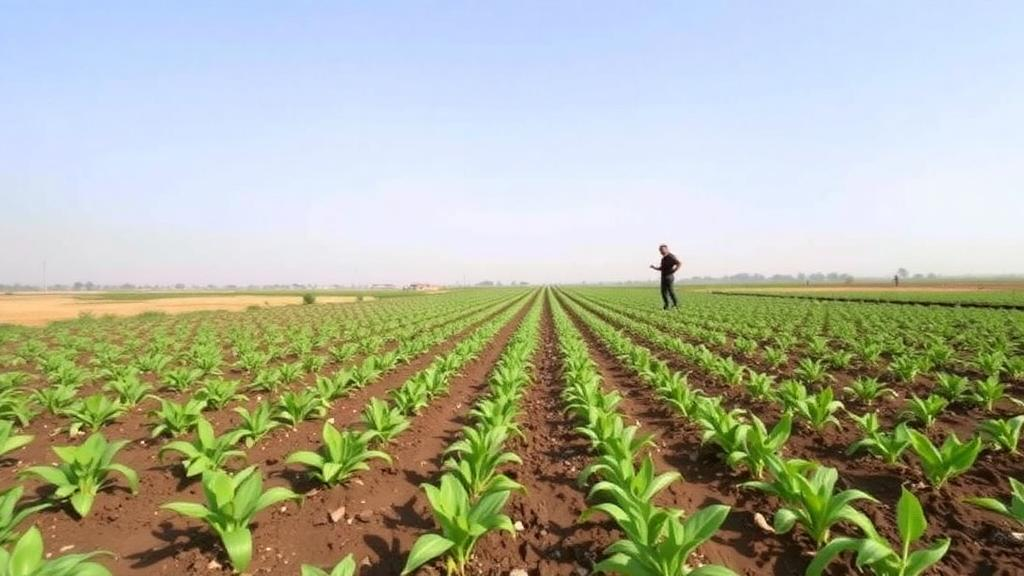
Organic and integrated crop management systems, particularly when paired with a package of Ghanajeevamrut, Beejamrut and mulching, maintained larger soil nitrogen reserves and higher biological activity than conventional mineral fertilization in a semi-arid rainfed field experiment in Hyderabad, India, according to a study published in Frontiers in Agronomy. The research, conducted by scientists at ICAR-Central Research Institute for Dryland Agriculture, monitored soil nitrogen fractions and biochemical properties throughout a sorghum and blackgram intercropping season during kharif 2024.
The experiment was established in 2022–23 at the Natural Farming Block of the Hayathnagar Research Farm and continued under fixed plots through the observation season. The site lies in a semi-arid tropical zone with roughly 750 mm of annual rainfall and a mean annual temperature near 27 °C. The soil is a sandy loam of the Hayathnagar series, classified as Typic Haplustalf, with initial organic carbon between 2.26 and 2.42 g kg-1 and available nitrogen between 166 and 186 kg ha-1. Sorghum and blackgram were grown in a 1:2 row ratio, one row of sorghum for every two rows of blackgram, in a randomized block design with three replications of 10 m × 10 m plots.
Eight treatments were compared. Natural farming applied Beejamrut seed inoculation, basal Ghanajeevamrut at 5 t ha-1, biweekly Jeevamrut drenches and sorghum straw mulch. Organic farming relied exclusively on farmyard manure applied at 14 t ha-1, while an organic-plus-GBM variant added the Ghanajeevamrut, Beejamrut and mulching package to that manure baseline. Integrated crop management split nitrogen equally between farmyard manure at 7 t ha-1 and urea, and a GBM-supplemented version of this system was also tested. Conventional farming received 70 kg N ha-1 entirely through urea, split 50 percent at sowing and 25 percent each at 30 and 45 days after sowing, with and without GBM. An unamended control completed the set. The recommended fertilizer dose for the intercrop was 70:40:40 kg N P2O5 K2O ha-1.
Soil samples were collected from the 0–15 and 15–30 cm depths before sowing, at blackgram flowering, at sorghum flowering and at harvest, giving 48 samples per stage and 192 across the season. Inorganic nitrogen was extracted with potassium chloride, while organic nitrogen fractions were determined by hydrolyzing soil with 6 N hydrochloric acid and separating total hydrolysable N, hydrolysable ammonium-N, amino sugar-N, amino acid-N and unidentified hydrolysable N. Non-hydrolysable N was calculated as total N minus total hydrolysable N. Microbial biomass carbon was measured by chloroform fumigation–extraction and urease activity by incubating fresh soil with urea and quantifying released ammonium-N.
The clearest signal emerged in available nitrogen. Organic systems with GBM achieved a 5–6 percent gain in available nitrogen, whereas conventional farming declined by about 11 percent from initial sampling to harvest. Because crop nitrogen uptake, mineralization rates and loss pathways such as leaching, volatilization and denitrification were not measured, the observed changes reflect differences in residual soil available N and cannot be assigned to any single process.
Mineral nitrogen forms diverged by management. Organic systems held relatively more ammonium-N, with OF recording the highest residual ammonium at harvest at 36.37 mg kg-1, whereas integrated management retained more nitrate toward maturity, with ICM recording the highest harvest nitrate-N at 23.57 mg kg-1 and ICM + GBM above 21 mg kg-1. Natural farming, organic farming and the control depleted nitrate below 10 mg kg-1 by harvest.
Organic nitrogen pools told a complementary story. Total hydrolysable N was highest initially under ICM + GBM at 641.00 mg kg-1 and peaked at 30 days after sowing under OF + GBM at 638.67 mg kg-1, then generally declined by 1.7 to 11.7 percent across treatments over the cropping cycle, consistent with utilization to meet crop nitrogen demand. At harvest, ICM + GBM maintained the highest total hydrolysable N at 584.34 mg kg-1, and the hydrolysable pool under ICM + GBM and OF + GBM exceeded the control by 31.2 to 36.4 percent. Non-hydrolysable N, the stable reserve, was highest at harvest under OF + GBM at 738.27 mg kg-1, followed by OF at 716.34 mg kg-1 and ICM + GBM at 705.34 mg kg-1, while the control ended lowest at 488.34 mg kg-1.
Within the hydrolysable pool, fractions ranked amino acid-N > ammonium-N > unidentified N > amino sugar-N. Hydrolysable amino acid-N was the dominant labile fraction, and OF + GBM recorded the highest harvest concentration at 321.67 mg kg-1. The authors emphasize that this reflected retention of a large initial pool rather than a net seasonal increase; the fraction declined only 3.0 percent during the season, and because the same treatments had been maintained since 2022–23, the initial value already embodied the legacy of earlier manure, Ghanajeevamrut and residue inputs. A similar initial-pool effect applied to amino sugar-N, which declined 22.84 percent under OF + GBM yet remained joint-highest with OF at harvest at 32.67 mg kg-1.
Biological indicators tracked these patterns. Microbial biomass carbon peaked in OF + GBM at 155.08 mg kg-1, significantly above conventional farming at 104.4 mg kg-1 and the control at 100.24 mg kg-1. Soil organic carbon was highest under ICM + GBM at 3.07 g kg-1, significantly exceeding the control at 2.27 g kg-1. Natural farming recorded the highest urease activity at 30 days after sowing, performed on par with OF + GBM and ICM at the 60-day peak, and retained the lead at harvest. Redundancy analysis explained 89.14 percent of the constrained variation across its first two axes, identifying soil organic carbon and microbial biomass carbon as strongly associated with the active hydrolysable nitrogen fractions, while bulk density and pH oriented in the opposite direction. Pearson correlations showed organic carbon, microbial biomass carbon and available potassium positively correlated with hydrolysable ammonium, amino sugar and amino acid fractions, with coefficients between 0.43 and 0.63.
Yield outcomes favored the integrated systems. Sorghum grain yield ranged from 500 kg ha-1 in the control to 970 kg ha-1 under ICM + GBM, and blackgram yields varied only slightly among managed treatments at 500.3 to 502.7 kg ha-1. ICM + GBM recorded the highest sorghum-equivalent yield at 2,059 kg ha-1, closely followed by ICM at 2,048 kg ha-1, while the control recorded 1,150 kg ha-1. Validation across seasons, soil types and agroclimatic conditions, along with direct measurements of nitrogen use efficiency, mineralization and loss pathways, remains necessary before the observed maintenance of soil nitrogen pools can be generalized.
Subject of Research: Effects of crop management systems on soil nitrogen fractions and biological activity in a semi-arid rainfed sorghum-blackgram intercropping experiment in India
Article Title: Crop management systems influence soil nitrogen fractions and biological activity in semi-arid agroecosystems
Article References: Tarun, N., Pushpanjali, Yami, B., Gurav, P. P., Santosh, S., Kundu, S., Saroja, D. G. M., Kunsoth, R., & Singh, V. K. (2026). Crop management systems influence soil nitrogen fractions and biological activity in semi-arid agroecosystems. Frontiers in Agronomy, 8, Article 1948788. https://doi.org/10.3389/fagro.2026.1948788
Image Credits: AI Generated
DOI: 10.3389/fagro.2026.1948788
Keywords: soil nitrogen fractions, natural farming, organic farming, integrated crop management, conventional farming, Ghanajeevamrut, microbial biomass carbon, urease activity, semi-arid rainfed agriculture, sorghum blackgram intercropping, nitrogen cycling, soil organic carbon
News Source: Alan Morgan. (October 28, 2026). Organic amendments reshape soil nitrogen pools in semi-arid Indian intercropping trial. Scienmag.