Osaka, Japan – When will 6G be a reality? The race to realize sixth generation (6G) wireless communication systems requires the development of suitable magnetic materials. Scientists from Osaka Metropolitan University and their colleagues detected an unprecedented collective resonance at high frequencies in a magnetic superstructure called a chiral spin soliton lattice (CSL), revealing CSL-hosting chiral helimagnets as a promising material for 6G technology. The study was published in Physical Review Letters.
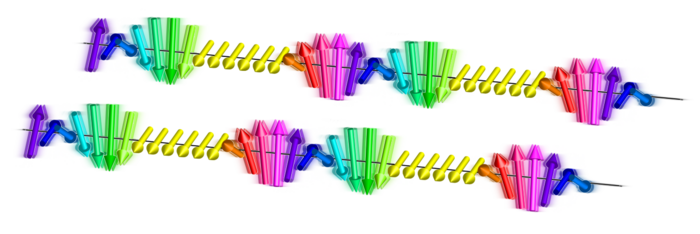
Credit: Osaka Metropolitan University
Osaka, Japan – When will 6G be a reality? The race to realize sixth generation (6G) wireless communication systems requires the development of suitable magnetic materials. Scientists from Osaka Metropolitan University and their colleagues detected an unprecedented collective resonance at high frequencies in a magnetic superstructure called a chiral spin soliton lattice (CSL), revealing CSL-hosting chiral helimagnets as a promising material for 6G technology. The study was published in Physical Review Letters.
Future communication technologies require expanding the frequency band from the current few Gigahertz (GHz) to over 100 GHz. Such high frequencies are not yet possible given that existing magnetic materials used in communication equipment can only resonate and absorb microwaves up to approximately 70 GHz with a practical-strength magnetic field. Addressing this gap in knowledge and technology, the research team led by Professor Yoshihiko Togawa from Osaka Metropolitan University delved into the helicoidal spin superstructure CSL. “CSL has a tunable structure in periodicity, meaning it can be continuously modulated by changing the external magnetic field strength,” explained Professor Togawa. “The CSL phonon mode, or collective resonance mode ― when the CSL’s kinks oscillate collectively around their equilibrium position ― allows frequency ranges broader than those for conventional ferromagnetic materials.” This CSL phonon mode has been understood theoretically, but never observed in experiments.
Seeking the CSL phonon mode, the team experimented on CrNb3S6, a typical chiral magnetic crystal that hosts CSL. They first generated CSL in CrNb3S6 and then observed its resonance behavior under changing external magnetic field strengths. A specially designed microwave circuit was used to detect the magnetic resonance signals.
The researchers observed resonance in three modes, namely the “Kittel mode,” the “asymmetric mode,” and the “multiple resonance mode.” In the Kittel mode, similar to what is observed in conventional ferromagnetic materials, the resonance frequency increases only if the magnetic field strength increases, meaning that creating the high frequencies needed for 6G would require an impractically strong magnetic field. The CSL phonon was not found in the asymmetric mode, either.
In the multiple resonance mode, the CSL phonon was detected; in contrast to what is observed with magnetic materials currently in use, the frequency spontaneously increases when the magnetic field strength decreases. This is an unprecedented phenomenon that will possibly enable a boost to over 100 GHz with a relatively weak magnetic field – this boost is a much-needed mechanism for achieving 6G operability.
“We succeeded in observing this resonance motion for the first time,” noted first author Dr. Yusuke Shimamoto. “Due to its excellent structural controllability, the resonance frequency can be controlled over a wide band up to the sub-terahertz band. This wideband and variable frequency characteristic exceeds 5G and is expected to be utilized in research and development of next-generation communication technologies.”
###
About OMU
Osaka Metropolitan University is a new public general university established by a merger between Osaka City University and Osaka Prefecture University in April 2022. For more science news, see https://www.upc-osaka.ac.jp/new-univ/en-research/, and follow @OsakaMetUniv_en, or search #OMUScience.
Journal
Physical Review Letters
DOI
10.1103/PhysRevLett.128.247203
Method of Research
Experimental study
Subject of Research
Not applicable
Article Title
Observation of Collective Resonance Modes in a Chiral Spin Soliton Lattice with Tunable Magnon Dispersion
Article Publication Date
17-Jun-2022