Protein and peptide-based medicines hold significant therapeutic promise, yet their effective delivery via the oral route remains a formidable challenge in pharmacology. When a patient swallows such a biologic, the drug must first survive the highly acidic environment of the stomach, navigate the complex transit of the gastrointestinal tract, and finally establish sufficient contact with the intestinal mucosa to be absorbed. Conventional oral delivery systems typically rely on passive gastrointestinal transit followed by environmentally triggered drug release.
To address these limitations, researchers developed a novel miniature robotic platform known as the spiny milli-ball robot, or SMB-bot. This biodegradable device is designed to move and localize within the intestine under the influence of an external magnetic field. By using integrated microneedles, the robot can establish direct contact with the intestinal mucosa and release drugs at a specific target site.
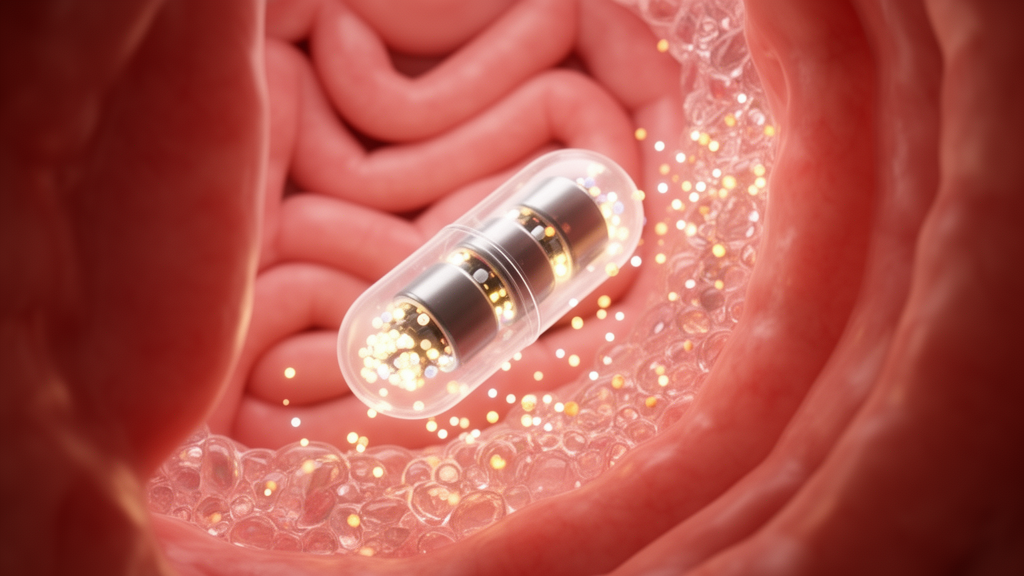
This approach offers a new paradigm for targeted oral delivery of biologics, shifting the process from passive transport to active, controlled administration. The SMB-bot integrates locomotion, drug loading, and mucosal interaction into a single spherical robotic platform. With a diameter of approximately 6.5 millimeters, the robot is small enough to be loaded into a commonly used size-00 capsule, facilitating easy oral ingestion.
The interior of the device contains a magnetically responsive skeleton that allows for external control. On the outer surface, microneedle-based drug delivery units are arranged to interact with the intestinal tissue. The microneedles on the robot’s surface feature a sophisticated core–shell structure designed to protect the payload and ensure controlled release.
The outer shell is composed of Eudragit L100-55, a polymer that helps protect the drug under gastric conditions. Inside the microneedle, the drug or active pharmaceutical ingredient is encapsulated together with a hyaluronic acid methacrylate hydrogel layer and a poly(vinyl alcohol) sealing layer containing gelatin and iron oxide. Once the robot reaches the intestine, an external magnetic field guides its movement toward the desired region.
Magnetic forces are used to bring the microneedles into contact with the intestinal mucosa and facilitate their insertion. This active control step distinguishes the SMB-bot from conventional carriers that rely solely on passive gastrointestinal transport. The researchers evaluated the motion of the SMB-bot under an external magnetic field and found that by adjusting the magnetic-field frequency, they could precisely control the robot’s movement speed.
At a fixed magnetic-field amplitude, the speed increased from approximately 25 to 180 millimeters per second, with the deviation between actual and theoretical trajectories remaining below five percent. The team also investigated the ability of the microneedles to establish contact with and penetrate tissue. Experiments using tissue-mimicking models and ex vivo tissue demonstrated that magnetic actuation could guide the robot toward the tissue surface.
The combined effects of magnetic force and gravity facilitated microneedle insertion into the mucosa. A critical feature of the system is its ability to prevent premature drug release in the stomach. Insulin-loaded SMB-bots were tested in simulated gastric fluid and then transferred to simulated intestinal fluid.
Under gastric conditions, drug release was strongly suppressed, ensuring that the payload remained intact until reaching the intestine. After entering the intestinal environment, release did not immediately reach its maximum but instead showed a delay before increasing substantially. In the experiments, release began to accelerate after approximately 20 minutes in intestinal fluid and then increased rapidly over the following period.
The researchers also demonstrated that the insulin loading capacity could be adjusted by modifying the microneedle structure. In porcine experiments, insulin delivered by the SMB-bot remained nearly undetectable during the first 20 minutes and then gradually increased, reaching a peak at approximately 80 minutes. By comparison, insulin levels rose earlier in the subcutaneous injection group.
These findings indicate that the system can shift part of the drug exposure toward later time points, producing a delayed and sustained delivery profile. The study combines biodegradable materials, magnetic actuation, and microneedle-based delivery into a miniature robotic platform capable of approaching the intestinal mucosa and releasing drugs locally. In vitro experiments and porcine studies demonstrated magnetic locomotion, mucosal insertion, and delayed drug delivery, providing preclinical evidence for a more actively controlled approach to oral biologic delivery.
However, the technology remains at an early preclinical stage. In the animal experiments, endoscopic and catheter assistance was used to deliver the robot to the target intestinal region. Therefore, the study does not yet demonstrate a fully autonomous process in which a swallowed capsule independently navigates to a deep intestinal target.
Long-term biodegradation in vivo, magnetic navigation in deeper intestinal regions, long-term mucosal safety, and reproducible large-scale manufacturing also require further investigation. Future studies will need to determine whether the platform can be adapted to biologics beyond insulin while improving navigation capability and manufacturing consistency. If these challenges can be addressed, a biodegradable miniature robot capable of moving, targeting, and releasing drugs could provide a more active and precise alternative to conventional oral drug-delivery systems.
Subject of Research: Targeted oral delivery of biologics using a biodegradable magnetic microrobot
Article Title: A tiny biodegradable robot that can “find its way” in the gut for targeted drug delivery
Article References: A tiny biodegradable robot that can “find its way” in the gut for targeted drug delivery. Original publication (Bibliographic details unavailable.)
Image Credits: AI Generated
DOI: Not provided
Keywords: drug delivery, microrobotics, biologics, oral administration, magnetic actuation, microneedles, intestinal targeting, biodegradable materials, insulin, preclinical research, tiny, biodegradable
News Source: Denise Maddox. (October 26, 2026). Magnetic Gut Robot Delays Biologic Release. Scienmag.