• HOME
  • NEWS
  • EXPLORE
    • CAREER
      • Companies
      • Jobs
    • EVENTS
    • iGEM
      • News
      • Team
    • PHOTOS
    • VIDEO
    • WIKI
  • BLOG
  • COMMUNITY
    • FACEBOOK
    • INSTAGRAM
    • TWITTER
Tuesday, October 27, 2026
BIOENGINEER.ORG
No Result
View All Result
  • Login
  • HOME
  • NEWS
  • EXPLORE
    • CAREER
      • Companies
      • Jobs
        • Lecturer
        • PhD Studentship
        • Postdoc
        • Research Assistant
    • EVENTS
    • iGEM
      • News
      • Team
    • PHOTOS
    • VIDEO
    • WIKI
  • BLOG
  • COMMUNITY
    • FACEBOOK
    • INSTAGRAM
    • TWITTER
No Result
View All Result
Bioengineer.org
No Result
View All Result
Home NEWS Science News Technology

Interpretable Linear Model Predicts Concrete Strength with 0.805 Cross-Validated R2

by
October 27, 2026
in Technology
Reading Time: 2 mins read
0
Interpretable Linear Model Predicts Concrete Strength with 0.805 Cross-Validated R2

Interpretable Linear Model Predicts Concrete Strength with 0.805 Cross-Validated R2

Share on FacebookShare on TwitterShare on LinkedinShare on RedditShare on Telegram

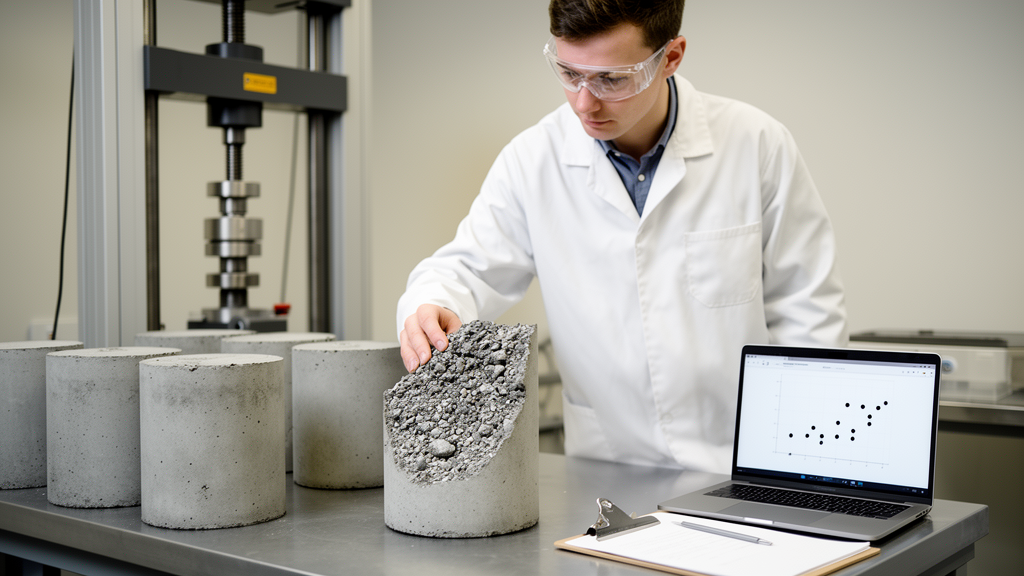
Concrete compressive strength is the backbone of quality control in civil engineering, yet the machine learning models that predict it most accurately often behave like black boxes. A new study published in Scientific Reports proposes a refreshingly simple alternative: an enhanced linear regression model that keeps the transparency of classical statistics while squeezing out accuracy close to that of far more complex ensembles. The work, led by Amir Sadeghi, builds on a publicly available dataset of 1,030 concrete mixtures.

Rather than feeding raw ingredient quantities into the model, the author restructured the variables. Cement, slag, and fly ash were combined into two physically meaningful descriptors: total binder content and the slag-to-binder ratio. The final model retained the water-to-cement ratio alongside superplasticizer and aggregate contents.

This parsimonious set of predictors achieved a full-data coefficient of determination, or R2, of 0.821, meaning the model explains roughly 82 percent of the variance in measured compressive strength across the dataset. The author used nested GroupKFold cross-validation, grouping folds by unique mixture design so that mixtures from the same design never appeared in both training and test sets. Under this rigorous scheme, the model achieved a mean outer-fold R2 of 0.805 with a standard deviation of 0.018, a root-mean-square error of 7.30 megapascals, and a mean absolute error of 5.62 megapascals.

Statistical diagnostics support the model's reliability. Multicollinearity was controlled, with a maximum variance inflation factor of 6.35 and a condition number of 4.97. All predictors were statistically significant at p less than 0.001, and the maximum Cook's distance was 0.0217, indicating that no single observation unduly influenced the fitted coefficients.

To benchmark performance, the study compared the linear model against two tuned ensemble methods: Random Forest and XGBoost. Under the same nested cross-validation, Random Forest reached an R2 of 0.884 and XGBoost 0.882. The ensembles are therefore more accurate, but their predictions cannot be decomposed into transparent, physically interpretable coefficients in the way a linear model can.

That trade-off is the central argument of the paper. For preliminary screening of mixture designs, an engineer may value a model whose coefficients can be read directly, showing how a change in water-to-cement ratio or slag fraction shifts the expected strength. The author positions the linear model as a transparent screening tool for preliminary strength estimation within the range of the studied dataset, not as a replacement for high-accuracy ensembles when maximum precision is required.

By grouping cross-validation folds by mixture design, the evaluation prevents information leakage between nearly identical mixes, producing error estimates that better reflect performance on genuinely new formulations.

Subject of Research: Interpretable linear regression modeling of concrete compressive strength prediction

Article Title: Practical prediction of concrete compressive strength using an interpretable enhanced linear regression model

Article References: Sadeghi, A. (2026). Practical prediction of concrete compressive strength using an interpretable enhanced linear regression model. Scientific Reports. https://doi.org/10.1038/s41598-026-77642-y

Image Credits: AI Generated

DOI: 10.1038/s41598-026-77642-y

Keywords: concrete, compressive strength, linear regression, machine learning, cross-validation, Random Forest, XGBoost, civil engineering, interpretability, quality control, Practical, prediction

News Source: Denise Maddox. (October 27, 2026). Interpretable Linear Model Predicts Concrete Strength with 0.805 Cross-Validated R2. Scienmag.


Tags: Civil Engineeringcompressive strengthconcretecross-validationinterpretabilitylinear regressionMachine LearningPracticalpredictionquality controlRandom ForestXGBoost
Share12Tweet7Share2ShareShareShare1

Related Posts

Quantum Annealing Meets PCA to Sharpen Carbon Emissions Predictions

Quantum Annealing Meets PCA to Sharpen Carbon Emissions Predictions

October 27, 2026
Australian smart bedding sensors that flag falls risk win US patent

Australian smart bedding sensors that flag falls risk win US patent

October 27, 2026

Quantized controller drives uncertain fractional-order neural networks into synchronization

October 27, 2026

Color and Fracture Mapping Yields First Quantitative Grade System for Dimension Stone Quarrying

October 27, 2026

POPULAR NEWS

  • Hundreds of spore-forming bacteria from Brazilian soils mapped in landmark phenotypic survey

    Hundreds of spore-forming bacteria from Brazilian soils mapped in landmark phenotypic survey

    29 shares
    Share 12 Tweet 7
  • Cryptogenic Organizing Pneumonia Shows Strong Survival but Relapses in Over 20% of Chinese Patients

    29 shares
    Share 12 Tweet 7
  • Liposome Treatment Keeps Lactococcus lactis Alive Longer in Storage

    29 shares
    Share 12 Tweet 7
  • Alpine summit blooms: Italian peak’s flora triples as warming lifts plants to record heights

    29 shares
    Share 12 Tweet 7

About

We bring you the latest biotechnology news from best research centers and universities around the world. Check our website.

Follow us

Recent News

Hundreds of spore-forming bacteria from Brazilian soils mapped in landmark phenotypic survey

Cryptogenic Organizing Pneumonia Shows Strong Survival but Relapses in Over 20% of Chinese Patients

Urban Rodents in Argentina Carry Diverse Cryptosporidium Species, Molecular Survey Finds

Subscribe to Blog via Email

Enter your email address to subscribe to this blog and receive notifications of new posts by email.

Join 85 other subscribers
  • Contact Us

Bioengineer.org © Copyright 2023 All Rights Reserved.

Welcome Back!

Login to your account below

Forgotten Password?

Retrieve your password

Please enter your username or email address to reset your password.

Log In
No Result
View All Result
  • Homepages
    • Home Page 1
    • Home Page 2
  • News
  • National
  • Business
  • Health
  • Lifestyle
  • Science

Bioengineer.org © Copyright 2023 All Rights Reserved.