A storage trick built from ordinary membrane fat could help one of biotechnology's workhorse bacteria survive the wait between production and use. In a study published in Applied Microbiology and Biotechnology, researchers report that suspending Lactococcus lactis cells with liposomes made of dimyristoylphosphatidylcholine (DMPC) markedly improved the bacteria's ability to form colonies after weeks of refrigerated and room-temperature storage. By day 28 at room temperature, treated suspensions contained 2.55 × 10⁵ colony-forming units per milliliter, while untreated controls had fallen to just 3.83 × 10¹ — a difference of nearly four orders of magnitude.
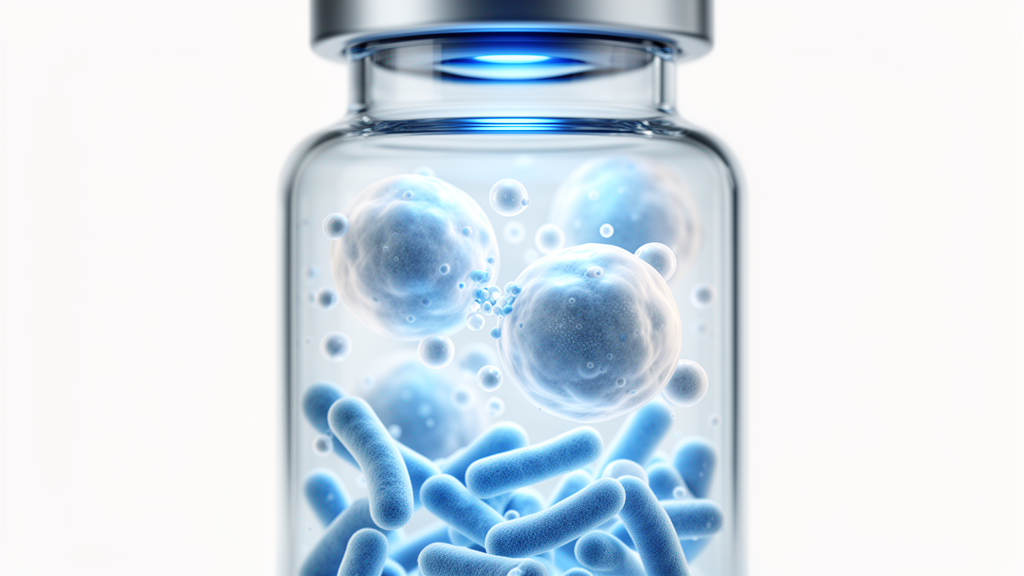
The team formed the liposomes by thin-film hydration in the presence of the bacterial cells, then stored the suspensions for 28 days at both 4 °C and room temperature. Cryogenic scanning electron microscopy revealed vesicular structures roughly 100 to 160 nanometers across, both in a DMPC-only sample and near cells in the treated suspensions. Notably, the imaging did not show a continuous coating around the bacteria, so the authors caution that the exact vesicle–cell interactions remain unresolved.
Size measurements pointed in the same direction. Optical density at 600 nanometers told a similar story early on: at room temperature on day 1, treated suspensions registered 0.99 versus 0.43 for the untreated samples, consistent with better-maintained turbidity in the treated cultures. Metabolic activity followed the same pattern before it, too, began to fade.
Measured by the reduction of the tetrazolium dye MTT, activity in treated suspensions at room temperature on day 1 reached 2.50 MTT-reducing units against 0.93 in the controls. That advantage subsequently declined, falling to 0.35 units in treated suspensions by day 14 — a reminder that liposome treatment slowed deterioration rather than halting it. Culturability, however, remained the clearest benefit: from day 7 onward, treated suspensions supported higher colony counts at both storage temperatures, with the largest relative gain seen at room temperature, where untreated bacteria lost viability fastest.
For microbial biotechnology, where maintaining culturability during storage is a persistent practical challenge, the findings suggest that phospholipid vesicle treatment is a promising, if not yet fully understood, preservation strategy. The authors emphasize that the protective effect was strongest during room-temperature storage and that the underlying interactions between DMPC vesicles and bacterial cells still need to be worked out before the approach can be optimized or scaled. As an early-access, peer-reviewed publication, the study's numbers are citable, but its interpretation — how nanoscale fat bubbles prop up a bacterium's ability to grow again — remains an open question for follow-up work.
Subject of Research: DMPC liposome treatment for improving the storage stability and culturability of Lactococcus lactis suspensions
Article Title: Dimyristoylphosphatidylcholine vesicle treatment enhances the storage stability and culturability of Lactococcus lactis suspensions
Article References: Burlaga, N., Grzywaczyk, A., Wojciechowska, O., & Kaczorek, E. (2026). Dimyristoylphosphatidylcholine vesicle treatment enhances the storage stability and culturability of Lactococcus lactis suspensions. Applied Microbiology and Biotechnology. https://doi.org/10.1007/s00253-026-14085-5
Image Credits: AI Generated
DOI: 10.1007/s00253-026-14085-5
Keywords: Lactococcus lactis, DMPC liposomes, storage stability, culturability, zeta potential, cryo-SEM, MTT assay, polydispersity, biopreservation, microbial biotechnology, Dimyristoylphosphatidylcholine, vesicle
News Source: Drew Townsend. (October 27, 2026). Liposome Treatment Keeps Lactococcus lactis Alive Longer in Storage. Scienmag.