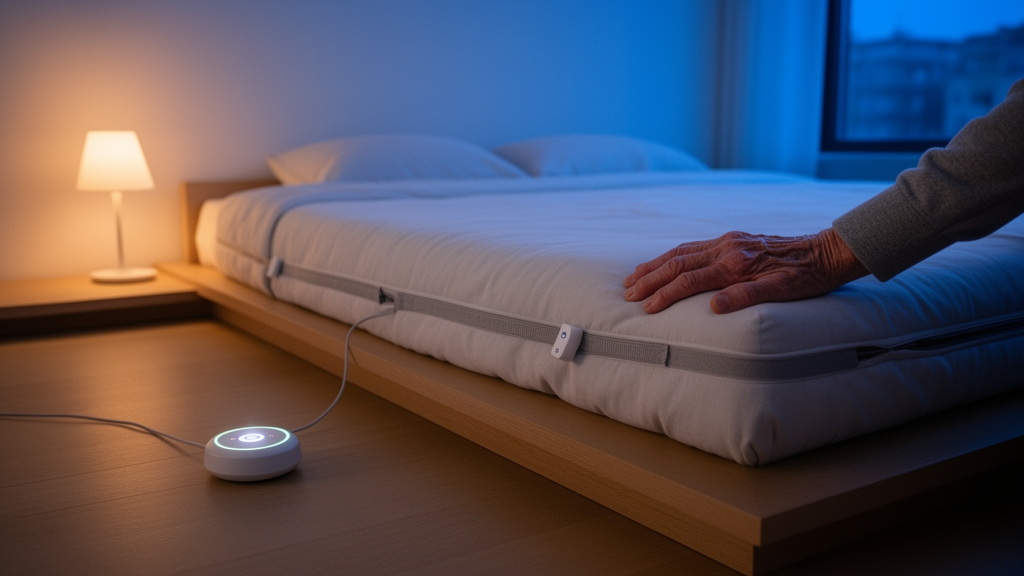
Australian medtech company Sleeptite and researchers at RMIT University have secured a US patent for smart bedding technology designed to monitor the wellbeing of residents in healthcare settings and identify the risk of falls so that carers can intervene before an injury occurs. The patented FlexiSense technology, which Sleeptite is developing for use with its REMi in-bed monitoring system, measures bed position and posture through soft, flexible electronics embedded in mattress protectors, and the company has now unveiled it at The MedTech Conference in Boston as part of an Australian trade delegation led by AUScelerate.
The US patent, granted this month under number US 12,761,092, covers both the design of the FlexiSense sensor and its manufacturing method. It follows an Australian provisional application lodged in 2020 and is the first to be granted from applications filed in ten jurisdictions worldwide. Sleeptite Founder and CEO Cameron van den Dungen said taking an idea from a provisional patent application to a granted US patent had taken years of persistence, noting that the United States Patent and Trademark Office does not grant patents on good intentions but on genuine novelty.
Underpinning the patent is a recent peer-reviewed study by RMIT and Sleeptite, published in the journal Flexible and Printed Electronics, which shows that the sensors can be manufactured using scalable production techniques while maintaining performance and durability. The paper, titled ‘Soft piezoresistive fabric-embedded pressure sensors for smart bedding for aged care applications’, describes sensors fabricated from silver and carbon ink printed on flexible polyurethane sheets, which detect changes in applied force through the material’s piezoresistive qualities.
Unlike camera-based monitoring systems or wearable devices, FlexiSense is built directly into mattress protectors, allowing residents to be monitored non-invasively without changing their daily routines. The sensors were designed by Distinguished Professor Madhu Bhaskaran, a multi-award-winning electronics engineer and Director of RMIT’s Discovery to Device MedTech Prototyping Facility, and her team, with the smart integration of the sensors into bedding systems outlined in the joint study.
Bhaskaran said the team’s focus on affordability from the outset was reflected not only in the product’s compatibility but also in its fabrication process. The sensors can be used across a wide range of mattress types, making the technology easier and more affordable to adopt. Through rigorous testing under a rollator machine, the ready-to-manufacture sensors demonstrated durability, sensitivity and robustness, accurately detecting body motion with minimal power consumption, according to the researchers.
The integration of the sensors into a wireless electronic module also enables continuous data monitoring and logging in the cloud. Bhaskaran described it as incredibly exciting to see the sensor developed in the laboratory move into the world to improve care for some of the most vulnerable people. The technology is designed to help care staff respond sooner to the risk of falls, with detection of pressure sore risk still in development.
Van den Dungen said the technology offered a cost-effective, scalable way to improve the quality of care throughout the night, whether in a care facility or in a person’s own home. Care workers cannot be in every room every minute of the night, he said, and the technology gives them an extra set of eyes without putting a camera in the room. It helps carers spot risks earlier so they can step in before a fall happens, and it gives the people in their care, and their families, real peace of mind, he added.
The patent’s coverage of the manufacturing method, not just the sensor’s function, carries commercial significance for the Australian company. Van den Dungen said it means Sleeptite can build its first production line in Melbourne and then replicate small-batch manufacturing close to customers in markets such as the United States, with the intellectual property and the know-how anchored in Australia. Not every small Australian deep tech company makes it to the end of that road, he said.
The collaboration began eight years ago with an Australian Government Cooperative Research Centre Project, bringing together experts in sensing technology, data analytics, healthcare and bedding manufacturing, and has involved manufacturing partner Sleepeezee Bedding Australia. The work rapidly progressed beyond the laboratory into a field trial at an aged care home, where six residents were monitored over more than 250 nights, generating more than 6,100 bed-hours of monitoring data. The partnership has since broadened into further joint projects, with Sleeptite and RMIT co-developing new applications using the Discovery to Device facility.
RMIT Deputy Vice-Chancellor Research and Innovation Distinguished Professor Calum Drummond AO said the collaboration was an example of RMIT’s commitment to working with industry to achieve impact, describing the project as focused on making a real difference in aged care through cutting-edge electronics invented at RMIT and demonstrating what long-term partnerships can achieve. The RMIT-Sleeptite partnership has won multiple awards, including Best Industry Collaboration at the 2021 Knowledge Commercialisation Australasia Awards, Digital Health & Health Tech Innovation of the Year at the 2022 InnovationAus Awards for Excellence, and two 2024 Australian Good Design Awards for the REMi smart bedding system. The study was published in Flexible and Printed Electronics on 6 August 2026, with the DOI 10.1088/2058-8585/ae8e8c.
Subject of Research: Flexible piezoresistive pressure sensors integrated into smart bedding for aged care falls-risk monitoring
Article Title: Australian smart bedding flags risk of falls, gains attention in the US
Article References: Australian smart bedding flags risk of falls, gains attention in the US. Original publication (Bibliographic details unavailable.)
Image Credits: AI Generated
DOI: Not provided
Keywords: smart bedding, falls risk, aged care, piezoresistive sensors, flexible electronics, US patent, RMIT University, Sleeptite, healthcare monitoring, printed sensors, medtech, Flexible and Printed Electronics
News Source: Denise Maddox. (October 26, 2026). Australian smart bedding sensors that flag falls risk win US patent. Scienmag.