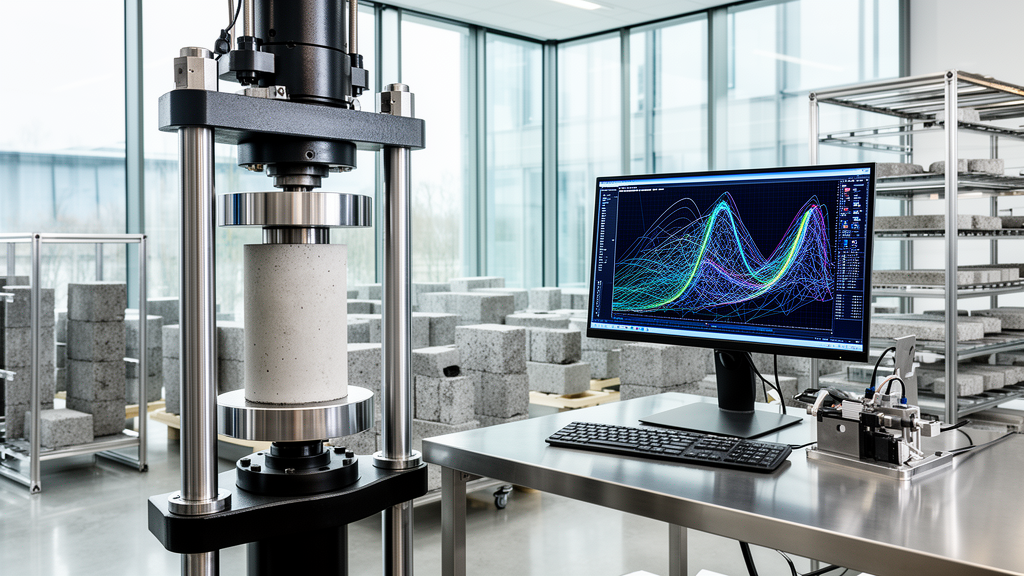
A research team has developed an advanced machine learning framework using Least Squares Boosting algorithms to simultaneously predict and optimize the compressive strength and carbon dioxide uptake of carbon dioxide-cured cementitious materials. The manufacturing of ordinary Portland cement represents a major contributor to global greenhouse gas emissions, generating approximately eight percent of worldwide carbon dioxide output. During standard clinker production, carbon dioxide release occurs through two primary operational pathways, encompassing the combustion of fossil fuels required to heat kilns to roughly 1450 degrees Celsius and the decarbonation decomposition of limestone, which alone accounts for nearly sixty percent of cement manufacturing emissions. In response to these significant environmental burdens, material scientists have focused on carbon dioxide curing technologies. This processing method exposes calcium silicate-based materials to controlled carbon dioxide environments, triggering accelerated carbonation reactions between calcium silicates, water, and gas. The resulting chemical reactions form calcium silicate hydrate and calcium carbonate phases, sequestering carbon while accelerating mechanical strength development within hours rather than the conventional twenty-eight-day water-curing timeframe.
Despite the recognized environmental and structural benefits of accelerated carbonation, predicting mechanical performance and carbon capture efficiency remains exceptionally difficult due to complex interactions among binder chemistry, mixture proportions, pre-conditioning environments, and curing variables. In ordinary Portland cement systems containing alite and beta-belite, traditional hydration generates calcium silicate hydrate alongside calcium hydroxide, whereas exposure to carbon dioxide-rich environments yields calcium silicate hydrate and stable calcium carbonate. Furthermore, non-hydraulic calcium silicates including gamma-belite, rankinite, and wollastonite can directly react with carbon dioxide to generate binding carbonate phases, offering a practical pathway to decrease reliance on ordinary Portland cement. To evaluate curing efficiency, researchers track compressive strength alongside carbon dioxide uptake, which is measured experimentally using thermogravimetric analysis, mass gain assessments, pressure monitoring, or elemental analysis. The theoretical upper limit for carbonation can be estimated through the Steinour formula based on binder oxide compositions. However, defining universal processing conditions has remained an elusive objective across civil engineering practice.
To overcome these predictive challenges, the investigators established a comprehensive literature-derived database gathered from fifteen published studies, compiling 423 datasets for compressive strength and 131 datasets for carbon dioxide uptake. The smaller volume of carbon uptake measurements reflected the necessity for specialized testing, specifically thermogravimetric analysis assessing mass loss caused by calcium carbonate decomposition. In this evaluation protocol, carbon dioxide uptake percentages were derived by comparing calcium carbonate contents against baseline control specimens relative to the total mass of binder used to manufacture each sample. Across the compiled literature database, compressive strength measurements exhibited a broad distribution with an overall average value of 31.7 megapascals. Conversely, carbon dioxide uptake values demonstrated a skewed profile averaging 9.5 percent, with the majority of observations concentrated below ten percent. Pearson correlation analyses indicated moderate interrelationships among selected variables, confirming that while multi-variable interactions existed, no severe multicollinearity undermined the utility of the dataset for empirical modeling.
The modeling architecture relied on Least Squares Boosting, an ensemble gradient boosting methodology that minimizes residual errors through the iterative refinement of weak learners, predominantly decision trees. Unlike alternative ensemble techniques such as Random Forest that construct individual trees using randomized feature subsets, the Least Squares Boosting implementation utilized the complete feature set across sequential weak learners to balance bias and variance while reducing inter-tree correlation. Prior to algorithm training, all input variables were scaled between zero and one via min-max normalization, and the database was randomly partitioned into an eighty percent training subset and a twenty percent testing subset in a MATLAB environment. The input parameters incorporated binder chemistry quantified through the Steinour formula, mixture ratios including water-to-binder and sand-to-binder proportions, pre-conditioning relative humidity and duration, carbon dioxide curing conditions including gas concentration, pressure, relative humidity, and exposure duration, as well as total curing age.
Hyperparameter optimization was systematically conducted across 420 distinct operational configurations to prevent predictive overfitting and ensure model generalizability across heterogeneous data. The investigators evaluated maximum split complexities set at three, five, and ten, minimum leaf sizes of one, three, and five, minimum parent sizes of two, five, and ten, learning cycles spanning 300 and 500 iterations, and learning rates varied between 0.1 and 1.0. Model performance was tracked across both targets using root-mean-square error, standard error deviations, and correlation coefficients visualized on contour plots and Taylor diagrams. The evaluations revealed that model precision was acutely sensitive to split complexity, leaf size, and learning rate. The optimal configuration converged at ten splits, a minimum leaf size of three, a minimum parent size of ten, 500 learning cycles, and a learning rate of 0.5, successfully achieving an equilibrium between iterative error minimization and generalizable algorithmic structure.
Under these fine-tuned hyperparameter specifications, the separate Least Squares Boosting models demonstrated strong predictive performance on unseen testing datasets, with correlation coefficients exceeding 0.95 for both targets. For compressive strength prediction, the model achieved a training root-mean-square error of 0.27 percent and a mean absolute percentage error of 1.0 percent, whereas testing performance yielded a root-mean-square error of 5.64 and a mean absolute percentage error of approximately 10.4 percent. The observable expansion between training and testing error metrics highlighted a recognized generalization gap inherent to models trained on heterogeneous literature databases. Mean absolute percentage errors could not be mathematically calculated for carbon uptake because the experimental records contained baseline samples with zero carbon uptake, rendering percentage denominator calculations infeasible.
Analysis of prediction residuals and squared error distributions provided deeper insight into model behavior across different parameter domains. For compressive strength evaluations, the training samples exhibited squared errors consistently below one, while testing specimens demonstrated minor error increases primarily within the medium-to-high strength ranges. The carbon dioxide uptake model exhibited extremely tight fitting during training, yielding squared errors frequently below 0.0001, but displayed broader residual fluctuations across independent testing data. These larger residual variations were concentrated in the high-uptake regions, reflecting the sparse and uneven distribution of experimental uptake literature spanning the wide zero to sixty percent range. Residual plots demonstrated that while predictive reliability remained strong across common experimental ranges, the scarcity of high-carbonation training examples introduced higher uncertainty when estimating extreme carbon sequestration values, emphasizing the need for future database expansion in elevated uptake domains.
The study determined relative variable significance using permutation-based feature importance assessments, measuring changes in mean square error across ten repeated permutation cycles. In the predictive model for compressive strength, accelerated curing parameters emerged as influential contributors, led by carbon dioxide concentration, relative humidity during curing, and total exposure duration. The availability of gaseous carbon dioxide and favorable moisture environments provided the essential kinetic driving forces required for accelerated carbonation and dense mineral precipitation, whereas mixture proportions and Steinour values exhibited comparatively lower normalized importance for strength prediction. Conversely, carbon dioxide uptake was heavily governed by the Steinour formula and overall curing age, followed by water-to-binder ratios and curing duration. The dominant importance of the Steinour calculation demonstrated that chemical carbonation potential, determined by reactive oxide composition within the binder matrix, dictates ultimate sequestration capacity, while carbon dioxide gas concentration exhibited a lower relative ranking due to penetration limitations and finite reactive calcium oxide reserves.
Using the trained machine learning models, the researchers conducted Monte Carlo simulation-based optimizations across one thousand randomly generated data points to identify practical curing conditions that maximize carbon sequestration in cement-fly ash blended mortars. The optimization examined mortar specimens at a water-to-binder ratio of 0.4 with fly ash replacement ratios of zero, twenty, and forty percent, designated as C10F0, C8F2, and C6F4, with sand-to-binder ratios adjusted to maintain a fixed sand volume fraction of 58 percent. Corresponding Steinour values ranged from 35.7 percent to 48.8 percent based on binder oxide compositions. Pre-curing relative humidity and duration were fixed at 99 percent and 24 hours, respectively, while carbon dioxide pressure was maintained at zero megapascals because pressure variations below 0.35 megapascals exert negligible effects. Curing durations were evaluated at 24, 48, and 72 hours, with target properties evaluated at 28 days.
The simulation results demonstrated that carbon curing for 24 hours yielded low carbon dioxide uptake regardless of gas concentration, humidity, or binder chemistry, but uptake increased substantially at 48 and 72 hours when gas concentrations exceeded ten percent and relative humidity remained above 60 percent. Maximum uptake levels reaching approximately 38.8 percent were predicted for C10F0 and C8F2, whereas C6F4 showed reduced sequestration due to lower quantities of reactive calcium components. Crucially, the simulations indicated that achieving peak carbon uptake does not require pure carbon dioxide environments; concentrations above approximately 15 percent combined with relative humidity between 60 and 70 percent supported elevated sequestration, with higher concentrations offering diminishing returns due to gas diffusion constraints. The authors emphasized that these optimization findings represent predictive model-based trends derived from literature data rather than universally validated experimental parameters, highlighting the necessity of targeted laboratory verification before implementing these curing thresholds across industrial precast manufacturing.
Subject of Research: Machine learning prediction and optimization of compressive strength and carbon dioxide uptake in carbon-cured cementitious materials
Article Title: Machine Learning-Based Prediction of Compressive Strength and CO2 Uptake in CO2-Cured Cementitious Materials
Article References: Han, S., Kim, J., Farrugia, K., Jun, H., Borg, R. P., Kim, J. H., & Yoon, J. (2026). Machine Learning-Based Prediction of Compressive Strength and CO2 Uptake in CO2-Cured Cementitious Materials. International Journal of Concrete Structures and Materials, 20(1), Article 86. https://doi.org/10.1186/s40069-026-00956-8
Image Credits: AI Generated
DOI: 10.1186/s40069-026-00956-8
Keywords: cementitious materials, carbon dioxide curing, machine learning, least squares boosting, compressive strength, carbon sequestration, Steinour formula, ordinary Portland cement, thermogravimetric analysis, fly ash mortar, accelerated carbonation, Monte Carlo simulation, calcium silicate hydrate, relative humidity, hyperparameter tuning, sustainable concrete, carbon capture
News Source: Teresa Odom. (November 19, 2026). Machine Learning Model Predicts Concrete Strength and Carbon Dioxide Uptake. Scienmag.