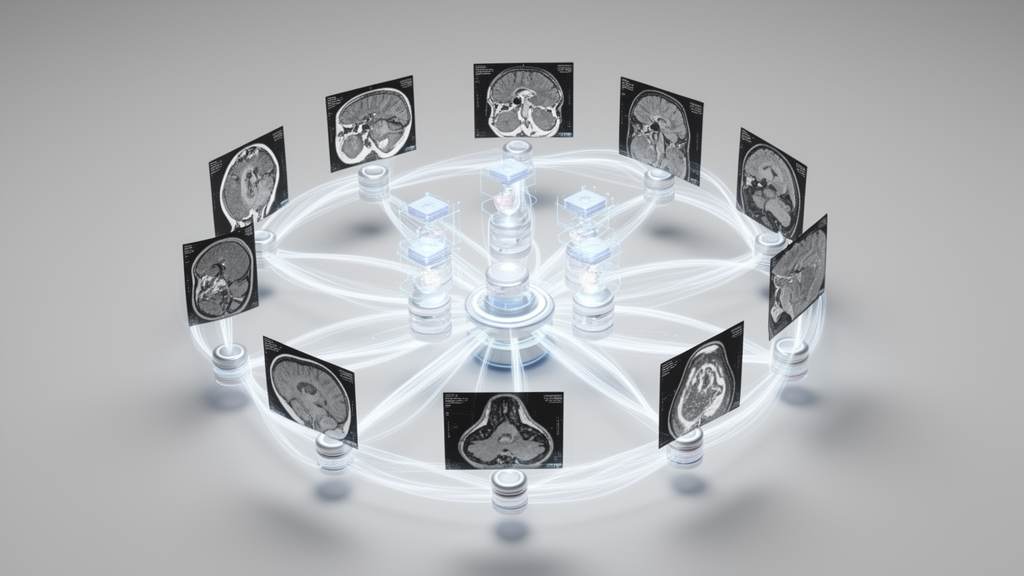
A distributed machine learning framework utilizing client-to-client co-distillation has demonstrated the ability to significantly mitigate the challenges of severe class imbalance in collaborative healthcare systems without requiring centralized model aggregation or the exchange of private patient data. Developed by researchers investigating federated learning across clinical institutions, the peer-to-peer methodology addresses the persistent tendency of diagnostic algorithms to develop substantial bias toward majority diagnostic categories when individual hospitals hold skewed medical imaging collections. By replacing the centralized aggregation of complete neural network parameters with a decentralized mechanism where participating client models mutually exchange probabilistic soft targets generated from their respective majority classes, the co-distillation architecture achieved superior minority class classification accuracy across extensive benchmark evaluations. Experimental evaluations conducted on real-world medical imaging datasets revealed that the co-distillation strategy consistently maintained high predictive fidelity under increasing data skew, outperforming conventional distributed baselines while recording the lowest standard deviation across repeated iterations.
Federated learning has gained substantial prominence across medical domains as an essential technical paradigm for training powerful computational models across distributed institutional repositories while strictly adhering to rigorous patient privacy mandates and regulatory data protections. Under conventional federated architectures, multiple hospital sites serve as individual clients that maintain local control over their proprietary diagnostic records, collaboratively training a shared predictive system by periodically communicating model parameters or weight updates to a centralized coordinating server. However, real-world deployment across clinical networks is frequently impeded by profound systemic heterogeneity arising from disparate institutional specializations, varying regional patient demographics, and inconsistent image acquisition protocols across care centers. Because specialized medical facilities naturally treat concentrated patient cohorts diagnosed with distinct conditions, individual hospital databases exhibit pronounced class imbalances where critical pathological states represent only a small minority of recorded cases. In such non-uniform operational environments, standard federated algorithms inevitably overfit dominant diagnostic categories, severely degrading classification performance on rare or underrepresented clinical conditions.
Addressing severe distribution skew within medical federated systems has traditionally prompted researchers to explore synthetic data generation methods, including Generative Adversarial Networks and the Synthetic Minority Over-sampling Technique, to synthetically augment deficient minority representation at local nodes. Despite algorithmic viability in controlled computational environments, the generation of artificial medical images introduces acute ethical concerns, clinical validation uncertainties, and risks of perpetuating synthetic artifacts within life-critical diagnostic tasks. Alternative federated strategies have explored meta-learning, localized client fine-tuning, support vector machine architectures, and conventional federated distillation protocols where student networks learn from centralized teacher ensembles. Previous federated distillation implementations typically aggregate feature representations across all participating clients regardless of whether an institution possesses substantive clinical expertise in a given diagnostic category, frequently diluting critical supervisory signals. Furthermore, conventional federated learning frameworks that repeatedly transmit comprehensive model parameter vectors incur massive communication overheads, creating substantial bandwidth bottlenecks that impede scalable, low-latency deployment across bandwidth-constrained hospital IT systems.
To overcome these structural impediments, the investigated co-distillation paradigm removes the requirement for a designated global aggregation server, establishing a fully collaborative peer-to-peer framework wherein client nodes iteratively share distilled knowledge directly with one another. Within this setting, each participating hospital node maintains a personalized local neural network initialized from a shared base architecture and independently classifies local validation data. Rather than relying on a centralized authority to compute weighted model parameter averages, the collaborative system treats every participating client as an autonomous student entity that actively solicits focused pedagogical guidance from peer institutions during each training epoch. Because participating healthcare centers inevitably harbor divergent caseload distributions, the co-distillation strategy strategically exploits natural institutional specialization by designating each client’s majority data distribution as its operational expertise class, allowing nodes with abundant diagnostic evidence for a specific medical condition to serve as informative instructional teachers for institutions lacking adequate representative cases.
The procedural mechanics governing the co-distillation training protocol operate through coordinated algorithms executed simultaneously across participating student and teacher nodes during each collaborative round. Every local student client independently selects a peer teacher node from the pool of available networked institutions using a uniform random sampling strategy, guaranteeing that all participating centers maintain an equal mathematical probability of providing instructional guidance. This uniform random selection mechanism purposefully fosters informational diversity, exposing student networks to varied empirical distributions and diverse feature spaces without requiring prior diagnostic performance tracking or centralized metadata registers. Upon establishing a connection, the inquiring student client formally requests instructional guidance specifically tied to the chosen teacher’s established expertise class. In response, the teacher node randomly samples a designated batch of training images from its dominant institutional class, computes the corresponding probabilistic output logits across those instances, and transmits only these probabilistic soft targets back to the student over the network.
Upon receiving the transmitted probabilistic targets, the student client executes localized knowledge distillation by computing comparative discrepancies between the received teacher logits and its own internal predictions across identical diagnostic classes. Mathematically, the local optimization objective combines a primary Cross-Entropy loss, which measures predictive divergence against localized ground-truth labels, with a supplementary distillation loss computed as the Mean Squared Error between the student’s internal logits and the soft targets supplied by the expert teacher node. This distillation penalty is scaled by a specialized co-distillation hyperparameter coefficient before the composite objective is backpropagated to update the student’s local network parameters. By transferring continuous probabilistic soft labels rather than discrete hard indicators, the framework delivers nuanced, smoothed supervisory signals that prevent local parameters from collapsing into majority-class overconfidence, substantially improving generalization over minority categories while drastically diminishing communication payloads by transmitting compact numerical vectors instead of voluminous neural weights or raw medical images.
The diagnostic efficacy of the co-distillation framework was comprehensively verified using two extensive, publicly recognized real-world clinical imaging collections: the APTOS diabetic retinopathy benchmark and the COVID-19 Radiography database. The APTOS collection encompasses 5,590 retinal fundus images spanning varying operational resolutions, originally distributed across five clinical severity grades ranging from healthy ocular baselines to advanced proliferative stages. For experimental standardization, the researchers consolidated the four diabetic retinopathy grades into an aggregated disease class, structuring a rigorous binary classification setup with training subsets ranging from 200 to 600 images per class and an independent testing corpus of 1,300 normal and 1,300 pathological samples. The COVID-19 Radiography collection comprises 33,920 chest X-ray scans with a native resolution of 299 by 299 pixels, encompassing 11,956 confirmed viral cases, 11,263 non-COVID viral or bacterial pneumonia presentations, and 10,701 normal radiographs, which the team consolidated into a binary diseased versus non-diseased diagnostic task with training sets spanning 50 to 200 images per class and a test set of 2,100 instances per category.
To rigorously standardize computational modeling across heterogeneous image inputs, all radiological and retinal samples were systematically downsampled and converted into grayscale representations with uniform dimensions of 200 by 200 pixels. Local neural network architectures were constructed utilizing the established LeNet-5 convolutional framework, configuring the penultimate layer to output a consistent feature dimension of 200 units to ensure reproducible latent representations across nodes. Model training proceeded across 100 complete epochs, with client nodes exchanging localized feature logits during every computational cycle to facilitate active co-distillation. The controlled experimental design divided institutional clients into balanced global coalitions, assigning half the network to hold condition A as their dominant majority class while the remaining institutions maintained condition B as their dominant majority, subsequently applying synthetic skew levels of zero, twenty, forty, and sixty percent to systematically evaluate minority-class degradation across four-client and six-client architectural topologies.
Across all evaluated operational environments, the co-distillation approach exhibited exceptional resilience against escalating data skew, consistently surpassing established baseline algorithms including Federated Averaging, Federated Attentive Message Passing, Federated Prototype Learning, and traditional Federated Distillation. In four-client APTOS evaluations, co-distillation maintained superior minority-class classification accuracy across almost every progressive skew threshold, achieving an exceptionally tight standard deviation of 0.06 across repeated independent experimental iterations. When tested on the COVID-19 radiography dataset across four clients, the framework surpassed all comparative baselines across every tested imbalance level while recording a minimal standard deviation of 0.03. Scaling the institutional network to six independent clients yielded congruent outcomes, with co-distillation maintaining peak accuracy across severe skews while generating standard deviations of 0.03 for APTOS and 0.10 for COVID-19, in stark contrast to conventional Federated Averaging architectures which suffered catastrophic performance collapse, dropping toward near-zero minority-class classification accuracy under sixty percent skew conditions.
The investigative team further scrutinized algorithmic behavior within strictly resource-constrained operational settings characterized by extreme scarcity in total labeled medical training imagery alongside sixty percent diagnostic imbalance. In these data-limited regimes, defined by 200 training images per class for APTOS and 50 images per class for COVID-19, co-distillation demonstrated remarkable stability, sustaining accuracy marks of 85.9 percent on APTOS and 19.3 percent on COVID-19, whereas competing federated baselines exhibited precipitous diagnostic degradation. Notwithstanding these empirical strengths, the authors identified inherent structural limitations, noting that the peer-to-peer framework exhibits degraded efficacy if specific clinical classes are universally absent across all participating institutions, as no node can provide expert supervisory targets. Furthermore, peer-to-peer exchanges introduce modest point-to-point network transactions, and the current empirical validation focused primarily on binary diagnostic classifications, highlighting the necessity for future investigations to expand the co-distillation methodology toward complex multi-class clinical topologies and environments exhibiting severe label noise.
Subject of Research: Decentralized co-distillation federated learning for class-imbalanced medical image classification
Article Title: Framework for co-distillation driven federated learning to address class imbalance in healthcare
Article References: Racha, S., Gupta, S., Firdowse, H., Solanki, A., Ramakrishnan, G., & Jadhav, K. S. (2025). Framework for co-distillation driven federated learning to address class imbalance in healthcare. Discover Data, 3(1), Article 39. https://doi.org/10.1007/s44248-025-00079-7
Image Credits: AI Generated
DOI: 10.1007/s44248-025-00079-7
Keywords: federated learning, co-distillation, class imbalance, healthcare machine learning, medical image analysis, knowledge distillation, decentralized learning, soft labels, diabetic retinopathy, COVID-19 radiography, data heterogeneity, client collaboration, privacy-preserving AI, LeNet5 architecture, minority class prediction, logits exchange, distributed deep learning
News Source: Veronica Carney. (November 19, 2026). Co-Distillation Federated Learning Framework Mitigates Class Imbalance in Medical Image Analysis. Scienmag.