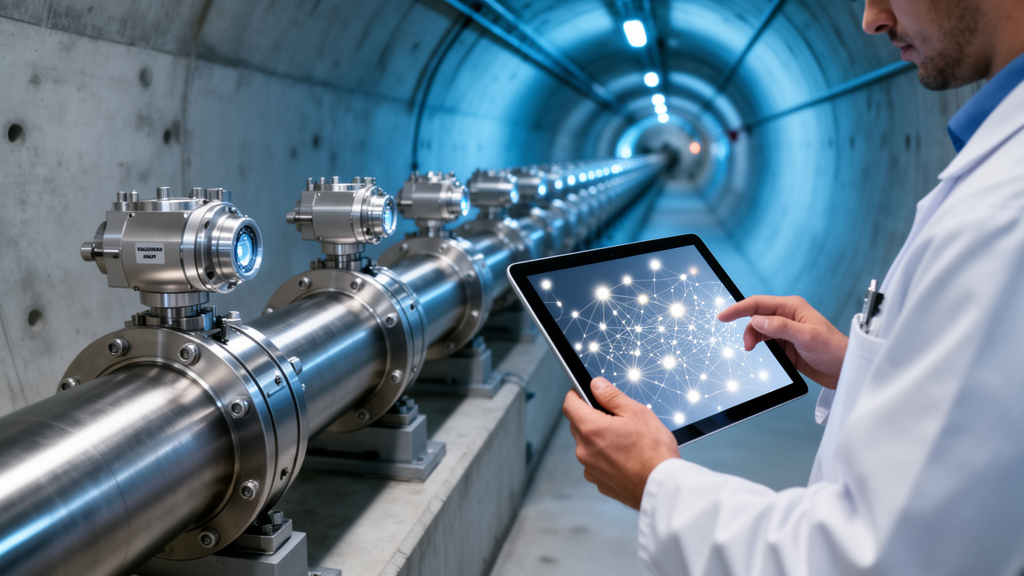
Inside the SuperKEKB particle collider in Japan, hundreds of beam position monitors trace the path of colliding beams turn by turn, and a handful of them are quietly broken. Researchers have now shown that two unsupervised machine-learning methods, which require no labelled training examples at all, can pick out these faulty sensors from raw turn-by-turn data with a reliability that matches the manual catalogues maintained by accelerator operators. The work, published in EPJ Research Infrastructures, was carried out by Quentin Bruant, Charles Ndung’u Ndegwa, Barbara Dalena, Francesca Bugiotti and Valerie Gautard, and it targets a scaling problem that will only grow as future colliders multiply the number of monitors in circulation.
Turn-by-turn beam position monitors, or TbT-BPMs, are the primary diagnostic tool for optics measurement and correction in high-luminosity colliders. Each monitor carries two or four electrodes that couple to the electromagnetic fields of the passing beam and generate electrical signals, from which the beam centroid’s position can be reconstructed at every turn. Reliable identification of faulty sensors is essential for any optics reconstruction pipeline, yet manual inspection does not scale to the hundreds of monitors in current rings or the thousands expected in future machines such as the Future Circular Collider. The main rings of SuperKEKB comprise around 900 quadrupole magnets, each associated with a four-electrode BPM for precise orbit control, and 138 of these monitors are designed to process turn-by-turn measurements, 68 in the High Energy Ring and 70 in the Low Energy Ring.
These turn-by-turn monitors are not the primary BPM system used to operate the machine, so their performance is not continuously monitored, and the list of malfunctioning BPMs provided by the operations team is not exhaustive. The quality of the data they produce is degraded by two major factors: faulty sensors and background noise. In the pipeline optimised for the Large Hadron Collider, faulty BPMs are commonly identified by a manual threshold applied to ensure the signal lies within the accelerator chamber’s physical range, and white noise is reduced using singular value decomposition. The complex and highly non-linear optics of SuperKEKB make such classical linear methods insufficient there, which is why the team explored adding machine-learning techniques to the existing pipeline.
The study compared two unsupervised algorithms on about 500 data files recorded during SuperKEKB commissioning and operation in 2024. Each file contains either 68 times 2 or 70 times 2 one-dimensional time series, corresponding to the horizontal and vertical beam centroid positions over 1000 or 4096 turns depending on the measurement. The first method applies density-based spatial clustering of applications with noise, DBSCAN, to a compact set of statistical features of each signal. Rather than choosing features in advance, the team computed more than 200 initial statistical features for each run and selected them automatically a posteriori through the Time2Feat library, using Principal Feature Analysis with a threshold set at 90 percent of the total variance of the BPM vectors. A separate analysis was conducted for each transverse plane, and a BPM was deemed anomalous if it was flagged in either plane.
DBSCAN was run in a one-versus-all manner, assuming that the main distribution of BPM vectors in feature space represents functioning monitors and that the outliers are the anomalous ones. The clustering distance parameter epsilon was tuned by grid search on simulated datasets generated with single-particle tracking through the model lattice, to which Gaussian noise and injected errors such as random spikes, removed signals and partial zero-masks were added. The tests on real data used epsilon values of 7.5 and 8.25 for the HER, corresponding to the best F1-score at two different beam excitation amplitudes, and 7.25 for the LER. A notable strength of the method is that it can judge a monitor measurement by measurement, which matters because some SuperKEKB TbT-BPMs appear problematic only during particular measurement sessions.
The second method is a one-dimensional convolutional autoencoder that operates directly on the raw waveforms. An undercomplete autoencoder maps each input signal to a compressed latent representation and reconstructs it from that representation alone, and the model is trained on all available BPM waveforms with no fault labels at any stage of training. Because faulty monitors are a small minority of the ring population, five of 68 in the HER and six of 70 in the LER, the model is dominated by the pattern of normal betatron waveforms, and a faulty BPM whose waveform deviates from that majority pattern incurs a large reconstruction error. A functioning monitor produces a smoothly decaying oscillation that falls exponentially over hundreds of turns, while a damaged one typically shows elevated background noise, dropouts or uneven wave heights, differences that convolutional filters can spot directly from the raw signal without any spectral transformation.
The HER model trained on 4623 waveforms from 69 files with roughly 110,000 parameters, and its mean squared error fell from 0.34 to 0.0035 over 50 epochs. The LER model, trained on a smaller set of 910 tracks from 13 files, applies batch normalisation and a tighter bottleneck, and its final validation loss was about 40 times the HER plateau, reflecting the greater diversity of beam dynamics in that ring. During inference, reconstruction errors are Z-score normalised within each measurement session, so a monitor is judged against the rest of its own ring rather than against a fixed threshold, and the monitors are then ranked by how often they appear among the highest-scoring outliers across sessions.
Evaluated against the reference list of hardware-damaged BPMs provided by the SuperKEKB operations team, the two methods returned strikingly similar results. On the High Energy Ring, both DBSCAN and the autoencoder detected five of the six known faulty monitors, achieving a recall of 83 percent, a precision of 56 percent and an F1-score of 67 percent when read at the same reporting depth of nine detections. Both methods missed the same single monitor, MQD3E23, which the authors say provides insight into the intermittent nature of hardware failures under specific machine conditions. On the Low Energy Ring, both methods recovered all six known-faulty BPMs across sixteen detections, giving 100 percent recall, 38 percent precision and an F1-score of 55 percent. The precision figures are bounded above by the ratio of the reference-list size to the reporting depth, and the authors stress they are lower limits for a crucial reason: the reference list itself is incomplete.
Because a monitor flagged by the methods but absent from the list is not necessarily a false positive, the team counted any monitor returned independently by both methods as likely faulty, reasoning that two methods with so little in common are unlikely to share an artefact. Nine such monitors emerged: MQEAE25 in the HER, and MQEAP33, MQD3P29, MQEAP32, MQN6OP, MQD3P21, MQC1LP, MQEAP44 and MQEAP30 in the LER. The authors inspected the turn-by-turn profiles of five of these and found that none behaved like a healthy monitor, with the expected amplitude decay from physical damping absent, signal amplitudes mismatched to healthy sensors, or amplitudes implying positions outside the beam chamber. If these nine were added to the reference list, the LER figures would rise to 88 percent precision and a 93 percent F1-score, and the HER figures to 67 percent precision and a 75 percent F1-score, although the authors do not claim these higher values as results, since only a hardware inspection can confirm the faults. The autoencoder also offers a practical speed advantage: DBSCAN needs roughly 20 minutes per ring per session because of its exhaustive feature extraction, while inference with the trained autoencoder takes seconds, with a one-time training cost of a few minutes. The authors present the framework as a scalable, low-latency roadmap for processing the thousands of monitors required for 100-kilometre-scale rings like the Future Circular Collider, and they argue that automated diagnostics already offer a more rigorous assessment of instrument health than manual catalogues.
Subject of Research: Unsupervised machine learning for detecting faulty beam position monitors at SuperKEKB
Article Title: Unsupervised Machine Learning for Anomaly Detection in Beam Position Monitors Data
Article References: Bruant, Q., Ndegwa, C. N., Dalena, B., Bugiotti, F., & Gautard, V. (2026). Unsupervised Machine Learning for Anomaly Detection in Beam Position Monitors Data. EPJ Research Infrastructures, 10(1), Article 31. https://doi.org/10.1007/s41781-026-00187-2
Image Credits: AI Generated
DOI: 10.1007/s41781-026-00187-2
Keywords: SuperKEKB, beam position monitors, anomaly detection, unsupervised machine learning, DBSCAN, autoencoder, particle accelerators, Future Circular Collider, optics reconstruction, fault detection, turn-by-turn data, HER and LER
News Source: Teresa Odom. (October 28, 2026). Machine Learning Finds Faulty Accelerator Sensors Without Any Labels. Scienmag.