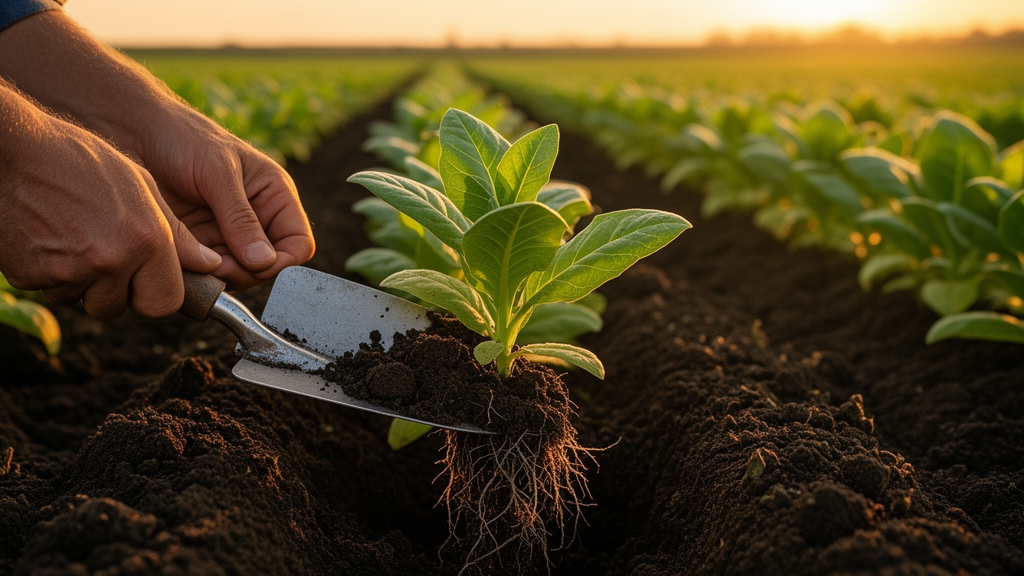
Flue-cured tobacco fields in Guizhou, China, have long received more nitrogen fertilizer than they need, a practice that degrades soil fertility and undermines leaf quality. A new two-factor field experiment published in Annals of Microbiology reports that pairing a reduced nitrogen rate of 121.5 kilograms per hectare with a technique called duckbill transplanting can reshape the rhizosphere soil environment, restructure the microbial community living around the roots, and improve the chemical composition of the cured leaves. The study used the widely grown cultivar Yunyan 87 and tested three nitrogen application rates against five transplanting methods, then analyzed the results with high-throughput sequencing of rhizosphere soil.
The sequencing effort identified 34 bacterial phyla and 13 fungal phyla in the rhizosphere. Proteobacteria emerged as the dominant bacterial phylum, while Ascomycota dominated the fungal community. Across treatments, both nitrogen rate and transplanting method significantly affected soil physicochemical properties. The combination of duckbill transplanting with low nitrogen application maintained the highest soil organic matter and available potassium contents, suggesting that the two practices interact rather than acting independently.
One of the most striking findings concerned nitrogen-cycling microorganisms. The same treatment also altered the relative abundance of dominant genera including Sphingomonas, Pseudomonas, Botryotrichum, and Mortierella. LEfSe analysis, a method used to identify biomarkers that distinguish groups, revealed distinct microbial signatures among the treatments: Sphingomonas and the family Sphingomonadaceae were significantly enriched under low nitrogen, whereas specific fungal taxa, including Agaricomycetes, served as indicators of certain transplanting regimes.
The researchers then connected these below-ground shifts to above-ground outcomes. Tobacco leaf chemical components were optimized under the treatment designated N1T3, which corresponds to the 121.5 kilograms per hectare nitrogen rate combined with duckbill transplanting. Pearson correlation analysis showed close linkages among key rhizosphere microbes, soil properties, and tobacco quality indices, indicating that the leaf chemistry improvements tracked changes in the soil microbial community and its environment rather than occurring independently of them.
The authors frame the reduced-nitrogen strategy as environmentally sustainable, arguing that it provides a scientific basis for greener tobacco cultivation. Because the work is a single two-factor field experiment on one cultivar in one tobacco-producing region, the findings are most directly applicable to conditions similar to those of Guizhou, and the reported relationships are correlational rather than demonstrations of direct causal mechanisms. The article was published as an open-access original article on 9 September 2026 and is currently shared as an accepted manuscript that will be replaced by the final version of record.
Subject of Research: Effects of nitrogen application rates and transplanting methods on rhizosphere soil properties, microbial communities, and leaf quality of flue-cured tobacco
Article Title: Nitrogen application rate and transplanting regime shape rhizosphere soil microenvironment, microbial community and leaf quality of flue‑cured tobacco
Article References: Cui, K., Wu, F., Shao, H., Qiu, K., Li, D., Song, Z., & Han, D. (2026). Nitrogen application rate and transplanting regime shape rhizosphere soil microenvironment, microbial community and leaf quality of flue‑cured tobacco. Annals of Microbiology. https://doi.org/10.1186/s13213-026-01873-7
Image Credits: AI Generated
DOI: 10.1186/s13213-026-01873-7
Keywords: flue-cured tobacco, rhizosphere microbiome, nitrogen fertilizer, duckbill transplanting, soil organic matter, Nitrospira, Nitrosomonas, Proteobacteria, Ascomycota, leaf quality, Guizhou, sustainable agriculture
News Source: Drew Townsend. (October 29, 2026). Lower Nitrogen and Duckbill Transplanting Boost Tobacco Rhizosphere Microbes and Leaf Quality. Scienmag.