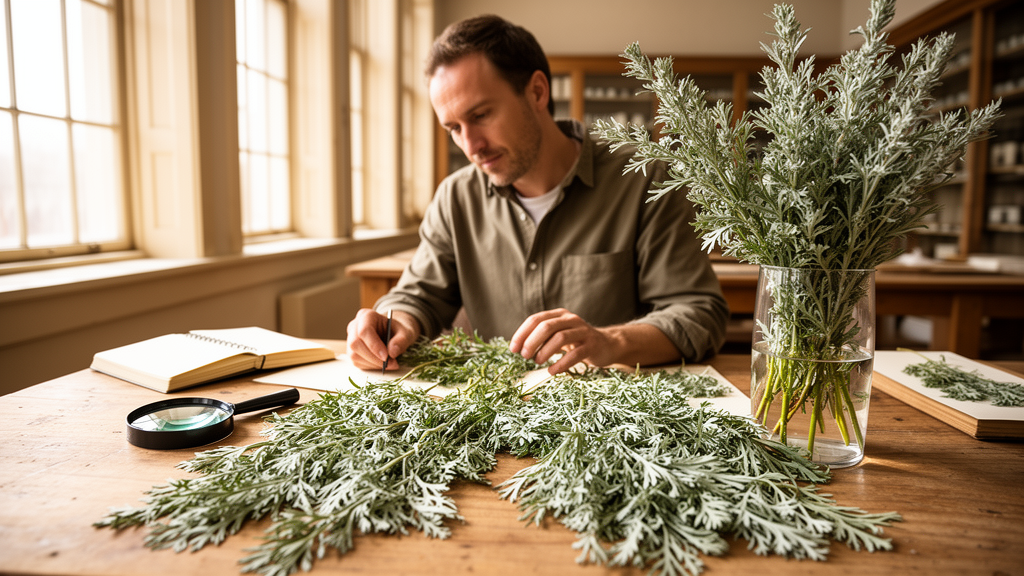
The wormwood genus Artemisia, a group of roughly 500 species of aromatic herbs, subshrubs, and shrubs with major medicinal and ecological importance, has just had a small but consequential piece of its taxonomic housekeeping completed. In the first installment of a planned series of nomenclatural notes, botanists have designated lectotypes for five species names within the subgenus Ponticae—Artemisia afra, A. brachyloba, A. mesatlantica, A. persica, and A. subspinescens—and corrected an error in the holotype citation of A. aksaiensis. These actions stabilize the scientific application of the names and lay groundwork for a full revision of the subgenus.
The problem these fixes address is historical rather than biological. Many Artemisia species were described in the eighteenth and nineteenth centuries, long before botanists adopted the type concept—the principle that each species name is permanently anchored to a single physical specimen. Because no type was indicated in the original publications of the five Ponticae names, the names could in principle drift between different interpretations. Under the International Code of Nomenclature for algae, fungi, and plants (the Madrid Code), a lectotype chosen from the original material fixes that anchor point once and for all.
The research team examined type and original material specimens physically or as digital images across more than twenty herbaria, including A, B, BM, G, K, LE, P, PE, RAB, and others, and cross-checked bibliographic citations against nomenclatural databases such as IPNI and Tropicos. Images of each newly designated lectotype are published directly in the paper, making the choices verifiable by any researcher with an internet connection.
The first name treated, Artemisia afra, is the familiar African wormwood, still accepted as a distinct species. It was proposed by N.J. von Jacquin and validly published by C.L. Willdenow in 1803 with a formal description, a German vernacular name, and the locality “Cap. b. spei?”—the question mark reflecting Willdenow’s uncertainty about the exact locality. The protologue also bears the annotation “(v. v.)” (vidi vivam), meaning Willdenow had seen living plants. No specimen was cited, so the lectotype had to be chosen from original material.
Only two original specimens could be located: B-W-15325-01 0 in the Willdenow herbarium at Berlin and HBG0504025 at Hamburg. The Willdenow herbarium was acquired in its entirety by the Berlin Herbarium in 1818 and, remarkably, survived the 1943 fire that destroyed much of the collection. The Berlin specimen bears the annotation “Van der Schott. W.”, confirming it came from Richard van der Schot, who worked alongside Jacquin at the Imperial Gardens of Schönbrunn—the likely source of the living plants Willdenow observed. Its habit, leaf morphology, indumentum, inflorescence, and involucre all match the protologue, and it is a well-developed, complete plant. The Hamburg specimen, separated later into Schlechtendal’s personal collection, is smaller, bears fewer capitula, and lacks the original Willdenow label. B-W-15325-01 0 was therefore designated the lectotype, with the Hamburg duplicate treated as an isolectotype.
The second typification concerns Artemisia brachyloba, described by Franchet in 1883 from material collected in China by the French missionary and naturalist Armand David. The protologue cited two gatherings—”environs de Pékin” (collection number 560) and “Si-wan” from September 1862—making both syntypes under the Code. The Si-wan locality corresponds to Xiwanzi, now in Chongli District, Zhangjiakou, Hebei Province, a historic Catholic mission station just north of the Great Wall. Specimen P00852268 at Paris bears the collector’s number 560, a complete label, and morphological characters—bipinnatisect leaves densely whitish-canescent beneath, hemispherical subnutant capitula, and lanate outer involucral bracts—that agree in detail with the original description. It was chosen as lectotype; the second Paris specimen, P00852269, which lacks an explicit collector’s number, remains a syntype.
Artemisia mesatlantica, described by Maire in 1928 from Morocco, presented a richer puzzle. The protologue cited four collecting expeditions across the Middle and High Atlas and stated that types were deposited at Algiers and Rabat, but named no holotype. Maire’s specimens were transferred from Algiers to Montpellier in the 1960s, with duplicates in Rabat and Paris, and the authors located eleven specimens of original material spanning seven gatherings covering all four expeditions. They selected RAB001242, gathered on Mount Erdouz in the High Atlas at 2,200 meters in July 1925, because its woody rhizome, leaf morphology, and indumentum are the best preserved among the syntypes, and because Rabat was one of the two institutions Maire himself designated for type deposition. Specimen MPU038183, an exact duplicate of the same gathering, becomes an isolectotype; the remaining nine specimens stay as syntypes.
The two remaining names trace back to the same remarkable episode in botanical commerce. Between 1841 and 1843, the collector Theodor Kotschy ranged extensively through Iran, and his specimens were organized and sold commercially by the Esslingen plant dealer R.F. Hohenacker, with identifications supplied by the Swiss botanist Pierre Edmond Boissier. This set was intended for sale rather than as a standard exsiccata, placing it in the category of gray literature taxonomically—yet the printed labels carried short diagnoses, which satisfied the requirements for valid publication. Artemisia persica was thus validly published in 1845 on the printed label of specimen number 630, citing a locality on Kuh-e Dena in the central Zagros, predating Boissier’s later 1846 monograph treatment.
Because Kotschy’s sets were distributed commercially, duplicates of number 630 ended up in some nineteen herbaria worldwide. The lectotype chosen, G00764808, sits in Boissier’s personal herbarium at Geneva and bears both the printed label constituting the protologue and a handwritten label; its 2–3-pinnatisect leaves and remote, non-spicate capitula match the diagnosis exactly. All other duplicates become isolectotypes. Its counterpart, Artemisia subspinescens, published by Boissier in 1846 from Kotschy number 782, collected at Cheshmeh Piaz on Kuh-e Dena, received the same treatment: Geneva specimen G00764811, explicitly annotated “n. sp.” and fully agreeing with the protologue, was designated lectotype, while a deviating, fragmentary duplicate gathering remains a syntype. Notably, while A. persica is currently accepted as a distinct species, A. subspinescens is today treated as a synonym of A. persica—so the lectotypification secures a name that now serves the older species.
The final correction resolved a typographical slip with real consequences. In his 1985 protologue of Artemisia aksaiensis, from Aksai in Gansu Province, China, Y.R. Ling cited the type as “G.L.Chang 1562, PE.” But the specimen numbered 1562 at the herbarium of the Institute of Botany in Beijing turned out to be a grass, Stipa tianschanica. A second specimen, numbered 1563, was collected at the same locality on the same date in August 1963 by the Hexi Expedition Team, of which G.L. Chang was a member; it matches the protologue completely and bears Ling’s own identification label. Since the two specimens differ only in the final digit of the collection number, “1562” was evidently a typographical error for “1563.” Under Article 9.2 of the Madrid Code, such an error does not invalidate the type designation, so G.L. Chang 1563 at PE stands as the intended holotype, with a duplicate at LZU as isotype. With these five lectotypes fixed and one citation corrected, the authors can now proceed with the taxonomic revision of subg. Ponticae—a subgenus of 23 species, mainly of temperate Eurasia with a few in Africa, diagnosed by its shrubby habit, strongly aromatic foliage, finely divided leaves, and ribless achenes—while follow-up nomenclatural work on the genus’s other subgenera is already underway.
Subject of Research: Typification of five Artemisia subg. Ponticae species names and correction of a holotype citation
Article Title: Notes on the nomenclature of Artemisia (I): A. subg. Ponticae ( Asteraceae )
Article References: Liu, Y., Seregin, A. P., Niu, G., Zhu, D., Leostrin, A., Krivenko, D. A., Jiao, B., & Gao, T. (2026). Notes on the nomenclature of Artemisia (I): A. subg. Ponticae (Asteraceae). PhytoKeys, 281, 23-37. https://doi.org/10.3897/phytokeys.281.210520
Image Credits: AI Generated
DOI: 10.3897/phytokeys.281.210520
Keywords: Artemisia, nomenclature, lectotypification, Asteraceae, herbarium specimens, Madrid Code, taxonomy, Artemisia afra, Artemisia persica, holotype correction, botanical history, subg. Ponticae
News Source: Drew Townsend. (October 29, 2026). Botanists Fix Two Centuries of Naming Confusion in the Wormwood Genus Artemisia. Scienmag.