Eurac Research is leading a €15 million European project that will build innovative district heating networks and study business models to manage them.
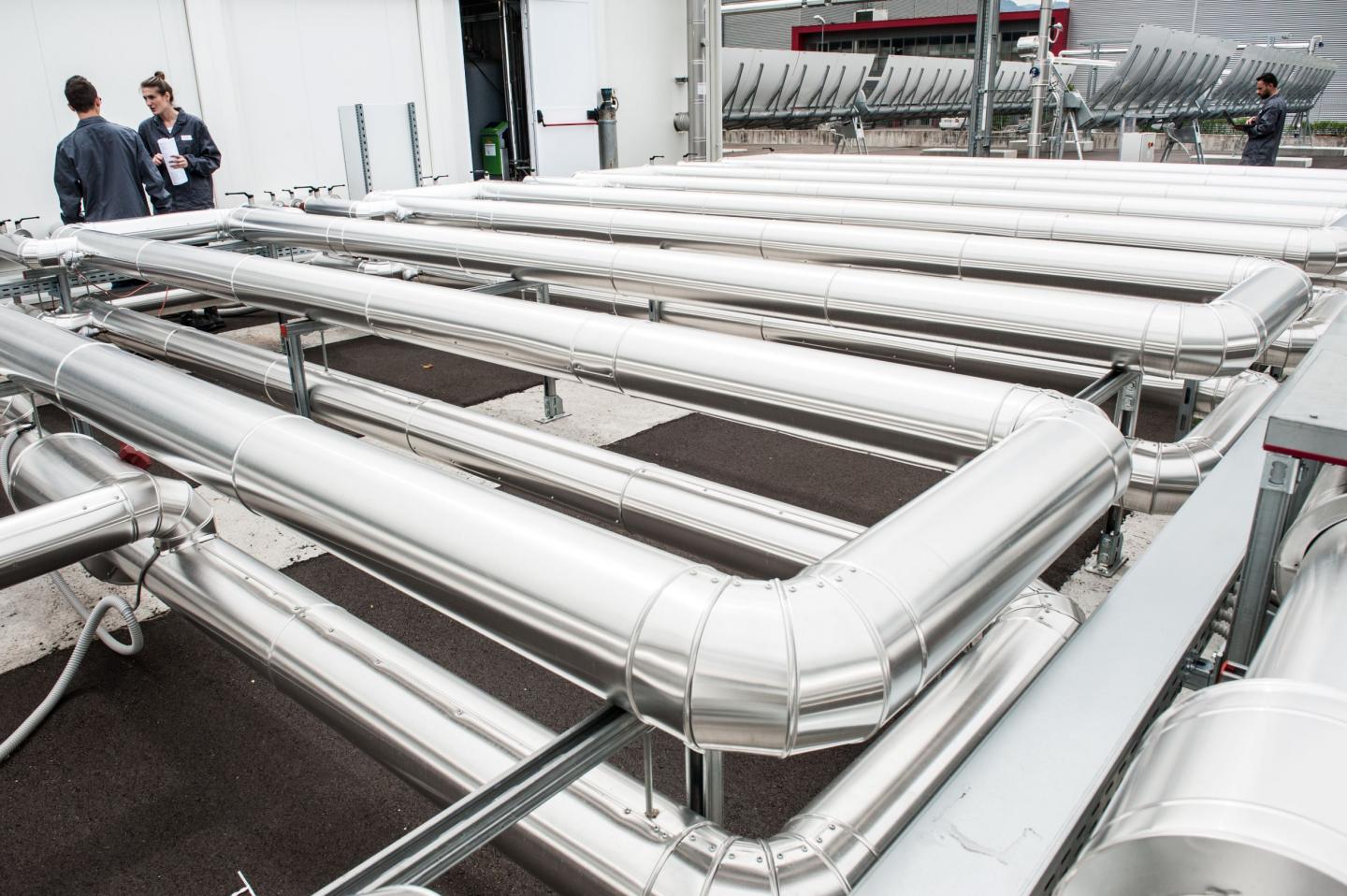
Credit: Ivo Corrà / Eurac Research
In Copenhagen, part of the traditional district heating network will be isolated to create an innovative low temperature network using the waste heat provided by two supermarket refrigeration systems. In the centre of Milan, a new district heating network will be built, which thermal energy will come from well water and an electrical grid transformer.
“With this project, low temperature district heating technologies are leaving our laboratories for the cities,” said Roberto Fedrizzi, coordinator of REWARDheat and head of the research group on sustainable heating and cooling systems of Eurac Research. For the first time, thanks to co-financing by the European Commission, eight different district heating networks are being installed simultaneously in Europe as part of a close collaboration between research institutions, technology producers, and energy companies. The researchers will support companies in the design and installation of the networks, monitoring their operation and studying new business models to manage them.
Low temperature district heating introduces a substantial change in the thermal energy market, as individual customers can produce energy for the network at the same time as use it. Traditional district heating grids operate at temperatures around 90 ?C, supplied by boilers, co-generators (or incinerators), and only a few industries can generate high-temperature, recoverable waste heat. In the district heating solutions of this project, the heat will be distributed at much lower temperatures (from 10 to 60 °C), allowing for a wider range of sources. For example, in Radolfzell, on Lake Constance, several buildings in a small industrial district will be able to purchase energy for heating and domestic hot water from a new district heating network– operating at 10 °C–and at the same time provide the same network with the waste heat from their own air conditioning systems.
Other innovative networks will be installed in Milan (where A2A Calore e Servizi will build a new network connected to condominiums, a library, and a school), as well as in Hamburg, Copenhagen, Sweden, Croatia, France, and the Netherlands.
Eurac Research is one of the first research centres in Europe to carry out investigations into low temperature district heating. “We started with our first laboratory at the NOI Techpark, financed by the Autonomous Province of Bozen/Bolzano, and then we led several European projects in which we studied the technology at a theoretical level and tested the plant management systems in the laboratory. Now we will see the concrete result of our work,” concludes Fedrizzi.
“REWARDheat will carry out massive interventions in the pilot areas. Contributing in such a concrete way to the development of the energy system of large European cities is an important goal for our research. This project is also remarkable from the point of view of the budget: with 15 million euros allocated from Brussels, it is the largest European project ever coordinated by Eurac Research. Of this, 10 million euro will finance the construction of the new networks, together with another 20 million in private capital provided by the energy companies involved,” says Wolfram Sparber, director of Eurac Research’s Institute for Renewable Energy.
###
Media Contact
Roberto Fedrizzi
[email protected]