By David L. Chandler
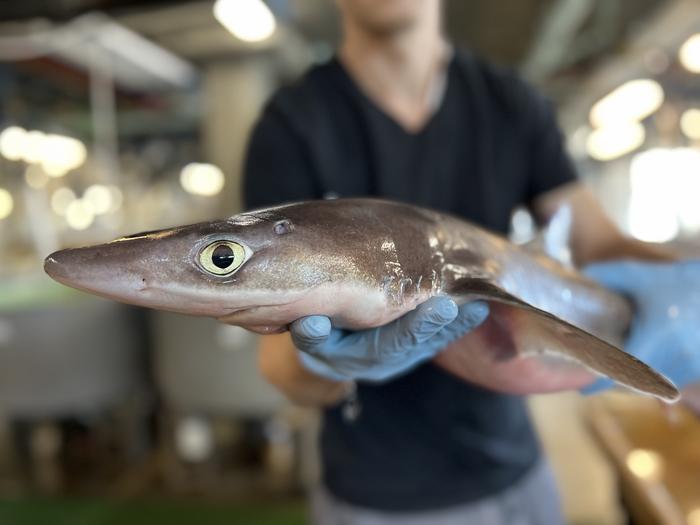
Credit: Etty Bachar-Wikström
By David L. Chandler
WOODS HOLE, Mass. — Sharks differ from other fish in many ways, including an apparently remarkable ability to heal from wounds, according to reports of sharks recovering from injuries sustained in the wild. While this healing ability has not yet been documented in controlled laboratory conditions, some of the chemical compounds found in shark skin may have significant biomedical potential.
To investigate this possibility, two dermatology researchers from the Karolinska Institute in Sweden carried out research on a small shark, the spiny dogfish (Squalus acanthias) and other cartilaginous fish species at the Marine Biological Laboratory (MBL) in Woods Hole. Their goal is to understand the unique biochemistry of the skin of these animals. Previous research on sharks in other labs has led to the development of a new antibiotic, and the discovery of biochemical pathways relevant to cystic fibrosis research.
Jakob Wikström, associate professor of dermatology and principal investigator at Karolinska, and Etty Bachar-Wikström, senior researcher, investigated the skin mucus of two species of sharks and their close relatives, little skates, at the MBL. Unlike the vast majority of fish species, which have relatively smooth skin protected by a thick, slimy layer of mucus, sharks have rough skin that feels like sandpaper. It wasn’t obvious whether this skin has a protective mucus layer at all.
“Much more is known about fish biology than shark biology, for obvious reasons,” Wikström said. “Fish are easier to handle, and there’s a bigger commercial interest in them.” Sharks are also fish, of course, but 99 percent of fish are bony species (Osteichthyes), unlike the cartilaginous sharks and skates (Chondrichthyes), he pointed out.
The initial results of their research on the mucus layer were recently published in the International Journal of Molecular Sciences. “Our aim in this paper was to characterize shark skin at the molecular level, which hasn’t been done in depth,” Bachar-Wikström said.
Their study found a very thin mucus layer on shark skin that is chemically different from that of bony fish. The shark mucus is less acidic, almost neutral, and turns out to be more chemically similar to some mammalian mucus, including some human mucus, than to bony fish mucus, she said.
It’s more evidence that “the molecular biology of sharks is unique,” Wikström said. “They’re not just another fish swimming around. They have a unique biology, and there are probably lots of human biomedical applications that one could derive from that. For example, when it comes to mucin [a primary component of the mucus], one can imagine different wound care topical treatments that could be developed from that.” Wound-treatment products have already been derived from codfish, he said, and “I think it’s possible that one could make something similar from sharks.”
Bachar-Wikström added, “Besides the human relevance, it’s also important to characterize these amazing animals, and to know more about them and how they survive in their environment… I think that this is just the first step to even deeper molecular understanding.”
The pair have a series of papers in the works to further characterize the unique biochemical properties of these species, which include chain catsharks (Scyliorhinus retifer) and the little skate (Leucoraja erinacea) along with spiny dogfish. These papers include in-depth studies of the different cell types in the skin on a single-cell level and also look in more detail at the healing abilities of shark skin.
“Animals that are far away [from us] evolutionarily can still give us very important information that is relevant for humans,” Wikström said.
While a great deal of research has been done on the wound healing of zebrafish, he said, “no one has really done it on sharks to the same extent, so it’s exciting because we really don’t know what we’re going to find. It’s explorative research.”
The researchers said the MBL provided special resources that made this work possible, including a large collection of specimens of the relevant species, and specialists who are highly experienced in working with them. “It’s really a unique competence they have,” Wikström said. “There are not many places in the United States or the world where they have it.”
—###—
The Marine Biological Laboratory (MBL) is dedicated to scientific discovery – exploring fundamental biology, understanding marine biodiversity and the environment, and informing the human condition through research and education. Founded in Woods Hole, Massachusetts in 1888, the MBL is a private, nonprofit institution and an affiliate of the University of Chicago.
Journal
International Journal of Molecular Sciences
DOI
10.3390/ijms241814331
Method of Research
Experimental study
Subject of Research
Animals
Article Title
Identification of Novel Glycans in the Mucus Layer of Shark and Skate Skin
Article Publication Date
20-Sep-2023