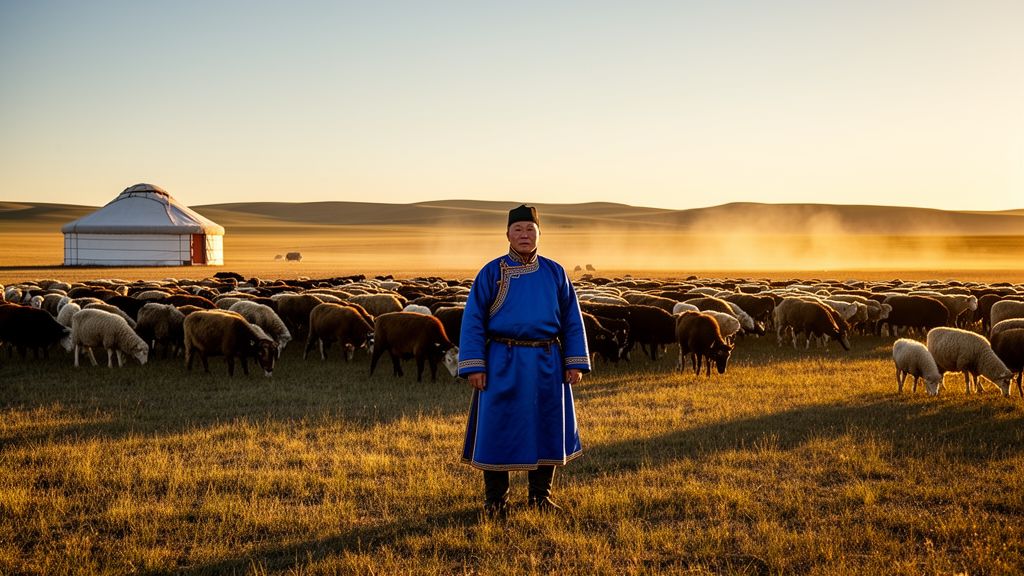
Human brucellosis in Inner Mongolia Autonomous Region, China, is most strongly associated with livestock inventory, according to a Bayesian spatio-temporal analysis of surveillance data from 2014 to 2023. The study, published in BMC Infectious Diseases, reports that areas with larger livestock holdings carried substantially higher risk of human infection, with a relative risk of 1.70 (95% credible interval: 1.26–2.30) for the livestock inventory variable.
The analysis also identified economic and climatic associations. GDP per capita showed a positive association with brucellosis risk (RR = 1.22, 95% CrI: 1.10–1.36), as did temperature (RR = 1.19, 95% CrI: 1.10–1.28). Wind speed showed a weak but statistically significant positive association (RR = 1.04, 95% CrI: 1.01–1.07). In contrast, the normalized difference vegetation index, a satellite-derived measure of vegetation greenness, was associated with reduced disease risk (RR = 0.93, 95% CrI: 0.90–0.97).
Brucellosis is a neglected zoonotic disease and remains a global public health priority for the World Health Organization, yet the study’s authors note that the disease remains substantially underreported in many regions despite its significant global health burden. The research team set out to examine the associations between human brucellosis and environmental, livestock-related and socioeconomic variables across Inner Mongolia over the decade from 2014 to 2023.
Descriptively, the epidemic followed a distinctive trajectory: incidence initially declined, then increased, and declined again over the study period, while demonstrating pronounced seasonality. The authors conclude that prevention and control efforts may be intensified during the spring and summer months and in regions with high livestock density and active economic development.
Methodologically, the study combined several analytical layers. Descriptive epidemiological methods were used to characterize overall epidemic trends, and time series decomposition was applied to analyze temporal dynamics and seasonal patterns of incidence. Candidate meteorological, socioeconomic and livestock-related variables were screened for multicollinearity using Spearman correlation and variance inflation factor diagnostics, a step designed to ensure that the modelled associations were not distorted by variables that measure overlapping phenomena.
The core of the analysis was a family of four nested Bayesian spatio-temporal negative binomial models, incorporating spatial, temporal and spatio-temporal interaction structures. These models were fitted and compared using the deviance information criterion and the widely applicable information criterion, and the best-fitting model was then used to estimate relative risks and 95% credible intervals for the association between each variable and brucellosis risk across the region. This framework allows the estimation of risk associations while accounting for spatial clustering, temporal trends and local variation in how risks evolve over time.
The relative risks reported should be interpreted as associations within this modelling framework rather than as direct measures of individual-level causation. The credible intervals indicate the range of plausible values for each association given the data and model structure, and the variables span very different domains: livestock husbandry intensity, regional economic activity, meteorological conditions and satellite-observed vegetation.
Based on the findings, the authors suggest that strengthening animal immunization, enhancing occupational protection, and improving surveillance in economically active livestock-producing regions may help reduce the regional disease burden. They emphasize that human brucellosis in Inner Mongolia exhibits significant seasonality and is associated with environmental and socioeconomic variables, particularly livestock husbandry intensity and regional economic activity.
For a region where livestock husbandry is central to both livelihoods and infection risk, the study’s mapping of where and when risk concentrates offers a data-driven basis for targeting interventions. The identification of spring and summer as periods of heightened incidence, alongside the link between livestock density and human cases, points to the value of coordinating human health surveillance with veterinary and agricultural monitoring in Inner Mongolia and comparable livestock-producing regions.
Subject of Research: Environmental, livestock-related and socioeconomic factors associated with human brucellosis in Inner Mongolia, China
Article Title: Factors associated with human brucellosis in Inner Mongolia Autonomous Region, China, 2014–2023: a Bayesian spatio-temporal analysis
Article References: Zhang, Q., Ta, N., Qu, R., Zheng, Z., Zhu, Z., Lan, B., Zhang, D., Shi, H., Xu, Y., Zhang, Z., & Zhang, W. (2026). Factors associated with human brucellosis in Inner Mongolia Autonomous Region, China, 2014–2023: a Bayesian spatio-temporal analysis. BMC Infectious Diseases. https://doi.org/10.1186/s12879-026-14663-y
Image Credits: AI Generated
DOI: 10.1186/s12879-026-14663-y
Keywords: brucellosis, zoonotic disease, Inner Mongolia, Bayesian spatio-temporal model, livestock, relative risk, seasonality, NDVI, temperature, GDP per capita, public health surveillance, China
News Source: William Thompson. (October 29, 2026). Livestock Density, Temperature and Income Linked to Human Brucellosis in Inner Mongolia. Scienmag.