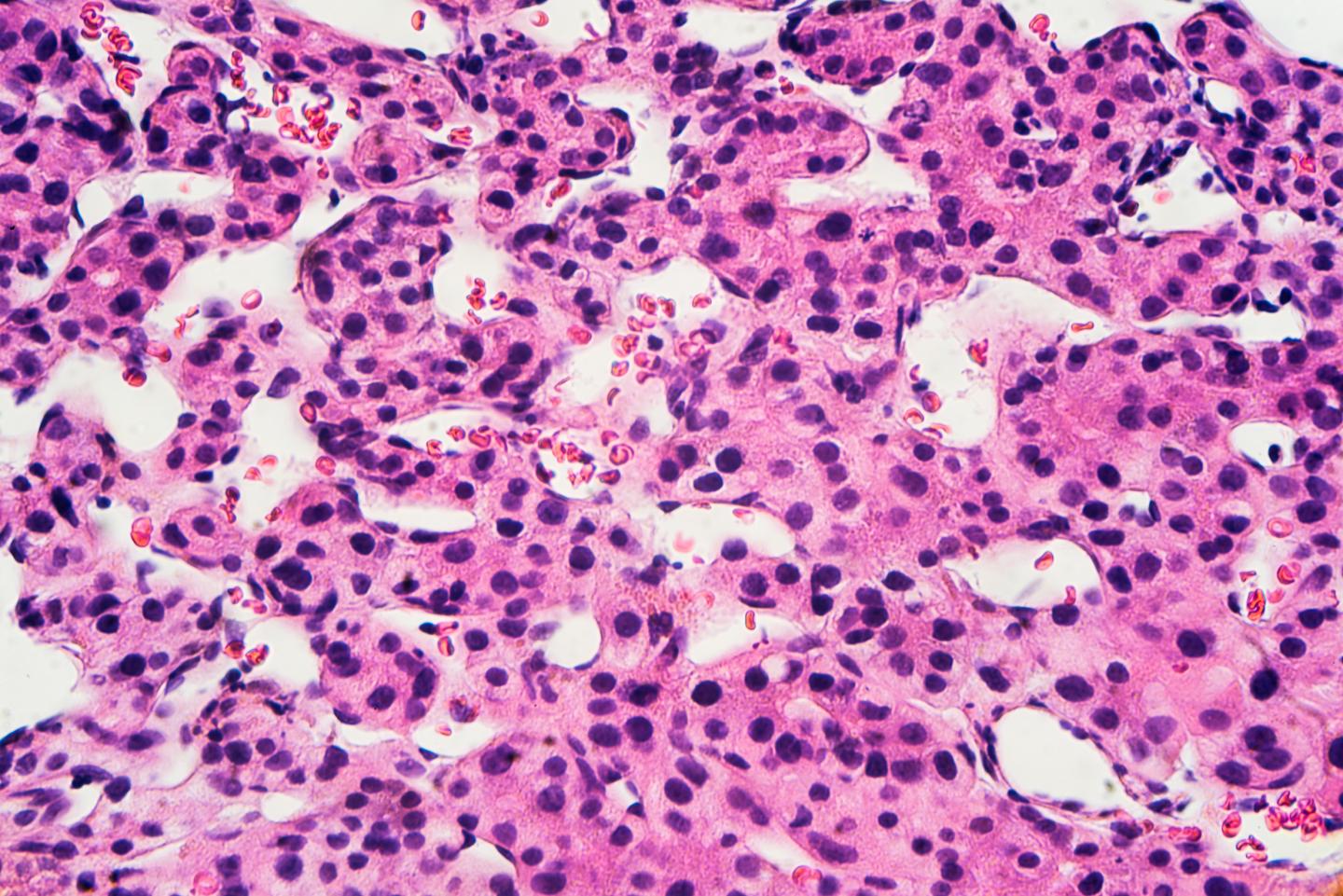
Credit: DR
Of all the hepatitis viruses, D is the most poorly known. This small virus, which can only infect people already infected with Hepatitis B, has so far been little studied. Hepatitis D is one of the most dangerous forms of chronic viral hepatitis because of its possible progression to irreversible liver diseases (cancer and cirrhosis, in particular). Scientists from the University of Geneva (UNIGE) and the Geneva University Hospitals (HUG) have studied the most serious consequence of chronic hepatitis: hepatocellular carcinoma, a particularly aggressive and often fatal liver cancer. By conducting a systematic review of the literature and a meta-analysis of all available data, they demonstrated that people infected with Hepatitis D have up to three times the risk of developing hepatocellular carcinoma compared to those infected only with Hepatitis B. These results, to be read in the Journal of Hepatology, plead for systematic screening of Hepatitis D in patients with Hepatitis B in order, on the one hand, to better manage patients and, on the other hand, to better understand the real prevalence of the disease.
There are five types of hepatitis viruses, with very different manifestations and consequences. Hepatitis A and E cause acute infections that can be severe but transient. Hepatitis B, C and D, however, can become chronic and cause liver dysfunction months or even years after infection. Although Hepatitis C is now well treated, Hepatitis B and especially D are still difficult to control. “The most serious consequence of Hepatitis B and D is hepatocellular carcinoma, explains Francesco Negro, Professor at the Department of Pathology and Immunology of UNIGE Faculty of Medicine and Head of the HUG Viropathology Unit. It was already known that co-infection of Hepatitis B and D accelerates the progression of cirrhosis. However, to what extent co-infection of Hepatitis B and D accelerates the progression towards this particularly aggressive liver cancer? This remained to be evaluated.”
“To find out whether Hepatitis D is even more dangerous than B, we carried out a systematic review and meta-analysis of all epidemiological studies, explains Dulce Alfaiate, a researcher at the Department of Pathology and Immunology of UNIGE Faculty of Medicine and first author of this work. To do this, we re-examined the data presented in 93 studies, representing a total of more than 100,000 patients. Although not all these studies are of similar quality, the analysis of the best of them is very clear: patients with Hepatitis D have an almost threefold risk of developing hepatocellular carcinoma compared to those with Hepatitis B alone. That’s huge!”
At least 15 million people infected worldwide
According to World Health Organization figures, hundreds of millions of people are infected with the Hepatitis B virus. In some regions, such as Polynesia and some African countries, more than 6% of the adult population is infected and the virus is largely transmitted from mother to child. Moreover, children infected at birth almost always develop the chronic form of the disease.
The Hepatitis D virus in turn infects a significant proportion of Hepatitis B carriers, but the extent of the problem is unknown. “Some estimates suggest that at least 15 to 20 million people are infected with Hepatitis D, whereas other estimates may reach 60 million, almost double the number of people living with HIV worldwide, says Dulce Alfaiate. In the absence of systematic testing, however, it is extremely difficult to be precise.” In Switzerland, an estimated 25,000 people live with Hepatitis B, among whom 1,500 with Hepatitis D. And this in spite of an available and effective Hepatitis B vaccine.
A call for research
Apart from interferon, an antiviral and an immuno-modulator with limited effectiveness but with deleterious side effects, there is currently no treatment for Hepatitis D. “In our view, the evolution towards liver cancer is grossly underestimated, Francesco Negro points out. And yet, this disease affects young patients who suffer from cirrhosis as early as the age of 25-30 years.”
Several ways of controlling the disease are currently being explored: Francesco Negro’s laboratory is studying the epigenetic changes induced by the virus and the mechanism of giving rise to liver tumours. The authors conclude: “Our work underlines the need to improve Hepatitis D screening in Hepatitis B patients and the urgent need for effective antiviral therapies, such as the one against Hepatitis C, which has saved the lives of millions of people since 2011.”
###
Media Contact
Francesco Negro
[email protected]
Related Journal Article
http://dx.