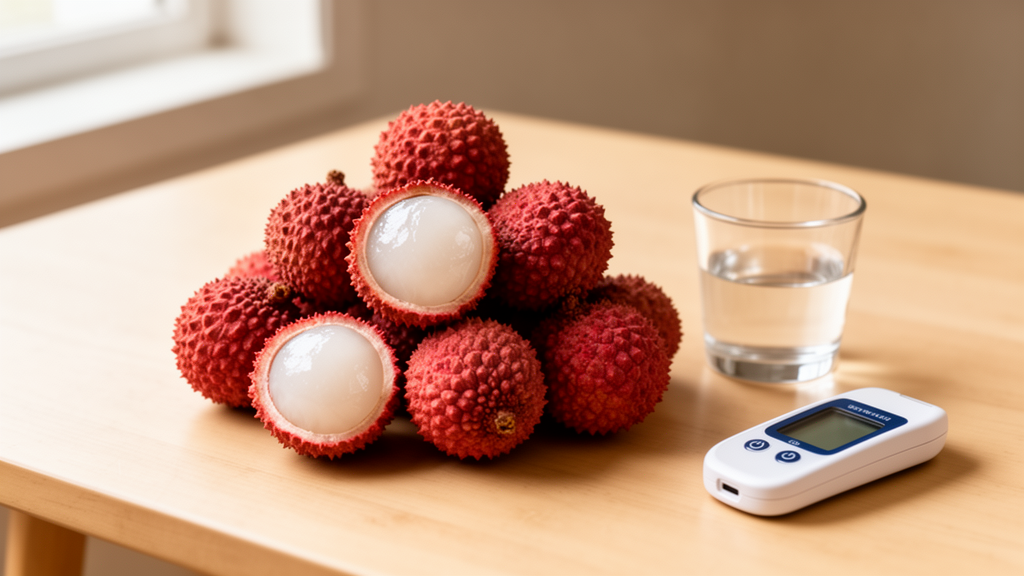
Researchers in China have produced one of the most complete nutritional portraits of fresh litchi pulp to date, and paired it with the first reported glycemic index and glycemic load values for the fruit. In a controlled self-comparison trial among healthy young volunteers, eating 300 grams of litchi pulp sent blood glucose climbing rapidly within 30 minutes, only for levels to fall back to fasting values around 120 minutes and then dip into a distinct trough between 120 and 180 minutes before recovering by 240 minutes. That trough, the authors suggest, may mark the critical risk window for the hypoglycemic illness known as “litchi disease,” which has repeatedly been reported during litchi ripening seasons in China, India, Bangladesh and Vietnam.
The fruit was picked from a farm in Huidong County, Guangdong, during the June ripening season, transported under cold chain, and peeled on site so the pulp could be analyzed immediately or frozen at minus 80 degrees Celsius for laboratory testing. Sugar contents were measured by high-performance liquid chromatography with evaporative light-scattering detection following the Chinese national standard GB 5009.8-2016, while amino acids, fatty acids and nine vitamins were quantified by HPLC-MS/MS.
The chemical analysis confirmed that litchi pulp is dominated by three simple sugars. Glucose, fructose and sucrose were the main sugar components, while maltose and lactose were not detected at all. Total sugar contents came to 19.40 grams per 100 grams in Feizixiao, 19.90 in Guiwei and 15.50 in Nuomici, values closely mirrored by the measured total soluble solids of 14.95 to 19.79 percent. Glucose and fructose ran highest in Feizixiao and lowest in Nuomici, whereas Feizixiao carried far less sucrose than the other two cultivars. Overall, no statistically significant difference in total sugar content emerged among the three varieties, with a median of 19.2 grams per 100 grams across all samples.
The pulp also proved to be a modest but meaningful source of proteins and amino acids. Total protein averaged roughly 816 milligrams per 100 grams across cultivars, and 15 amino acids were identified, including the essential amino acids valine, isoleucine, leucine, tyrosine, phenylalanine, lysine, histidine and arginine; methionine was absent. Alanine, glutamic acid, aspartate and proline each averaged more than 40 milligrams per 100 grams and together accounted for about half of the quantified amino acid pool. Fatty acid profiles varied by cultivar: palmitic, linoleic and alpha-linolenic acids appeared in Guiwei, only linoleic acid in Feizixiao, and only alpha-linolenic acid in Nuomici.
Vitamin results sharpened the contrast between cultivars. Of nine vitamins screened, riboflavin (B2), niacin (B3), nicotinamide (B3), pyridoxine (B6) and vitamin C were detected in all three, while vitamins A, D and E went undetected and B1 sat near the detection limit. Niacin was the most abundant vitamin, contributing 52 to 78 percent of the total vitamin content, followed by vitamin C and B6. Feizixiao contained the most vitamins overall, Nuomici the least, with a relatively elevated B2 level noted in Nuomici. In vitro antioxidant assays using ABTS, DPPH and FRAP methods tracked this pattern: Feizixiao’s water extracts posted radical-scavenging rates of 50.76 percent (ABTS), 61.31 percent (DPPH) and 56.20 percent (FRAP), the highest of the three, while Guiwei and Nuomici ranged roughly between 30.6 and 51.5 percent. The authors read this as evidence that the higher the vitamin content, the stronger the antioxidant activity.
The human component was a controlled self-comparison trial in 20 healthy volunteers aged 18 to 25, half male and half female, recruited after physical examinations and biochemical screening for glucose metabolism, thyroid, kidney and liver function. Participants had body mass indexes between 18.5 and 24, no diabetes or impaired glucose tolerance, no relevant diseases or family history of diabetes, and had taken no medications or supplements affecting glucose tolerance in the previous three months. Each volunteer completed five separate morning fasting tests, three with litchi and two with 50 grams of glucose as the reference, spaced at least 72 hours apart. Blood glucose was measured at nine time points from 0 to 240 minutes, and the glycemic index was calculated as the incremental area under the glucose curve for each food relative to glucose, following the Chinese health industry standard WS/T 652-2019.
The glycemic curves told a two-act story. In the first half hour after eating litchi, blood glucose rose as steeply as it did after pure glucose, a pattern the authors attribute to the fruit’s abundant free glucose: 300 grams of pulp delivers roughly 12.8 to 24.1 grams of glucose, some 27.5 to 41.4 percent of total sugars, which is absorbed directly through the small intestine. But the curves then diverged. The litchi peak arrived at the 30th minute, earlier than the glucose test’s 45-minute peak, and was lower. By 120 minutes glucose levels had returned to fasting values, and between 120 and 180 minutes they dropped into a trough before rebounding by 240 minutes. The authors link the trough to a delayed insulin feedback loop: secreted insulin drives glucose down, and the signal to throttle insulin secretion arrives late, letting levels overshoot downward. The cultivars behaved similarly, though Feizixiao produced a higher glycemic increment at the 60th minute than Nuomici, consistent with its higher glucose content. Fructose, whose glycemic index is only 23, appears to have contributed little: the 12.6 to 24.6 grams of fructose in a 300-gram serving falls below the roughly 30-gram small-intestinal absorption capacity estimated for a healthy 60-kilogram adult on an empty stomach.
The calculated glycemic indices were 76 for Feizixiao, 64 for Guiwei and 58 for Nuomici, a difference that did not reach statistical significance. Averaged across cultivars, litchi’s glycemic index came out at 66, placing it in the medium-GI band of 55 to 70, and its glycemic load at 11, just inside the medium-GL range of 10 to 20. For context, the authors note that these values sit above familiar fruits such as apples, pears, grapes and oranges, which carry GI values of 36 to 43, and near pineapples at 66, while the comparatively low glycemic load reflects the fruit’s high water content. On that basis, the researchers recommend moderate consumption for the general population, including people with diabetes. No hypoglycemic symptoms, allergic reactions or other discomforts were reported or observed in any of the five test rounds.
A proteomic add-on extended the work beyond nutrition. Eight of the volunteers, four male and four female, were randomly selected for untargeted plasma proteomics comparing samples taken before and 240 minutes after each litchi or glucose drink. Of 1,752 proteins identified across 64 plasma samples, 718 passed the abundance threshold for analysis. After litchi consumption, 87 proteins were significantly regulated, 34 up and 53 down, and 61 remained after excluding proteins that also changed in the glucose test, which the researchers treated as a control for circadian and other non-specific effects. Six proteins stood out with fold changes above one and a false discovery rate below 0.001: BASP1, TSKU, MTSS1, VCL, PPIA and TUBA1B. Enrichment analyses pointed to blood coagulation, hemostasis, platelet aggregation, focal adhesion and cytoskeletal functions, and protein-protein interaction analysis highlighted VCL, TAGLN2, TUBA1B, TUBB, TUBA4A, YWHAZ, ITGB3 and ITGA2B as hub proteins. Several of these, the authors note, have been implicated in anti-tumor processes in prior cell studies involving litchi phytochemicals such as quercetin and epicatechin, and others relate to neurological function and atherosclerosis pathways previously studied with litchi proanthocyanidins in animal models.
The authors are careful about the limits of these observations. The trial participants were all healthy young adults from the litchi-growing region, so generalizing the glycemic findings to other populations, including older adults or people with metabolic disease, requires caution, and subgroup analysis by sex found no significant difference in glycemic response. The proteomic work is exploratory; altered plasma proteins after a single fruit meal are clues to potential mechanisms, not proof of clinical benefit, and the conclusion that litchi may offer anti-tumor, anti-aging or cardiovascular advantages remains a hypothesis for future research rather than a demonstrated effect in humans. What the study does establish concretely is a detailed nutritional map of three major cultivars, the fruit’s first glycemic index and glycemic load values, and a defined two-hour window after a large fasting litchi serving in which blood glucose dips below baseline, a finding that could sharpen public-health guidance during litchi season for the populations where hypoglycemic illness has historically clustered.
Subject of Research: Nutritional analysis of litchi cultivars and their postprandial glycemic and plasma proteomic effects in healthy human volunteers
Article Title: Comprehensive analysis of nutritional profile, in vitro antioxidant activity of litchi and its effects on postprandial glycemic response and plasma proteome in humans
Article References: Wen, L., Yu, W., Liu, S., Qiao, F., Wan, Y., Xiao, W., Xiang, X., Wang, Z., Liu, L., & Wang, J. (2026). Comprehensive analysis of nutritional profile, in vitro antioxidant activity of litchi and its effects on postprandial glycemic response and plasma proteome in humans. Agricultural Products Processing and Storage, 2(1), Article 35. https://doi.org/10.1007/s44462-026-00068-2
Image Credits: AI Generated
DOI: 10.1007/s44462-026-00068-2
Keywords: litchi, glycemic index, glycemic load, postprandial glucose, plasma proteome, antioxidant activity, vitamin C, niacin, litchi disease, hypoglycemia, Feizixiao, controlled trial
News Source: Alan Morgan. (October 29, 2026). Litchi Raises Blood Glucose Fast, Then Dips Below Baseline Two Hours Later. Scienmag.