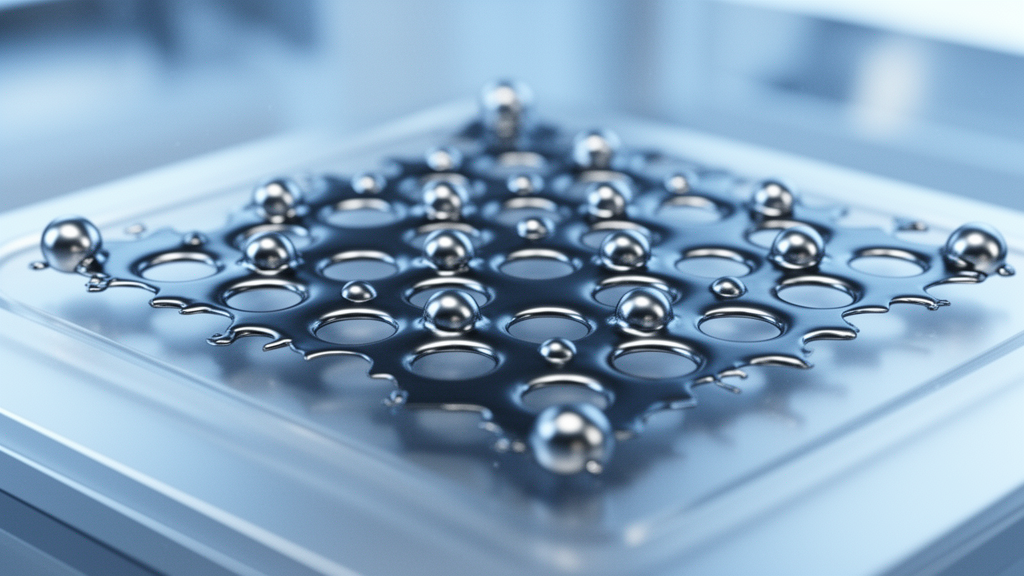
Liquid-metal interfaces can produce atomically thin oxides and related materials while simultaneously creating a rich, tunable landscape of vacancies, grain boundaries, wrinkles, mixed phases, and compositional gradients. A review of this emerging field argues that these defects are not simply unwanted imperfections: they are intrinsic products of coupled oxidation, fluid motion, printing, and transfer, and their deliberate control could improve gas sensors, electronic devices, photodetectors, piezoelectric systems, and neuromorphic memories. The central challenge is to move from empirical synthesis toward predictive engineering in which defect type, density, and location are linked directly to processing conditions and measured functionality.
The chemistry begins at the surface of a liquid metal, where oxygen molecules adsorb even at concentrations above 1 ppm and accept electrons from the metal. The resulting charge transfer creates a potential across the nascent oxide, often described by the Cabrera–Mott mechanism, and an internal electric field that drives further oxidation. At the very early stage, field-assisted ion transport can make the oxide grow rapidly; as the layer thickens, diffusion barriers eventually produce self-limiting growth. Temperature, oxygen availability, alloy composition, and the kinetics of interfacial transport therefore determine not only film thickness and stoichiometry but also the distribution of native point defects such as oxygen vacancies.
Multicomponent liquids expand this chemical palette. Low-melting Ga–In and Ga–In–Sn alloys can be processed easily, while differences in oxygen affinity determine which elements oxidize first and how dopants migrate toward the growing surface. Selective oxidation can create mixed oxides rather than isolated substitutions, and lattice mismatch between ZnO and SnO2, for example, can generate oxygen vacancies, phase boundaries, and grain boundaries that increase surface reactivity. Noble metals incorporated into gallium-based liquids have also been used to support oxygen exchange and stabilize oxidation states associated with p-type behavior in Ga2O3, illustrating how alloy chemistry and defect formation can be connected within one synthesis route.
The films are commonly detached by weak van der Waals interactions between the oxide skin and its liquid-metal substrate. Touch printing was reported for two-dimensional metal oxides in 2017, followed by squeeze printing, roll printing, blade coating, brush printing, and transfer with elastomeric supports. As a droplet deforms, it continually exposes fresh metal and regenerates its oxide skin, allowing some tears to heal during printing. A substrate-driven rolling method has produced homogeneous films over areas exceeding 100 cm2 at speeds of 0.1–20 cm per second, although residual liquid metal must be removed. Dewetting-induced printing offers another route to cleaner bilayers, but film quality still depends sensitively on printing parameters and interfacial behavior.
Liquid metals are not restricted to oxide production. Exposure to H2S can generate two-dimensional sulfides, while sulfidation, nitridation, and related post-synthetic reactions produce ultrathin compounds beyond oxides. Liquid interfaces can also transport precursors, reduce compounds, or support the formation of graphene, nitrides, and carbon-based structures. These approaches add other control variables because precursor supply, diffusion, and reaction kinetics can influence nucleation and defect formation. They also show that the essential feature is an active liquid interface capable of transporting matter and sustaining reactions, rather than liquid metal alone. At the same time, the interface remains difficult to model because chemical reactions, fluid renewal, and mechanical deformation occur together.
Defects can be sorted by where and how they originate. Interfacial oxidation produces vacancies, interstitials, non-stoichiometry, compositional fluctuations, and grain boundaries at the atomic or nanoscale. Printing and transfer introduce larger wrinkles, folds, cracks, pores, voids, discontinuities, thickness variations, and liquid-metal residues. Cleaning and annealing can add scratches, contamination, redistribution, healing, recrystallization, and changes in grain boundaries. These categories overlap: rupture of an oxide skin exposes new metal to oxidation, while pressure, contact time, wetting, atmosphere, and temperature alter both the chemical reaction and the mechanical outcome. A final film therefore records the cumulative history of a dynamic interface rather than a single equilibrium reaction.
Temperature provides one of the clearest demonstrations of that coupling. Printed indium oxide reportedly increases from about 4 nm at 170 degrees Celsius to about 16 nm at 300 degrees Celsius, with low-temperature material remaining largely amorphous and hotter material developing greater crystallinity and grain growth. Higher temperatures also enhance atomic diffusion, allowing vacancies to migrate and annihilate, although the review notes that the underlying defect populations cannot be predicted from equilibrium equations alone. Environmental control matters as well: ambient exposure can yield SnOx sheets with a SnO2 surface, whereas oxygen-reduced conditions can favor uniform monolayer SnO. Moisture can additionally introduce hydroxides into nominally oxide films, complicating both phase identification and defect analysis.
Atomic-scale disorder may improve performance when it is controlled rather than minimized. Oxygen vacancies in Bi2O3 have been associated with substantially enhanced piezotronic responses, while an ordered-vacancy structure in indium sulfide supports extended electron-transport pathways. Grain boundaries can provide adsorption sites but also scatter carriers. In zinc–tin composite oxides, heterointerfaces and lattice mismatch generate additional defect states, improving gas adsorption and sensing even as they constrain transport. A reported change from Bi2O2.98 to Bi2O2.68 increased two piezoelectric coefficients by approximately 650-fold and 210-fold, respectively, an effect attributed to local symmetry breaking during rapid printing. Conversely, excessive vacancies or dopants can introduce deep traps, disrupt the lattice, or slow device response, so greater disorder is not automatically beneficial.
Characterizing this landscape requires methods that probe different dimensions of the material. High-resolution and aberration-corrected transmission electron microscopy can reveal vacancies, lattice disorder, and grain boundaries, but they sample small areas and can alter beam-sensitive specimens. EELS maps local electronic structure, XPS identifies surface composition and oxidation states, and Raman and photoluminescence spectroscopy probe strain, disorder, thickness, charge transfer, and recombination. AFM measures roughness and topography, while STM, conductive AFM, piezoresponse force microscopy, and kelvin probe force microscopy examine local electronic or electromechanical behavior. Atom-probe tomography, time-of-flight secondary-ion mass spectrometry, X-ray reflectometry, and synchrotron X-ray absorption spectroscopy add compositional and depth information, although each brings limitations in quantification, specimen preparation, spatial resolution, or model dependence.
The review identifies three priorities for turning defect control into a programmable capability: quantitative synthesis–defect relationships, direct observation under in situ or operando conditions, and scalable processing that separates oxidation, fluid dynamics, and transfer mechanics. Standardized reporting of defect density, type, and distribution is needed because current studies rarely use comparable metrics. Rapid-transfer and in situ measurements are especially important because fresh films can oxidize, relax, or reconstruct after transfer, hiding metastable states present at growth. Automated printing, programmable alloy chemistry, and interfacial confinement could improve reproducibility, while computation and data analysis may help connect processing variables to defect stability and diffusion. The broader goal is to design spatial patterns, gradients, vacancy arrangements, and mixed phases deliberately, then verify their effects on transport, sensing, switching, dielectric behavior, and long-term reliability.
Subject of Research: Interfacial chemistry and defect engineering in liquid-metal-derived two-dimensional materials
Article Title: Liquid‐Metal Interfacial Chemistry for Crystal and Defect Engineering in Two‐Dimensional Post‐Transition‐Metal Materials
Article References: Hong, Z., Ghasemian, M. B., Nguyen, C. K., Nguyen, H. H., Kalantar‐Zadeh, K., Daeneke, T., Syed, N., & Zavabeti, A. (2026). Liquid‐Metal Interfacial Chemistry for Crystal and Defect Engineering in Two‐Dimensional Post‐Transition‐Metal Materials. Advanced Science, 13(58), Article e77978. https://doi.org/10.1002/advs.77978
Image Credits: AI Generated
DOI: 10.1002/advs.77978
Keywords: two-dimensional materials, liquid metals, interfacial oxidation, defect engineering, crystal growth, metal oxides, printing methods, nanomaterials, optoelectronics, neuromorphic devices, Liquid, Metal
News Source: Kathleen Holcomb. (October 21, 2026). Liquid Metals Offer a Route to Programmable Defects in Two-Dimensional Materials. Scienmag.