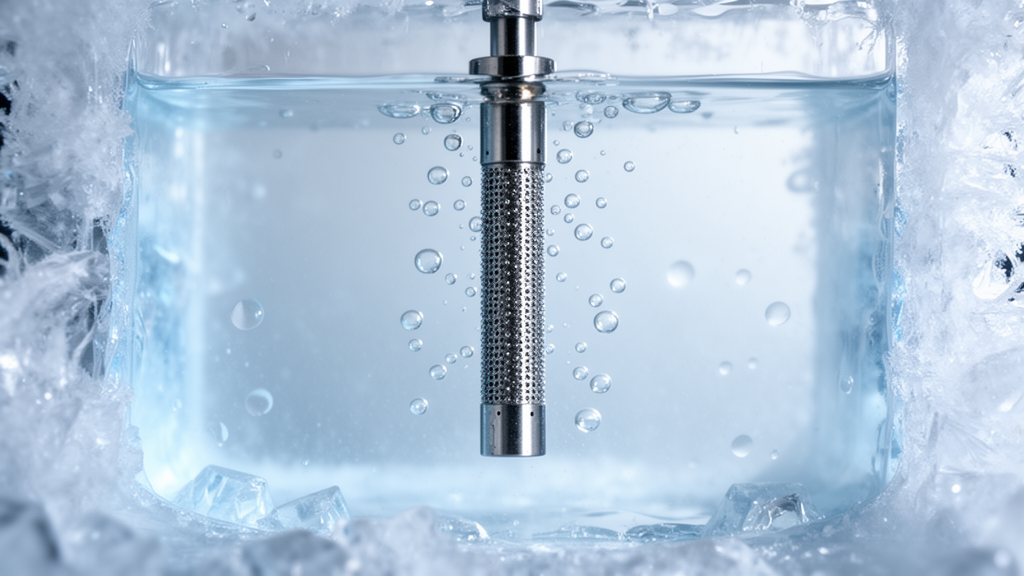
Cooling an electrolyte to just below 0 °C can extend the operating life of a manganese dioxide electrocatalyst for the oxygen evolution reaction, despite reducing its reaction rate. A study of γ-MnO2 found that near-freezing conditions suppressed catalyst degradation associated with permanganate formation more strongly than they slowed water oxidation. The result identifies a narrow temperature optimum in which activity and stability can be balanced, rather than a simple trade-off in which faster catalysis necessarily means faster deterioration. The reported behavior contrasts with the usual temperature dependence of chemical reactions, for which higher temperatures generally accelerate catalytic processes.
The experiments examined how the temperature dependence of oxygen evolution and permanganate formation changed across a broad range, with reported measurements spanning temperatures from 80 to −12 °C. At temperatures above the freezing point of water, the oxygen evolution reaction behaved conventionally: reducing the temperature decreased its rate. The degradation pathway followed a different pattern, however. Cooling from conventional operating temperatures toward 0 °C increasingly restrained permanganate formation, and the catalyst’s long-term stability improved. At −8 °C, long-term tests found substantially better retention than at higher temperatures, demonstrating that the enhancement was associated with durability rather than increased catalytic output.
Further cooling did not produce a continually better outcome. Below 0 °C, permanganate formation accelerated rather than being further suppressed, creating an optimum close to the freezing point. This reversal was linked to the supercooling of the electrolyte and a temperature-dependent structural transition in water. The findings indicate that the reactions respond differently to changes in the surrounding molecular environment: cooling can initially restrict degradation more effectively than it restricts oxygen evolution, but pushing the electrolyte farther below its normal freezing point changes the balance. The authors describe this as an anti-Arrhenius response, noting that it is a rare example of anomalous temperature-dependent electrocatalysis under subzero conditions.
For electrocatalysts susceptible to competing reaction pathways, temperature may therefore function as a selective control variable. Instead of maximizing water oxidation alone, operators could seek a temperature at which the useful reaction remains sufficiently active while degradation is minimized. The study’s implications extend to electrochemical systems that must operate during winter, in polar regions, or in extraterrestrial environments, where water may approach or fall below its freezing point. The work does not establish a universal operating temperature for electrolysis: its conclusions are based on γ-MnO2 in the tested electrolyte and conditions, and the central result is an optimum near 0 °C rather than a claim that colder is always better. It nevertheless shows that deliberately managing temperature can lengthen catalyst lifetime without eliminating catalytic activity, offering a design principle for balancing performance and durability in water-oxidizing systems.
Subject of Research: Temperature control of activity and degradation in manganese dioxide electrocatalysts for water oxidation
Article Title: Cooling water to near freezing breaks the activity–stability trade-off of water oxidation electrocatalysis
Article References: Wardhana, A. C., Ooka, H., Lim, T., Li, A., Adachi, K., Chen, C., Hashizume, D., & Nakamura, R. (2026). Cooling water to near freezing breaks the activity–stability trade-off of water oxidation electrocatalysis. Nature Chemistry. https://doi.org/10.1038/s41557-026-02274-8
Image Credits: AI Generated
DOI: 10.1038/s41557-026-02274-8
Keywords: electrocatalysis, manganese dioxide, oxygen evolution reaction, catalyst stability, permanganate formation, temperature control, subzero electrolytes, electrolyte supercooling, catalyst degradation, Cooling, water, near
News Source: Bethany Barker. (October 21, 2026). Near-Freezing Water Balances Oxygen Evolution Activity and Catalyst Stability. Scienmag.