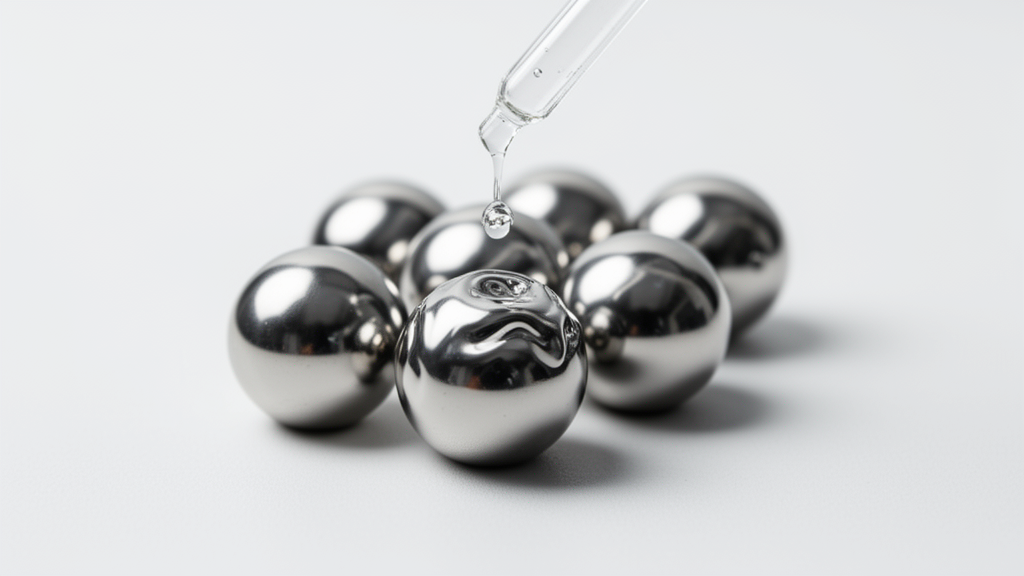
Researchers have fabricated liquid metal-coated polymer beads that demonstrate stimuli-responsive electrical conductivity through the cooperative action of an inner polymer core and a metallic surface layer. In a study published in Discover Sensors, Christopher Hiromi Shimamura, Shunichiro Ito, and Kazuo Tanaka reported that polymer beads coated with eutectic gallium-indium alloy microparticles alter their electrical current when exposed to organic solvents such as toluene in both liquid and vapor states. The as-prepared liquid metal powder coating is initially insulating because of native oxide shells and surfactant molecules covering the alloy microparticles. Applying mechanical sintering through controlled vortex mixing ruptures these surface shells, establishing conductive paths that yield an electrical current of approximately twenty-four milliamperes under an applied voltage of one volt. When the sintered beads are subsequently exposed to toluene, solvent absorption drives swelling within the underlying crosslinked polymer matrix, physically separating the conductive alloy domains and precipitating an immediate drop in electrical current.
The investigative effort addressed long-standing limitations in fabricating functional soft composite materials composed of liquid metals and flexible polymer matrices. Eutectic gallium-indium alloy, commonly designated as EGaIn with a weight ratio of seventy-five point five percent gallium and twenty-four point five percent indium, possesses a melting point of fifteen point four degrees Celsius and low toxicity, making it suitable for stretchable electronics. Conventional composite fabrication has typically relied on dispersing liquid metal within bulk elastomers or depositing continuous liquid metal coatings over planar substrates. However, coating spherical polymer particles while preserving physical and chemical accessibility to the underlying core has remained difficult. Prior stimuli-responsive liquid marbles or colloidosomes generally derived responsiveness exclusively from polymeric coatings enveloping a liquid center without functional engagement of the core. By contrast, the authors envisioned a core-shell architecture where a soft liquid metal shell and a responsive polymer core interact cooperatively, enabling structural swelling or contraction of the core to directly govern surface electrical properties.
Synthesizing the stimuli-responsive beads began with the preparation of stabilized liquid metal powder consisting of eutectic gallium-indium microparticles functionalized with 1-dodecanethiol. The eutectic alloy was first produced by combining high-purity gallium and indium in the specified weight ratio at room temperature, followed by heating at two hundred degrees Celsius for more than fifteen hours on a ceramic plate. To generate powder, one gram of the prepared EGaIn alloy was introduced into a sealed vial containing ten milliliters of dehydrated ethanol and zero point three molar 1-dodecanethiol that had undergone nitrogen degassing for over twenty minutes. The mixture was subjected to bath sonication at forty-two kilohertz for three hours at approximately twenty-five degrees Celsius. Following sonication, the suspension was centrifuged at fifteen hundred revolutions per minute, separated from the supernatant, and washed three times with pure ethanol using vortex mixing. The particles were subsequently washed three times with benzene and lyophilized in a liquid nitrogen bath, yielding hydrophobic liquid metal powder.
The hydrophobic surface properties imparted by the aliphatic chains of 1-dodecanethiol enabled the researchers to construct several interfacial systems, including liquid marbles and oil-in-water droplets. When a five-microliter droplet of water or an approximately one-hundred-and-sixty-milligram droplet of EGaIn was rolled across a bed of liquid metal powder on a polyethylene spoon, spontaneous surface coating occurred. The resulting liquid-metal-powder-coated EGaIn marbles floated freely on water, demonstrating pronounced surface hydrophobicity despite the high density of the underlying metallic alloy. Building upon this interfacial stabilization, the researchers floated seven milligrams of the powder on two point five milliliters of water in a glass vial and carefully dispensed one hundred microliters of chloroform onto the surface. The high-density chloroform droplet dragged floating liquid metal powder downward as it precipitated into the aqueous phase, producing stable oil-in-water droplets enclosed by a protective outer shell of hydrophobic liquid metal microparticles at the fluid interface.
To transition from transient liquid droplets to solid functional composites, the investigators formulated a photopolymerizable monomer mixture to serve as the core. The formulation comprised two-phenoxyethyl acrylate, selected for its hydrophobicity and high density of one point one one grams per milliliter, combined with the crosslinker 1,6-hexanediol dimethacrylate and the photoinitiator 1-hydroxycyclohexyl phenyl ketone. An oil-in-water droplet was assembled by depositing the degassed monomer solution through the vial wall onto seven milligrams of powder floating on water under a nitrogen atmosphere. Adjusting the monomer volume to roughly zero point three milliliters ensured complete coverage of the droplet surface before exposing the system to three-hundred-and-sixty-five-nanometer ultraviolet light for one hour. Photopolymerization yielded spherical beads with an average diameter of six point one four millimeters and an estimated liquid metal weight fraction of four percent. Field emission scanning electron microscopy revealed that the bead surface featured an intact multilayer of spherical microparticles interspersed with open penetration paths between primary particles.
Because the as-prepared polymer beads remained electrically insulating due to the native gallium oxide shells and surfactant layers on the microparticles, the team employed mechanical sintering to induce electrical conduction. Placing an individual bead into a glass vial and shaking it vigorously on a vortex mixer for twenty to sixty seconds exerted compression and shear forces that broke the oxide shells, causing adjacent microparticles to coalesce into conductive metallic domains. Sintering for sixty seconds reduced the liquid metal weight fraction to approximately one point five percent as excess alloy adhered to the vial walls, while imparting a reflective metallic luster. Electrical measurements under one volt revealed that mechanical sintering increased current from a negligible baseline to roughly twenty-four milliamperes, with similar current magnitudes achieved across sintering durations ranging from ten to sixty seconds. Alternative sintering techniques, including rolling between glass substrates and exposure to hydrochloric acid vapor, caused severe material detachment and disjointed domains, confirming vortex mixing as the superior approach.
The electrical responsiveness of the sintered beads was evaluated through in situ conduction experiments where individual beads were sandwiched between two indium tin oxide substrates with a sheet resistance of ten ohms per square. Connected to a source meter operating at a constant potential of one volt, the sintered beads were submerged directly into a liquid toluene bath for four minutes. In seven out of eight tested samples, the measured electrical current dropped almost immediately to negligible values upon solvent immersion. Following removal from the toluene bath and subsequent drying in ambient air, electrical conductivity demonstrated gradual recovery in four of the specimens, reaching approximately thirty percent of initial current. Extending the immersion duration to thirty minutes resulted in a lower post-drying recovery rate of approximately twenty percent. The researchers concluded that four minutes represented the optimal immersion duration necessary to achieve complete electrical disconnection while minimizing irreversible disruption of the conductive surface layer.
Microstructural analysis and swelling measurements validated the cooperative mechanism governing the observed drop and recovery in electrical conductivity. Cross-sectional and surface electron microscopy demonstrated that while vigorous vortex shaking coalesced primary microparticles into conductive networks, non-sintered liquid metal domains persisted across the bead surface. These non-sintered domains preserved microscopic pathways that permitted solvent molecules to penetrate the outer shell and access the inner polyacrylate network. Swelling ratio tests confirmed substantial toluene uptake within the polymer core, causing volumetric expansion that pulled adjacent liquid metal domains apart and severed conductive pathways between the measurement electrodes. When solvent evaporated during air drying, the polymer network shrank, facilitating partial reconnection of the metallic domains. To examine matrix influence, beads were prepared with crosslinker concentrations of zero point five, five, and fifty weight percent. Beads containing higher crosslinker densities exhibited reduced current suppression in toluene, demonstrating that increased network rigidity restricts swelling and attenuates electrical sensitivity.
The investigation further explored whether the sintered beads could detect airborne volatile organic compounds by measuring current responses inside a sealed chamber filled with toluene vapor. When toluene vapor was introduced around a sintered bead held under a constant one-volt bias, the electrical current decreased by approximately two percent before reaching saturation after sixty minutes of vapor exposure. Purging the test chamber with dry nitrogen gas displaced the organic vapor, prompting solvent desorption from the polymer core and allowing the electrical current to recover gradually toward its initial baseline. Direct control comparisons using polymer beads coated by simple immersion into bulk liquid metal showed no solvent responsiveness, underscoring that the porous, partially sintered particle architecture is indispensable for vapor transport. Although the two percent vapor response confirmed chemical sensing capability, the authors noted significant technical challenges, including slow response kinetics, baseline current drift, and limited device-to-device repeatability across successive test cycles.
Overall, the research demonstrates a practical pathway for engineering responsive electronic composites by coupling hydrophobic liquid metal powders with photopolymerizable polymer cores. The resulting core-shell beads successfully translate matrix swelling and contraction into measurable surface electrical modulation, providing a conceptual framework for detecting liquid solvents and airborne volatile organic compounds. Scanning electron microscopy confirmed that retaining non-sintered microparticle domains after mechanical agitation is vital for maintaining chemical permeability and structural flexibility. However, the researchers emphasized that the current prototype exhibits low sensitivity, prolonged response times, and limited cycling durability, indicating that substantial optimization is required before practical sensing deployment. Shimamura, Ito, and Tanaka concluded that while hurdles remain, the cooperative interaction between soft cores and deformable metallic coatings offers promising possibilities for responsive electronic interfaces.
Subject of Research: Stimuli-responsive electrical conductivity in liquid metal-coated polymer beads
Article Title: Development of liquid metal-coated polymer beads with stimuli-responsive electrical conductivity
Article References: Shimamura, C. H., Ito, S., & Tanaka, K. (2026). Development of liquid metal-coated polymer beads with stimuli-responsive electrical conductivity. Discover Sensors, 2(1), Article 35. https://doi.org/10.1007/s44397-026-00069-7
Image Credits: AI Generated
DOI: 10.1007/s44397-026-00069-7
Keywords: liquid metal, EGaIn, polymer beads, mechanical sintering, stimuli-responsive materials, electrical conductivity, chemical sensing, volatile organic compounds, Development, liquid, metal-coated, polymer
News Source: Neil Sanderson. (November 9, 2026). Liquid Metal Coated Polymer Beads Exhibit Responsive Electrical Conductivity Under Solvent Exposure. Scienmag.