A prospective randomized clinical trial evaluating rehabilitation strategies following arthroscopic rotator cuff repair has demonstrated that initiating early passive motion accelerates shoulder range of motion at three months postoperatively compared with a delayed protocol, though both approaches result in equivalent functional and pain outcomes at one year. The investigation, conducted by surgical researchers Mohamed Rabie Abdallah, Ahmed Shaban Hassan, and Mohamed Abdelal, specifically focused on patients undergoing primary single-row knotless repair for small and medium-sized full-thickness supraspinatus tears. While early mobilization provided an initial mechanical advantage in restoring joint movement, long-term assessments confirmed that prolonged immobilization does not impair ultimate recovery, highlighting distinct short-term trajectories that converge over twelve months of clinical and radiological follow-up.
Postoperative management following rotator cuff reconstruction has historically represented a therapeutic dilemma in orthopedic sports medicine and shoulder surgery. Early postoperative motion is recognized for its potential to prevent capsular adhesions, diminish postoperative stiffness, and mitigate fear-avoidance behaviors during the acute inflammatory phase of tendon healing. Conversely, clinicians have expressed concern that premature physical loading and mechanical strain across the repair footprint could disrupt tendon-to-bone integration, thereby elevating the risk of structural failure or recurrent tears. Delayed mobilization, defined by a multi-week period of immobilization, prioritizes biological healing at the tendon insertion site but frequently results in transient joint stiffness that requires subsequent rehabilitation to overcome.
To evaluate these competing physiological hypotheses, the investigators designed a randomized trial involving 70 enrolled patients aged between 20 and 70 years who presented with MRI-confirmed small or medium-sized full-thickness supraspinatus tears measuring less than three centimeters. Surgical procedures were carried out at Helwan University Hospitals between January 2024 and June 2025. Strict inclusion criteria mandated primary arthroscopic repair, an intact subscapularis tendon, and the complete absence of glenohumeral instability. Patients with massive tears measuring greater than three centimeters, previous revision shoulder procedures, substantial glenohumeral osteoarthritis, labral pathologies, or documented noncompliance were excluded from participation to preserve cohort uniformity.
Surgical intervention was standardized across all participants and performed by a single surgeon utilizing the beach-chair position under general anesthesia supplemented by an interscalene nerve block. Following diagnostic arthroscopy and indicated subacromial decompression, tears were repaired anatomically under minimal tension using single-row knotless suture anchors. Small tears measuring under 1.5 centimeters received one anchor, while medium-sized tears measuring between 1.5 and 3.0 centimeters received two anchors. Notably, the postoperative regimen avoided the use of an abduction sling entirely, relying instead on standard immobilization or protected early motion protocols.
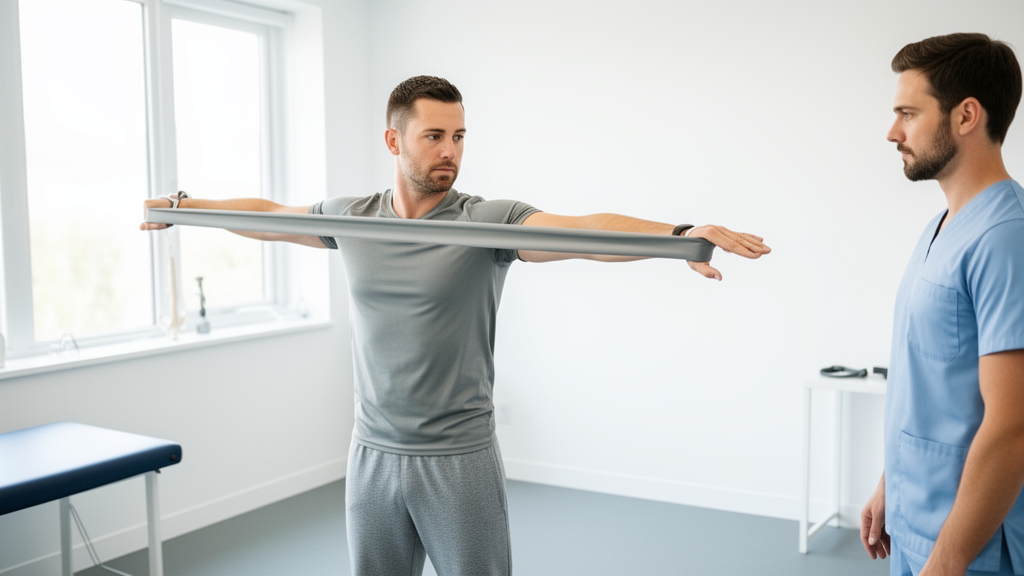
Following surgical repair, participants were randomized into two equal cohorts of 35 patients each. The early passive mobilization group initiated passive pendulum exercises and assisted forward elevation within the first 24 hours following surgery. This cohort progressed to active-assisted motion after four weeks and entered a structured strengthening phase at eight weeks postoperatively. In contrast, the delayed protocol group underwent strict immobilization for four weeks before commencing the identical passive motion regimen, followed sequentially by active-assisted exercises and eventual resistance training under identical timeframes relative to motion initiation.
Baseline demographic and clinical characteristics showed no statistically significant differences between the two study arms. The mean age was 56.8 years in the early mobilization group and 57.3 years in the delayed group, with medium-sized tears requiring two anchors representing the majority of cases in both cohorts. Comprehensive pre-interventional profiling included automated hematology panels, hepatic enzymes, renal metabolic markers, viral screenings, and baseline sonographic assessments. Postoperative evaluations took place at six weeks, three months, six months, and twelve months, capturing forward flexion and external rotation via goniometric measurements, subjective pain levels on a Visual Analog Scale, and composite scores using the Constant-Murley and UCLA shoulder scoring instruments.
The primary short-term endpoint revealed a statistically significant acceleration of forward flexion in the early mobilization cohort at the three-month milestone. Patients in the early protocol achieved a mean range of motion of 130 degrees, compared with 115 degrees recorded among patients managed with initial four-week immobilization, yielding a statistically significant difference. This observation aligns with previously published biomechanical literature suggesting that early passive movement diminishes periarticular fibrotic deposition and maintains glenohumeral capsular compliance during the initial phases of soft-tissue remodeling.
Despite the early disparity in joint excursion, serial assessments conducted at six and twelve months demonstrated a progressive closure of the performance gap between the two cohorts. By the final twelve-month evaluation, functional parameters had fully converged, with both groups achieving statistically indistinguishable scores across the Constant-Murley and UCLA metrics alongside equivalent reductions in visual pain scores. These findings indicate that while initial immobilization temporarily retards motion recovery during the first trimester of rehabilitation, it does not impose a permanent ceiling on shoulder functionality or overall clinical recovery.
Structural tendon integrity was formally quantified at twelve months postoperatively utilizing magnetic resonance imaging classified according to the Sugaya grading system. Across the entire cohort of 70 patients, 69 repairs remained fully intact, establishing an overall structural healing rate of 98.6 percent. A single structural re-tear, representing an incidence of 2.8 percent, was identified within the early mobilization group in a patient who had undergone repair of a medium-sized tear using two knotless anchors. No structural failures were observed within the delayed mobilization cohort, nor were any re-tears documented among small tears treated with a single anchor across either study arm.
The study authors emphasize several critical methodological boundaries when interpreting these comparative outcomes. Because the clinical trial was statistically powered a priori to identify differences in functional performance rather than low-frequency structural failure events, the single recorded re-tear remains a descriptive empirical observation rather than definitive proof of elevated structural hazard. Furthermore, the absence of a prespecified subgroup analysis powered specifically by tear diameter precludes differential clinical recommendations regarding rehabilitation pacing based strictly on small versus medium defect size. Consequently, both early passive exercise and initial four-week immobilization represent viable rehabilitation pathways following single-row knotless rotator cuff reconstruction, offering equivalent annual functional endpoints.
Sample size calculations for the trial relied on an a priori statistical power analysis configured with a two-sided alpha error threshold of 0.05 and a statistical power of 80 percent. Based on anticipated effect sizes established in earlier orthopedic literature evaluating rotator cuff rehabilitation, the investigators established that a minimum cohort of 30 patients per study arm would provide adequate sensitivity to identify clinically meaningful differences across post-intervention functional metrics. To incorporate an anticipated 15 percent attrition or loss-to-follow-up rate over the twelve-month observation cycle, the recruitment target was adjusted upward to 35 patients per treatment group, yielding the final cohort of 70 individuals. During initial patient enrollment at Helwan University Hospitals, clinical staff screened a preliminary cohort of 73 candidates presenting with full-thickness supraspinatus tears. Three prospective candidates were excluded before allocation, comprising one individual who declined study participation and two candidates whose clinical presentations failed to fulfill prespecified anatomical and physiological inclusion criteria.
Preoperative evaluation protocols incorporated comprehensive clinical profiling performed using standardized laboratory instrumentation. Hematological assessments were processed via automated analyzer platforms, utilizing hydrodynamic focusing and fluorescence flow cytometry to establish full blood pictures alongside differential leukocyte counts. Serum biochemistry panels, encompassing liver enzyme evaluations of alanine aminotransferase and aspartate aminotransferase, total and direct bilirubin, serum albumin concentrations, and renal markers including blood urea and creatinine, were processed through dedicated auto-analyzer systems. Candidates additionally underwent serological screening for viral hepatitis B and hepatitis C, complemented by abdominal ultrasound imaging. Statistical processing was executed through SPSS software version 25. Quantitative continuous variables demonstrating normal distributions were compared using Student’s t-tests, whereas non-normally distributed parameters were evaluated through Mann-Whitney U testing. Categorical relationships and qualitative variables were assessed using Chi-squared tests, with Fisher’s exact test or Monte Carlo corrections applied whenever expected cell counts dropped below five. Statistical significance across all comparisons was defined by probability values below 0.05.
The temporary nature of the observed mobility gains corresponds with broader patterns documented across several substantial systematic reviews and randomized investigations. A meta-analysis pooling thirteen randomized controlled trials and 1,082 surgical patients similarly identified superior early forward flexion and abduction following accelerated protocols without compromising structural safety across varying tear dimensions. That analysis, however, confirmed that between-group disparities dissolved over subsequent follow-up, showing no enduring differences in external rotation or functional scores. Comparable outcomes were observed in an evaluation of 206 patients weaning early from postoperative slings, which demonstrated accelerated movement at six weeks, as well as an investigation of biceps rerouting for large tears where early intervention cohorts attained maximal range by three months before reaching functional parity at one year. Larger syntheses aggregating data from nine trials comprising 830 patients and twenty trials involving 1,841 participants confirmed that pain relief, structural healing, and functional metrics exhibit equivalent long-term trajectories between early motion and delayed immobilization protocols.
Beyond trial-specific outcomes, researchers noted that considerable heterogeneity persists across shoulder rehabilitation literature, with early motion protocols initiated anywhere between the first postoperative day and six weeks. In addition, many underlying clinical trials carry unclear or high risk of bias, highlighting the necessity for larger trials stratified by repair technique. Because individual healing capacity and defect size influence how much early strain tendons can endure, postoperative pathways must remain individualized rather than standardized.
Subject of Research: Early versus delayed rehabilitation outcomes after arthroscopic rotator cuff repair
Article Title: Impact of early versus delayed mobilization after arthroscopic rotator cuff repair in small and medium-sized tears: a prospective randomized study
Article References: Abdallah, M. R., Hassan, A. S., & Abdelal, M. (2026). Impact of early versus delayed mobilization after arthroscopic rotator cuff repair in small and medium-sized tears: a prospective randomized study. Journal of Orthopaedic Surgery and Research, 21(1), Article 634. https://doi.org/10.1186/s13018-026-07284-3
Image Credits: AI Generated
DOI: 10.1186/s13018-026-07284-3
Keywords: rotator cuff repair, arthroscopic surgery, early mobilization, delayed mobilization, shoulder rehabilitation, range of motion, supraspinatus tear, knotless suture anchors, beach-chair position, postoperative recovery, orthopedic surgery, Constant-Murley score, UCLA shoulder score, tendon healing, structural integrity, clinical trial
News Source: Ophelia Keating. (November 18, 2026). Early Shoulder Mobilization Accelerates Initial Motion but Yields Equivalent Annual Outcomes. Scienmag.