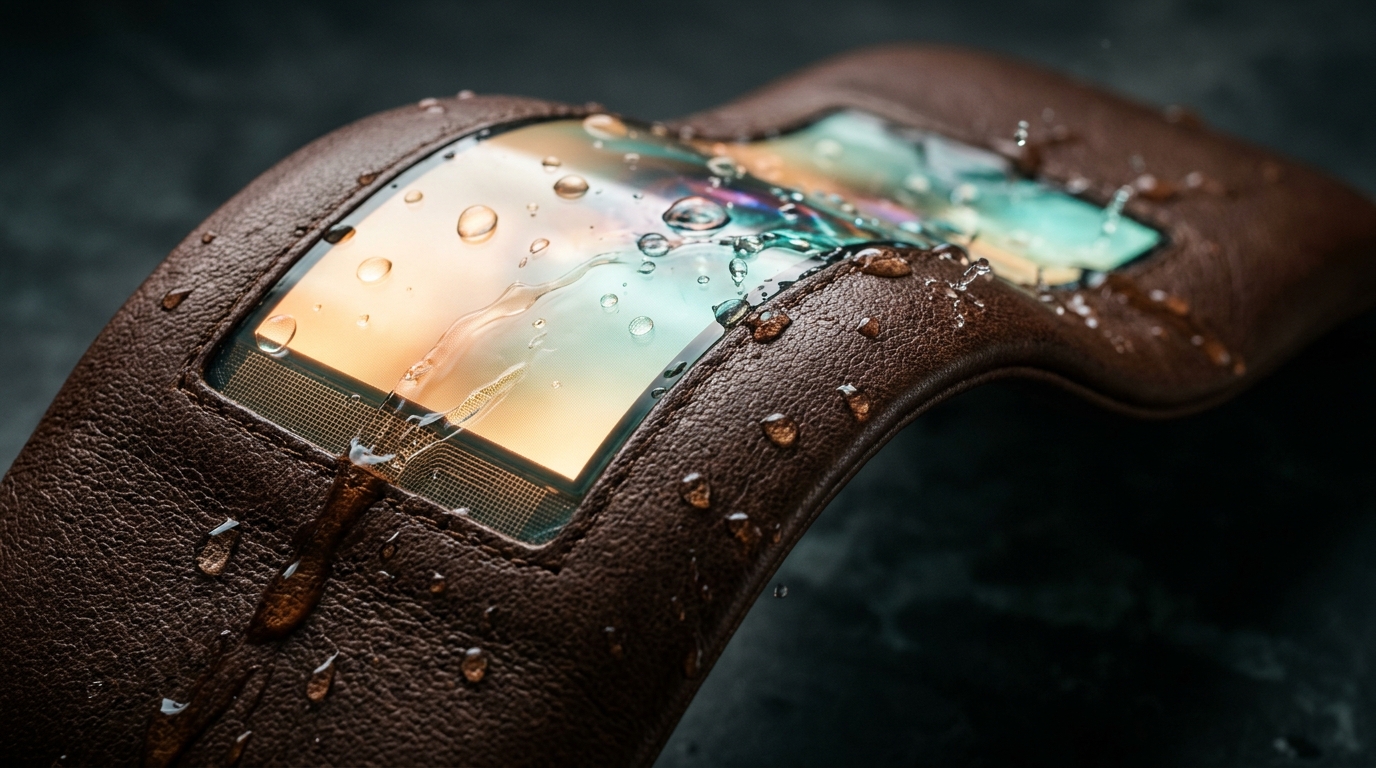
Engineers have turned ordinary chrome-tanned cowhide into a working flexible display that glows blue or orange on demand, shields against microwave radiation and keeps shining after a thousand bends, an hour in a washing bath and eight hours of continuous operation. The device, described in the journal Collagen and Leather, borrows two of the oldest tricks of the leather trade—retanning and finishing—and repurposes them as steps in an electronics fabrication line.
The team, led by Bi Shi of Sichuan University together with colleagues including Hanzhong Xiao, Ziying Hu, Hongjie Zhu, Yujia Wang and Xin Huang, started from a simple observation. Natural leather is mostly type I collagen, a protein arranged in a three-dimensional woven fibre network that gives the material exceptional tensile strength, softness and breathability. Untreated leather in their study showed a tensile strength of 18.69 newtons per square millimetre, a tear strength of 24.81 newtons per millimetre and a water-vapour transmission rate of 7990 grams per square metre per day. Those numbers describe a substrate that is mechanically tough yet comfortable against skin—an unusual combination in flexible electronics, where thin polymer films typically trade strength for flexibility.
The first fabrication step mimics retanning, the secondary tannage in which reactive groups on collagen fibres bind added chemicals. The researchers soaked five-centimetre squares of leather, each half a millimetre thick, in a solution of pyrrole monomer together with sodium p-toluenesulfonate as a dopant, then added ferric chloride as an oxidant and held the mixture at minus 20 degrees Celsius for three hours. Pyrrole molecules penetrated the leather and polymerised in place, coating the entire hierarchical fibre structure with polypyrrole. The result was a conductive leather with an electrical resistivity of 1.55 ohm centimetres, low enough to serve as the bottom electrode of an electroluminescent device while preserving the leather’s woven architecture.
Scanning electron microscopy confirmed that the polypyrrole uniformly sheathed the collagen fibres throughout the leather’s thickness, establishing a three-dimensional conductive network rather than a surface film. This architecture matters for two reasons. As an electrode, it distributes the applied electric field across the whole device. As a shielding material, the continuous fibrous network forces incoming electromagnetic waves into repeated internal reflections, dissipating their energy as they traverse the porous, conductive matrix.
The second step borrows from leather finishing, the industrial process used to coat protective polymer layers onto leather surfaces with strong adhesion. Following that principle, the team rod-coated the flesh side of the conductive leather with an electroluminescent layer made of polyurethane loaded with barium titanate and metal-doped zinc sulfide phosphors, then applied a top electrode of silver nanowires dispersed in water at 3.0 milligrams per millilitre. A final five-minute dip in a dilute polydimethylsiloxane solution sealed the stack. Electron microscopy and energy-dispersive X-ray mapping showed the silver nanowires in conformal contact with the phosphor layer and a clean, well-bonded interface between the electroluminescent layer and the conductive leather, with chromium from the leather side and zinc and barium from the phosphor layer matching precisely across the boundary.
The electroluminescent layer works through hot-electron impact excitation. When an alternating electric field is applied between the polypyrrole bottom electrode and the silver nanowire top electrode, accelerated charge carriers strike the doped zinc sulfide phosphors, which emit light. Barium titanate, a high-permittivity ceramic, was added to boost the local field strength on the phosphor particles and raise emission output. By choosing the dopant, the researchers tuned the colour: copper-doped zinc sulfide produced blue emission at 452 nanometres, with CIE colour coordinates of (0.1575, 0.1772), while manganese-doped zinc sulfide produced orange emission at 586 nanometres, with coordinates of (0.4224, 0.4876).
Driven at 110 volts and 1.0 kilohertz, a three-by-three-centimetre display reached a luminance of 56.45 candela per square metre, and when the team divided the emitting area into nine equal regions the relative intensity deviations among them stayed below 5 percent, indicating uniform output across the panel. Voltage and frequency offered additional control. At a fixed 400 hertz, luminance climbed from 3.26 to 53.92 candela per square metre as the voltage rose from 50 to 300 volts; at a fixed 300 volts, luminance rose from 17.88 to 53.92 candela per square metre as frequency increased from 100 to 400 hertz. Patterned displays were made simply by restricting the area coated with the top electrode or by cutting the panel into specific shapes.
Durability testing put the leather-derived interfacial bonding to the test. After 1000 bending cycles on a flexometer, the display still emitted 52.32 candela per square metre at 110 volts and 1.0 kilohertz. After 1000 abrasion cycles on a Martindale tester, luminance remained at 49.26 candela per square metre. Continuous electrical excitation for eight hours left a residual luminance of 52.56 candela per square metre, and after 60 minutes of magnetic stirring in deionised water the device still produced 49.41 candela per square metre. The finished display also retained the leather’s comfort credentials, recording a water-vapour transmission rate of 1340 grams per square metre per day—far above the 8.5 grams per square metre per day measured for a polyethylene terephthalate substrate—and tensile and tear strengths of 19.57 newtons per square millimetre and 20.03 newtons per millimetre, respectively.
The electromagnetic shielding results came from waveguide measurements across the 8.20 to 12.40 gigahertz band. The conductive leather alone shielded 2.4 to 2.7 decibels; adding the electroluminescent layer raised that to 2.8 to 3.2 decibels, and completing the full display brought the single-panel shielding effectiveness to 6.9 to 7.4 decibels. Stacking panels multiplied the effect in line with transmission line theory: two stacked displays exceeded 16.4 decibels and three stacked displays surpassed 25.8 decibels, blocking at least 99.8 percent of incident waves in that band. The three-panel stack also achieved more than 18.5 decibels against electromagnetic waves in the 2.60 to 3.95 gigahertz range. At 8.5 gigahertz, absorption accounted for 23.3 decibels of the total shielding while reflection contributed 2.6 decibels, marking the device as an absorption-reflection hybrid shield.
The authors argue that the approach does more than demonstrate one device. Because retanning and finishing are mature, high-throughput industrial processes, the same chemistry could in principle be scaled without new manufacturing infrastructure, and the multifunctional layer stack could be reconfigured for other leather-based electronics. For now, the leather display stands as a rare example of an ancient wearable material hosting a modern optoelectronic stack—one that bends, breathes, glows in two colours, survives the washing machine and quietly absorbs microwaves while it does so.
Subject of Research: A leather-based flexible display combining electroluminescent lighting and electromagnetic interference shielding
Article Title: Natural leather enabled skin-friendly, multifunctional and durable flexible display with integrated electroluminescent displaying and electromagnetic interference shielding performances
Article References: Xiao, H., Hu, Z., Zhu, H., Wang, Y., Huang, X., & Shi, B. (2026). Natural leather enabled skin-friendly, multifunctional and durable flexible display with integrated electroluminescent displaying and electromagnetic interference shielding performances. Collagen and Leather, 8(1), Article 41. https://doi.org/10.1186/s42825-026-00262-9
Image Credits: AI Generated
DOI: 10.1186/s42825-026-00262-9
Keywords: natural leather, flexible display, electroluminescence, polypyrrole, EMI shielding, collagen, water-vapour transmission, wearable electronics, retanning, finishing, AgNW electrode, durability
News Source: Denise Maddox. (November 4, 2026). Leather-Based Flexible Display Glows, Shields and Survives Washing. Scienmag.