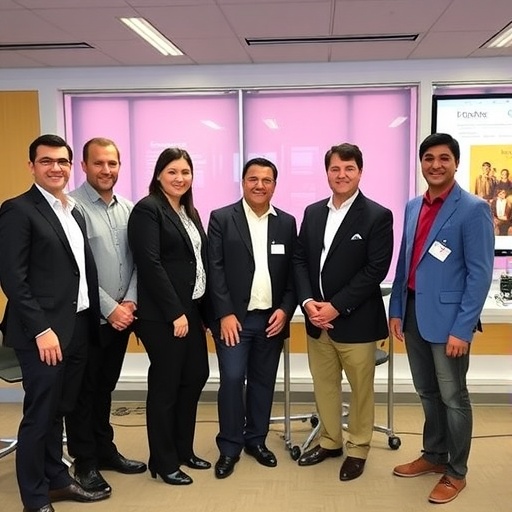
Building a genomics ‘information commons’ will enable more medical centers to share growing volumes of data

Credit: Boston Children’s Hospital
With a shared vision of accelerating genomic discovery and improving patient outcomes, leaders from Boston Children’s Hospital, Children’s Hospital of Philadelphia (CHOP), and Cincinnati Children’s Hospital (CCHMC) came together in 2015 to form the Genomics Research and Innovation Network (GRIN). Now, the hospitals plan to use a multi-year federal grant to scale up and extend the data-sharing collaboration to new institutions.
The award (grant #1U01TR002623-01A1) from the National Institute of Health’s National Center for Advancing Translational Sciences (NCATS) will transform GRIN into a larger “federation” of medical centers that are equipped to share large amounts of genomic information while protecting patient privacy. UPMC in Pittsburgh, and Washington University, St. Louis are two new institutions who have joined the project to help scale up.
“As medicine evolves from art to digital data-driven science, large datasets are needed for care and discovery,” says Kenneth Mandl, MD, MPH, director of the Boston Children’s Hospital Computational Health Informatics Program and the project’s principal investigator. “Clinicians and researchers need diverse reference populations to better understand individual patients’ genetic findings, while allowing data to remain with the patients and the hospitals that generated it. And those reference populations should resemble the patients being studied and treated.”
The power of numbers
The most significant barrier to pediatric research has been the ability to identify and recruit sufficiently large patient cohorts, especially when studying rare diseases. Expanding a nationally interconnected network of institutions will accelerate GRIN’s success at translating genomic discoveries into improved clinical care.
To determine whether a patient’s genes contain disease-causing mutations, their DNA must be compared with that from large populations. Furthermore, that DNA must be accompanied by contextual information about the population as a whole. Moreover, databases that are currently accessible to researchers or clinicians generally do not link genomic data to diagnosis, clinical progression, and therapeutic response. As a result, advances in incorporating genomics into the practice of 21st century medicine are limited.
“Genomics is impacting all aspects of health care and research in pediatrics,” said Ian Krantz, MD, director of the Roberts Individualized Medical Genetics Center at CHOP, also a GRIN leader and a co-investigator on the new grant. “In order to optimize the utility of this information for breakthroughs in care and discovering new cures, we need a new model to share data collaboratively across institutions. GRIN has stepped up to do this and this award is a validation of this approach to transforming precision medicine.”
“Patients with rare diseases should be an early beneficiary of this grant’s support of our federated collaborative network,” says another GRIN leader, Tracy Glauser MD, associate director of the Cincinnati Children’s Research Foundation and a co-investigator in the new grant. “There are over 7,000 rare diseases which in aggregate create a large impact on both pediatric and adult public health. The grant funding will accelerate our federated network’s ability to make both impactful discoveries and improve care through more rapid and efficient sharing of genomic information for all of these disorders.”
The GRIN Network has demonstrated the power of sharing comprehensive, hard-to-gather data about childhood diseases across multiple hospitals. A paper recently published in Genetics in Medicine describes how the network was established and reports proof-of-concept outcomes for three pilot studies on early childhood obesity, epilepsy, and growth disorders and short stature. The new grant will enhance GRIN’s biomedical informatics infrastructure and create shareable versions of its consents and agreements.
###
Media Contact
Kristen Dattoli
[email protected]
617-919-3141