• HOME
  • NEWS
  • EXPLORE
    • CAREER
      • Companies
      • Jobs
    • EVENTS
    • iGEM
      • News
      • Team
    • PHOTOS
    • VIDEO
    • WIKI
  • BLOG
  • COMMUNITY
    • FACEBOOK
    • INSTAGRAM
    • TWITTER
Tuesday, September 22, 2026
BIOENGINEER.ORG
No Result
View All Result
  • Login
  • HOME
  • NEWS
  • EXPLORE
    • CAREER
      • Companies
      • Jobs
        • Lecturer
        • PhD Studentship
        • Postdoc
        • Research Assistant
    • EVENTS
    • iGEM
      • News
      • Team
    • PHOTOS
    • VIDEO
    • WIKI
  • BLOG
  • COMMUNITY
    • FACEBOOK
    • INSTAGRAM
    • TWITTER
  • HOME
  • NEWS
  • EXPLORE
    • CAREER
      • Companies
      • Jobs
        • Lecturer
        • PhD Studentship
        • Postdoc
        • Research Assistant
    • EVENTS
    • iGEM
      • News
      • Team
    • PHOTOS
    • VIDEO
    • WIKI
  • BLOG
  • COMMUNITY
    • FACEBOOK
    • INSTAGRAM
    • TWITTER
No Result
View All Result
Bioengineer.org
No Result
View All Result
Home NEWS Science News Chemistry

Laying out directions for future of reliable blood clotting molecule models

Bioengineer by Bioengineer
November 19, 2019
in Chemistry
Reading Time: 3 mins read
0
IMAGE
Share on FacebookShare on TwitterShare on LinkedinShare on RedditShare on Telegram

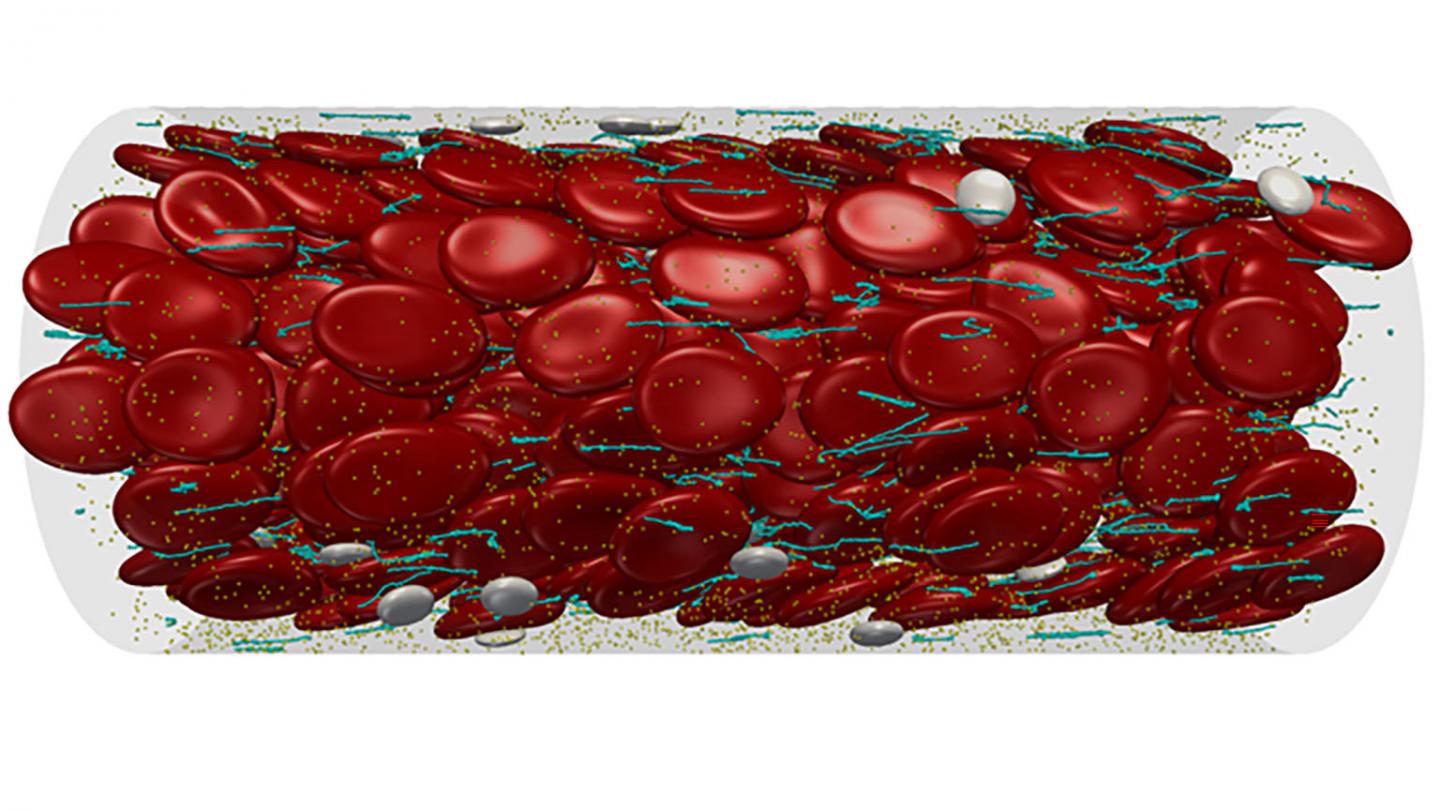
Emerging methods for simulating the net-forming molecule behind clots, von Willebrand Factor, point to several promising avenues for future thrombus therapies
IMAGE

Credit: Zixiang Liu


WASHINGTON, D.C., November 19, 2019 — Blood clots have long been implicated in heart attacks and strokes, together accounting for almost half of deaths annually in the United States. While the role of one key protein in the process, called von Willebrand factor, has been established, a reliable model for predicting how vWF collects in blood vessels remains elusive.

Researchers at the Georgia Institute of Technology published a review of recent work on understanding the behavior of vWF in APL Bioengineering, from AIP Publishing. The paper paints a portrait of vWF, which uncoils under the shear stress of blood flow to form nets that trap platelets passing by, which then form a blood clot, called a thrombus. By highlighting advances in the field, the authors put forth promising avenues for therapies in controlling these proteins.

“The thrombus must block blood flow as it closes off, like trying to use your thumb at the end of a garden hose and then stopping all flow with some mud,” said David Ku, an author on the paper. “This is extremely hard to accomplish, so thrombosis requires the fastest, strongest bonds in all of biology.”

One challenge is that many of today’s experimental models can only image events on the scale of microns every second or so. vWF proteins, however, are approximately one-thousandth of that size, and their interactions occur in one-thousandth of that time.

A variety of computer models have been proposed to bridge the gap from microscale to nanoscale in clot formation, ranging from simulations based on the time it takes for clots to form to computationally intensive models that re-create how platelets, vWF and cells all interact in the bloodstream. The paper calls on researchers across biology, computer science and other areas to collaborate to build an improved model.

In addition to targeting platelet aggregation and high-shear environments that stretch vWF, one potential therapy is to enhance the activity of another protein, ADAMTS13, which cleaves vWF and renders it unable to form clots. While research in mouse models shows promise, much work is still required to determine if ADAMTS13 therapies would be safe or effective for humans.

Ku’s own research pointed to negatively charged nanoparticles that computational modeling has shown might keep vWF in its coiled unreactive state. The group found the nanoparticles reduce how quickly vessels become occluded and are exploring how to explain and optimize this process.

Ku said he hopes the paper will inspire others to dive deeper into new ways of measuring and understanding the clot-forming vWF.

###

The article, “Occlusive thrombosis in arteries,” is authored by Dongjune Albert Kim, Christopher Bresette, Zixiang Liu and David N. Ku. The article will appear in APL Bioengineering on Nov. 19, 2019 (DOI: 10.1063/1.5100292). After that date, it can be accessed at https://aip.scitation.org/doi/10.1063/1.5115554.

ABOUT THE JOURNAL

APL Bioengineering is devoted to research at the intersection of biology, physics, and engineering. The journal publishes high-impact manuscripts specific to the understanding and advancement of physics and engineering of biological systems. APL Bioengineering is the new home for the bioengineering and biomedical research communities. See https://aip.scitation.org/journal/apb.

Media Contact
Larry Frum
[email protected]
301-209-3090

Related Journal Article

http://dx.doi.org/10.1063/1.5100292

Tags: Algorithms/ModelsBiologyBiomechanics/BiophysicsCardiologyChemistry/Physics/Materials SciencesMedicine/Health
Share13Tweet8Share2ShareShareShare2

Related Posts

Free Open-Source Workflow Matches Costly Software in Screening Bauxite Residue’s Climate Footprint

Free Open-Source Workflow Matches Costly Software in Screening Bauxite Residue’s Climate Footprint

September 21, 2026
Waste Catalyst Turned Air Purifier Destroys Formaldehyde at Room Temperature

Waste Catalyst Turned Air Purifier Destroys Formaldehyde at Room Temperature

September 21, 2026

Flame-Proof Phosphate Electrolytes May Unlock Safer Sodium Batteries

September 21, 2026

Biodegradable Hydrogel Beads Keep Beneficial Fungus Alive and Boost Pepper Growth

September 21, 2026
Please login to join discussion

POPULAR NEWS

  • Leopard Genomics Paper on South Africa’s Cape Floristic Region Retracted

    29 shares
    Share 12 Tweet 7
  • AI Learns to Forget: New Hypernetwork Framework Enables Data-Free Unlearning

    29 shares
    Share 12 Tweet 7
  • Elite Powerlifting Study Reveals the Myth of the Bodyweight Multiplier

    29 shares
    Share 12 Tweet 7
  • Evidence Under Fire: New Debate Over How Medication Optimisation Tools Should Be Judged

    29 shares
    Share 12 Tweet 7

About

We bring you the latest biotechnology news from best research centers and universities around the world. Check our website.

Follow us

Recent News

Leopard Genomics Paper on South Africa’s Cape Floristic Region Retracted

AI Learns to Forget: New Hypernetwork Framework Enables Data-Free Unlearning

Elite Powerlifting Study Reveals the Myth of the Bodyweight Multiplier

Subscribe to Blog via Email

Enter your email address to subscribe to this blog and receive notifications of new posts by email.

Join 85 other subscribers
  • Contact Us

Bioengineer.org © Copyright 2023 All Rights Reserved.

Welcome Back!

Login to your account below

Forgotten Password?

Retrieve your password

Please enter your username or email address to reset your password.

Log In
No Result
View All Result
  • Homepages
    • Home Page 1
    • Home Page 2
  • News
  • National
  • Business
  • Health
  • Lifestyle
  • Science

Bioengineer.org © Copyright 2023 All Rights Reserved.