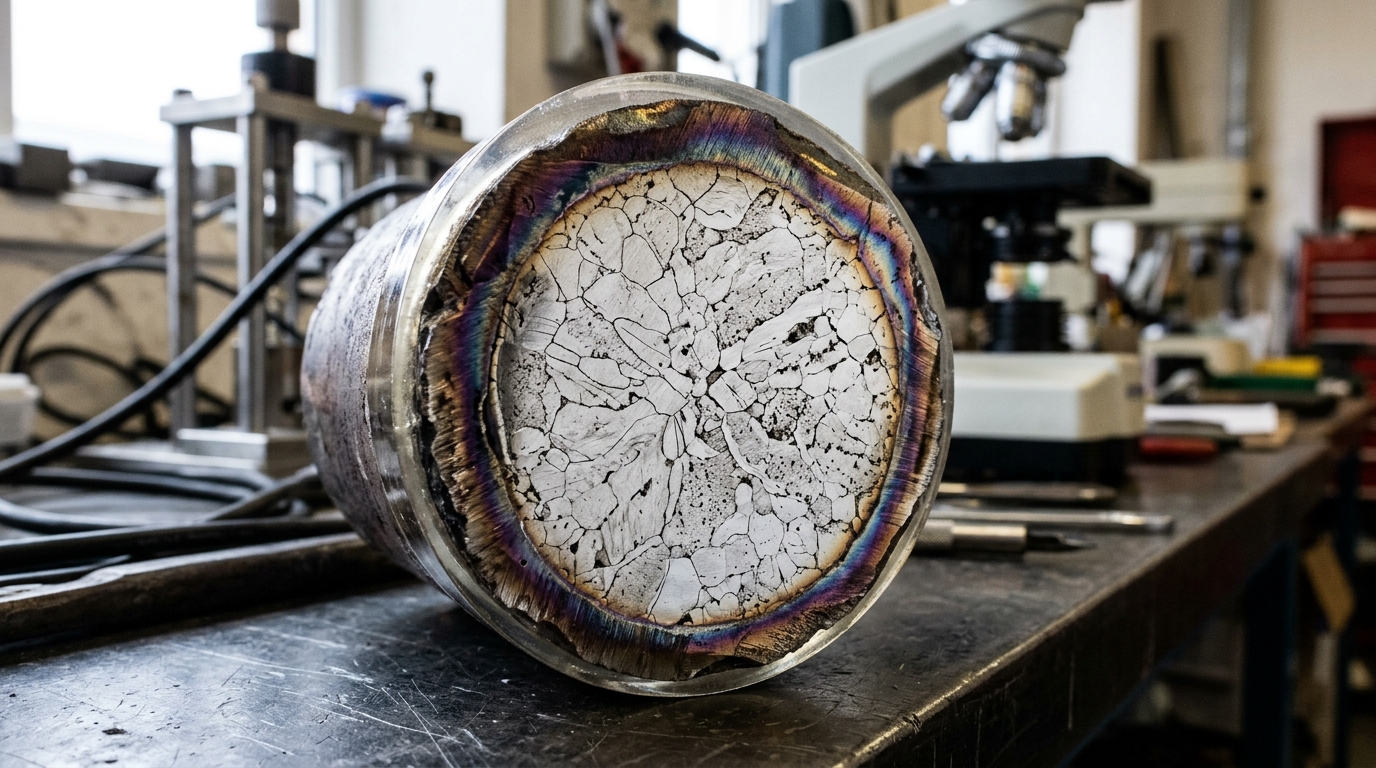
Continuous precipitation and coarsening of the Laves phase are the primary drivers of sustained creep resistance degradation in long-term aged 9% chromium heat-resistant steel, according to experimental investigations of microstructural evolution. Researchers observed that even fine, dispersed Laves phase particles formed during the early stages of thermal aging, measuring an average size of approximately 170 nanometers, are detrimental to the material’s creep properties.
The 9% chromium heat-resistant steels serve as critical components under prolonged high-temperature and high-pressure conditions in ultra-supercritical power plants. Standard structural design and remaining service life assessments for these power plant components have traditionally relied on the creep properties of as-received materials, omitting the microstructural degradation and diminished creep resistance that develop over extended operating periods.
To evaluate these long-term degradation mechanisms, commercial 9% chromium steel samples underwent isothermal thermal aging at temperatures of 600 degrees Celsius and 650 degrees Celsius for durations spanning 3,000 to 10,000 hours. Subsequent constant-load uniaxial creep testing was conducted at 600 degrees Celsius under mechanical stress levels of 160, 180, and 190 megapascals.
The mechanical tests revealed that creep rupture life decreased and the minimum creep rate increased monotonically with higher aging temperatures and longer durations, while creep ductility increased to varying degrees. The steel’s creep threshold stress fell progressively from 145 megapascals in the as-received condition to 108 megapascals after 10,000 hours of aging at 650 degrees Celsius. Additionally, the creep damage tolerance factor lambda ranged between 6 and 9.5, confirming that microstructural degradation served as the dominant creep damage mechanism.
Quantitative microstructural characterization demonstrated that dislocation density decreased and both martensitic laths and intergranular M23C6 carbides coarsened slightly during the thermal exposure. However, because these specific microstructural parameters exhibited no significant differences across the varied aging states, they did not account for the continuous decline in mechanical endurance.
In contrast, the progressive growth of Laves phase particles correlated directly with the monotonic decrease in creep rupture life. These precipitates depleted tungsten and molybdenum solute atoms from the matrix, diminished pinning resistance against moving dislocations and grain boundaries, and generated local stress concentrations at particle-matrix interfaces that facilitated creep void nucleation. The researchers note that these long-term creep measurements and mechanistic insights provide essential guidance for refining structural design and remaining life assessments in ultra-supercritical energy facilities.
The findings clarify a long-standing controversy regarding the effect of the Laves phase on the creep properties of 9% chromium heat-resistant steel.
Subject of Research: Creep resistance degradation and Laves phase evolution in aged 9% Cr steel
Article Title: Degradation mechanisms of creep resistance dominated by Laves phase in long-term aged 9% Cr heat-resistant steel
Article References: Tian, G., Wang, M., Shi, C., Zhang, Z., Xu, Y., Ma, S., Ye, C., Fu, L., Zhao, S., Wang, Y., & Shan, A. (2026). Degradation mechanisms of creep resistance dominated by Laves phase in long-term aged 9% Cr heat-resistant steel. Journal of Materials Science. https://doi.org/10.1007/s10853-026-13781-x
Image Credits: AI Generated
DOI: 10.1007/s10853-026-13781-x
Keywords: 9% Cr steel, creep resistance, Laves phase, thermal aging, power plants, microstructural degradation, threshold stress, materials science, Degradation, mechanisms, creep, resistance
News Source: Denise Maddox. (November 6, 2026). Laves Phase Drives Creep Resistance Degradation in Aged Chromium Steel. Scienmag.