• HOME
  • NEWS
  • EXPLORE
    • CAREER
      • Companies
      • Jobs
    • EVENTS
    • iGEM
      • News
      • Team
    • PHOTOS
    • VIDEO
    • WIKI
  • BLOG
  • COMMUNITY
    • FACEBOOK
    • INSTAGRAM
    • TWITTER
Friday, May 15, 2026
BIOENGINEER.ORG
No Result
View All Result
  • Login
  • HOME
  • NEWS
  • EXPLORE
    • CAREER
      • Companies
      • Jobs
        • Lecturer
        • PhD Studentship
        • Postdoc
        • Research Assistant
    • EVENTS
    • iGEM
      • News
      • Team
    • PHOTOS
    • VIDEO
    • WIKI
  • BLOG
  • COMMUNITY
    • FACEBOOK
    • INSTAGRAM
    • TWITTER
  • HOME
  • NEWS
  • EXPLORE
    • CAREER
      • Companies
      • Jobs
        • Lecturer
        • PhD Studentship
        • Postdoc
        • Research Assistant
    • EVENTS
    • iGEM
      • News
      • Team
    • PHOTOS
    • VIDEO
    • WIKI
  • BLOG
  • COMMUNITY
    • FACEBOOK
    • INSTAGRAM
    • TWITTER
No Result
View All Result
Bioengineer.org
No Result
View All Result
Home NEWS Science News Chemistry

Lack of damage after secondary impacts surprises researchers

Bioengineer by Bioengineer
June 23, 2020
in Chemistry
Reading Time: 3 mins read
0
IMAGE
Share on FacebookShare on TwitterShare on LinkedinShare on RedditShare on Telegram

Study on damage caused by high-velocity impacts provides answers about how materials exposed to secondary shocks recompact
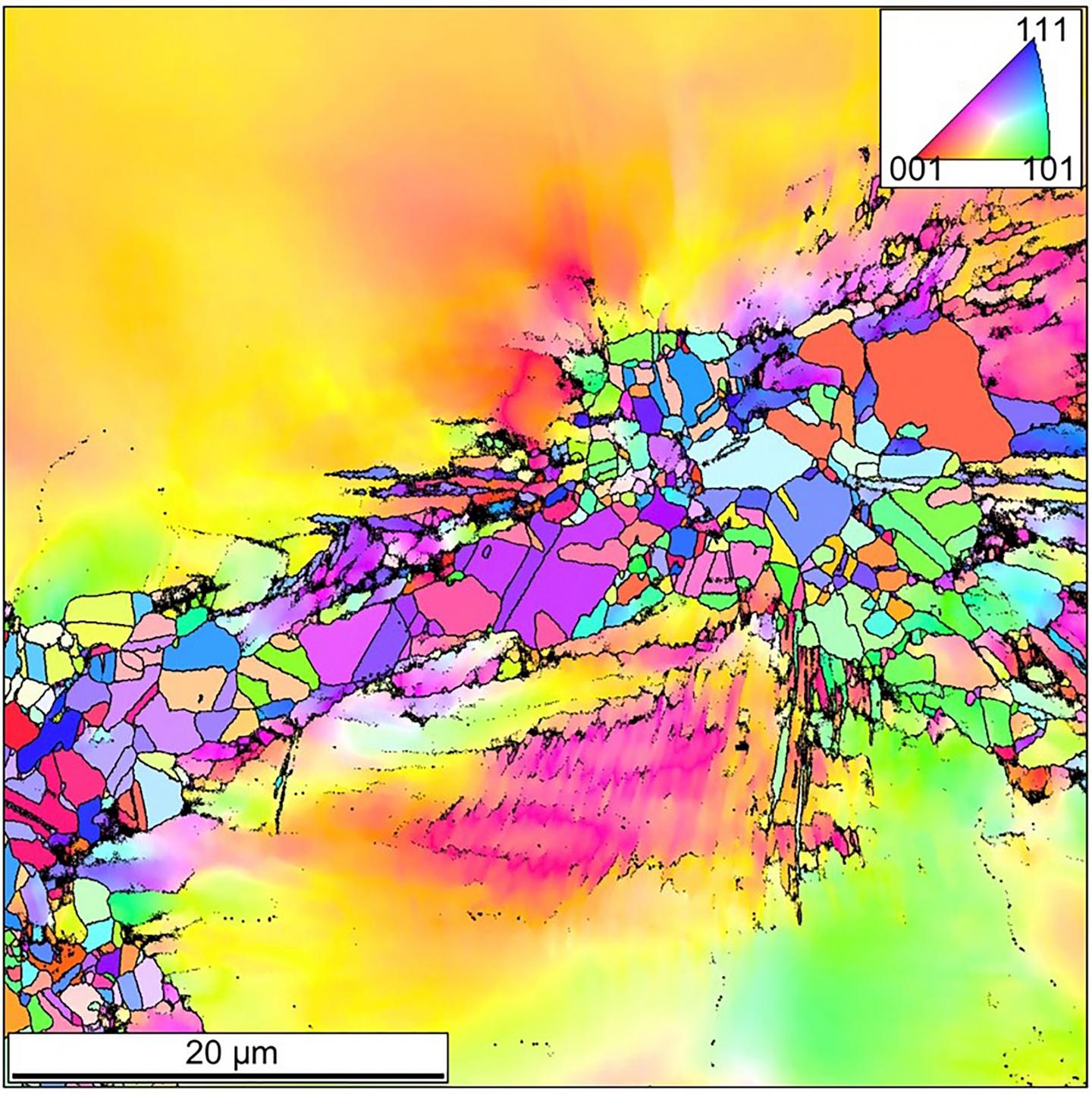
IMAGE

Credit: David Jones

WASHINGTON, June 23, 2020 — When a material is subjected to an extreme load in the form of a shock or blast wave, damage often forms internally through a process called spall fracture.

Since these types of intense events are rarely isolated, research is needed to know how damaged materials respond to subsequent shock waves — a piece of armor isn’t much use if it disintegrates after one impact.

To the surprise of researchers, recent experimentation on spall fracture in metals found that, in certain cases, there was an almost complete lack of damage with only a thin band of altered microstructure observed. Usually, under these sorts of conditions, the material would contain hundreds of small voids and cracks.

In an article for the Journal of Applied Physics, published by AIP Publishing, researchers from Los Alamos National Laboratory narrowed down exactly why the expected damage was missing.

“Conflicting hypotheses were suggested for the lack of damage. Was there some sort of strengthening occurring, so that damage never nucleated, or was the damage recompacted to a fully dense state by some other loading?” said author David Jones. “By splitting the experiment into two phases — damage formation and recompaction — we could determine which hypothesis was correct.”

Materials experiencing shock damage at high strain rates from a sudden impact will exhibit significantly different behavior compared to their response under standard, low-rate mechanical testing.

The researchers used gas-gun flyer-plate impact experiments to first damage samples, and then impact these samples a second time to see how the shock wave interacts with the damage field, which had not been done before. They found a shock stress of just 2 to 3 gigapascal actually recompacted a damaged copper target and created a new bond where the once broken surfaces were brought back together.

“This research, where careful experiments are used to isolate the strength and damage response of a material under shock loading, helps to reveal how microstructure plays a key role in dynamic response,” said Jones.

The authors hope the future of shock physics research will involve next-generation free electron X-ray lasers, a game-changing tool.

“Being able to image in real time these micrometer-scale, microsecond-duration damage events in metals will be a paradigm shift in shock physics diagnostics,” said Jones.

###

The article, “Shock recompaction of spall damage,” is authored by David Jones, Saryu Fensin, Benjamin Morrow, Daniel Martinez and Robert Hixson. The article will appear in the Journal of Applied Physics on June 23, 2020 (DOI: 10.1063/5.0011337). After that date, it can be accessed at https://aip.scitation.org/doi/10.1063/5.0011337.

ABOUT THE JOURNAL

The Journal of Applied Physics is an influential international journal publishing significant new experimental and theoretical results in all areas of applied physics. See https://aip.scitation.org/journal/jap.

Media Contact
Larry Frum
[email protected]

Related Journal Article

http://dx.doi.org/10.1063/5.0011337

Tags: Atomic/Molecular/Particle PhysicsChemistry/Physics/Materials SciencesMaterialsMolecular PhysicsTechnology/Engineering/Computer Science
Share12Tweet8Share2ShareShareShare2

Related Posts

Scientists Overcome Longstanding Challenge in Measuring Semiconductor Defects — Chemistry

Scientists Overcome Longstanding Challenge in Measuring Semiconductor Defects

May 14, 2026
Wall Design Highlights Deaf and Hard-of-Hearing Experience at #ASA190 — Chemistry

Wall Design Highlights Deaf and Hard-of-Hearing Experience at #ASA190

May 14, 2026

New Method Finds More Efficient Route Between Earth and Moon Than Ever Before

May 14, 2026

Unveiling the Unseen: Exploring the Boundaries of Two-Photon Vision

May 14, 2026
Please login to join discussion

POPULAR NEWS

  • Research Indicates Potential Connection Between Prenatal Medication Exposure and Elevated Autism Risk

    842 shares
    Share 337 Tweet 211
  • New Study Reveals Plants Can Detect the Sound of Rain

    729 shares
    Share 291 Tweet 182
  • Salmonella Haem Blocks Macrophages, Boosts Infection

    62 shares
    Share 25 Tweet 16
  • Breastmilk Balances E. coli and Beneficial Bacteria in Infant Gut Microbiomes

    58 shares
    Share 23 Tweet 15

About

We bring you the latest biotechnology news from best research centers and universities around the world. Check our website.

Follow us

Recent News

Comprehensive Study Finds No Clear Association Between Common Antidepressant Use During Pregnancy and Autism or ADHD in Children

Viagra Shows Promise as Potential Treatment to Halt Peyronie’s Disease

Screening Leads to Moderate Reduction in Prostate Cancer Mortality

Subscribe to Blog via Email

Enter your email address to subscribe to this blog and receive notifications of new posts by email.

Join 82 other subscribers
  • Contact Us

Bioengineer.org © Copyright 2023 All Rights Reserved.

Welcome Back!

Login to your account below

Forgotten Password?

Retrieve your password

Please enter your username or email address to reset your password.

Log In
No Result
View All Result
  • Homepages
    • Home Page 1
    • Home Page 2
  • News
  • National
  • Business
  • Health
  • Lifestyle
  • Science

Bioengineer.org © Copyright 2023 All Rights Reserved.