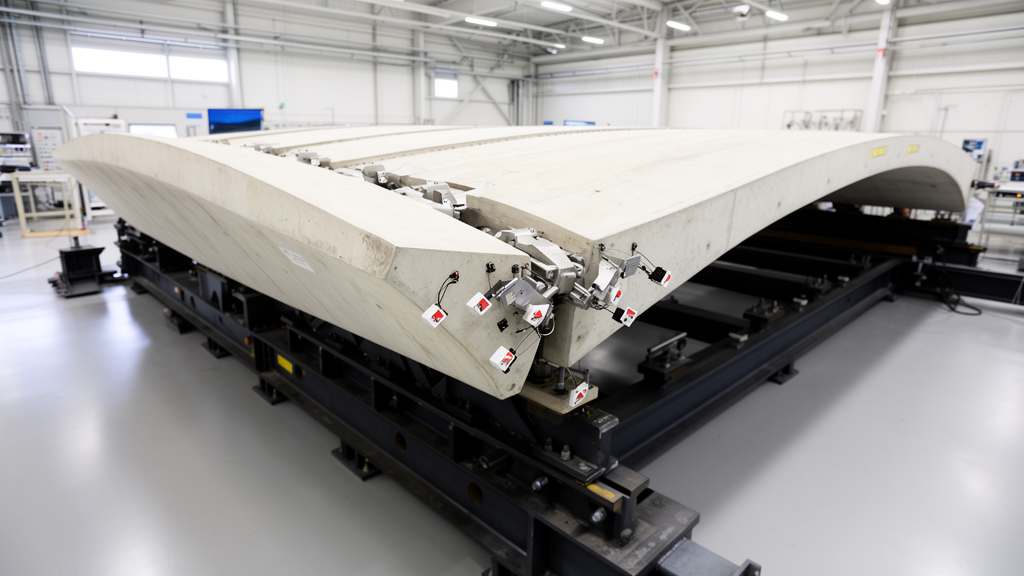
A geometric-kinematic modeling study combined with a dual-strategy heuristic screening method to evaluate ductile-hinge layouts for multi-body coordinated incremental launching of spatially curved bridges. The work focused on a 1,991-metre steel box-girder viaduct weighing 36,000 tonnes, a construction arrangement intended for bridge projects where site constraints limit conventional launching conditions.
The framework represents bridge segments as composite rigid bodies and updates their positions through chainage-based boundary lookup. Spatial posture is calculated with a safeguarded endpoint-based Rodrigues transformation, allowing the model to track how the coordinated system changes as the launching sequence proceeds. The study presents the approach as a quantitative pre-construction tool rather than as a field demonstration.
To screen potential hinge arrangements, the researchers combined a proximity rule for detecting lateral-deviation exceedances with a global assessment of candidates associated with height-difference exceedances. The heuristic was designed to identify feasible layouts with fewer ductile hinges. In the reported case, one simulation containing 772 states took approximately 14 seconds, illustrating the computational efficiency sought by the model.
For the example viaduct, adding five hinges reduced the maximum lateral deviation from 2.997 metres to 0.911 metres. The maximum height difference fell from 1.727 metres to 0.586 metres. Internal geometric checks and convergence checks supported the numerical consistency of the simulations, while the fixed-layout test found that the selected arrangement remained within the stated 1.0-metre lateral-deviation and 0.8-metre height-difference constraints across 100 simulations with independent 10-millimetre coordinate perturbations.
These results show how a kinematic simulation can be linked to hinge-layout screening in an incremental-launching process for bridges with spatially variable curvature. The study does not establish performance in completed bridge projects, and the reported evidence is limited to modeling, numerical checks and perturbation simulations. Its contribution is a computational method for comparing layouts and quantifying changes in geometric deviations before construction, with the authors describing the approach as a design tool for multi-body coordinated incremental launching of spatially curved bridges.
Subject of Research: Computational screening of ductile-hinge layouts for spatially curved bridge launching
Article Title: Kinematic modeling and dual-strategy heuristic screening of ductile hinge layout for multi-body coordinated incremental launching of spatial curve bridges
Article References: Zhang, X., Xiao, L., Li, M., Chen, L., Wang, M., Zheng, H., & Zhu, H. (2026). Kinematic modeling and dual-strategy heuristic screening of ductile hinge layout for multi-body coordinated incremental launching of spatial curve bridges. Scientific Reports. https://doi.org/10.1038/s41598-026-76812-2
Image Credits: AI Generated
DOI: 10.1038/s41598-026-76812-2
Keywords: bridge engineering, incremental launching, ductile hinges, kinematic modeling, curved bridges, composite rigid bodies, geometric deviation, construction design, steel box girders, Kinematic, modeling, dual-strategy
News Source: Denise Maddox. (October 26, 2026). Kinematic Model Tests Ductile-Hinge Layouts for Curved Bridge Launching. Scienmag.