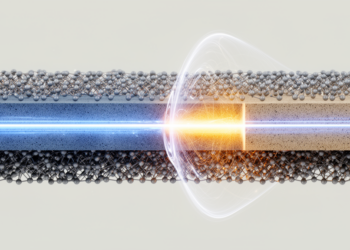
A review of flame-retardant polymer nanocomposites identifies porous ZIF-67 metal-organic framework material as a versatile platform for combining phosphorus-, clay- and carbon-based flame retardants. The researchers report that ZIF-67’s porous structure can improve the dispersion of flame-retardant components within polymer matrices, while its cobalt-containing active sites can promote protective char formation during combustion. Together, these features may slow heat transfer, reduce the release of combustible products and suppress smoke.
The study, published in Advanced Nanocomposites as “ZIF-67-driven synergistic strategies for high-performance flame retardant polymer nanocomposites,” examines how the framework can act as more than a passive filler. Its adjustable chemistry and cobalt-based sites allow it to work with different classes of flame retardant, creating systems intended to address several aspects of polymer fire behavior at once. The work is a review and analysis of experimental strategies rather than a report of a single newly demonstrated application.
The review groups preparation routes into four categories: direct mixing, in situ growth, etching and conversion into carbon-based derivatives. Each route offers a different way to incorporate ZIF-67 into a polymer nanocomposite. The authors present these approaches as design options for developing multifunctional polymer materials with improved fire safety and potential additional functions such as electromagnetic protection and thermal management.
The summary does not provide numerical performance gains or identify a commercially deployed product. The proposed flame-retardant systems are described as synergistic: ZIF-67 is intended to work with phosphorus-, clay- or carbon-based components rather than deliver all of its effects independently. Its pore network can help distribute flame-retardant phases throughout the polymer and improve their dispersion.
During combustion, cobalt-containing sites can facilitate protective carbon-layer formation, while the combined system may slow heat transfer, reduce combustible-product release and suppress smoke. These are mechanisms identified by the review in relation to flame-retardant polymer nanocomposites, not outcomes of a new clinical or commercial trial. The authors identify three priorities for subsequent research: scalable preparation methods, improved understanding of how ZIF-67-based structures evolve during combustion and development of intelligent fire-resistant materials for practical applications.
The review also points to the need to connect structural behavior under combustion conditions with the resulting flame, heat and smoke behavior.
Subject of Research: Review of ZIF-67 strategies for flame-retardant polymer nanocomposites
Article Title: New method for safer plastics through porous ZIF-67 materials
Article References: New method for safer plastics through porous ZIF-67 materials. Original publication (Bibliographic details unavailable.)
Image Credits: AI Generated
DOI: Not provided
Keywords: ZIF-67, metal-organic frameworks, polymer nanocomposites, flame retardants, fire safety, smoke suppression, protective char, materials chemistry, nanotechnology, electromagnetic protection, method, safer
News Source: Neil Sanderson. (October 26, 2026). Review finds ZIF-67 supports synergistic flame-retardant polymer strategies. Scienmag.