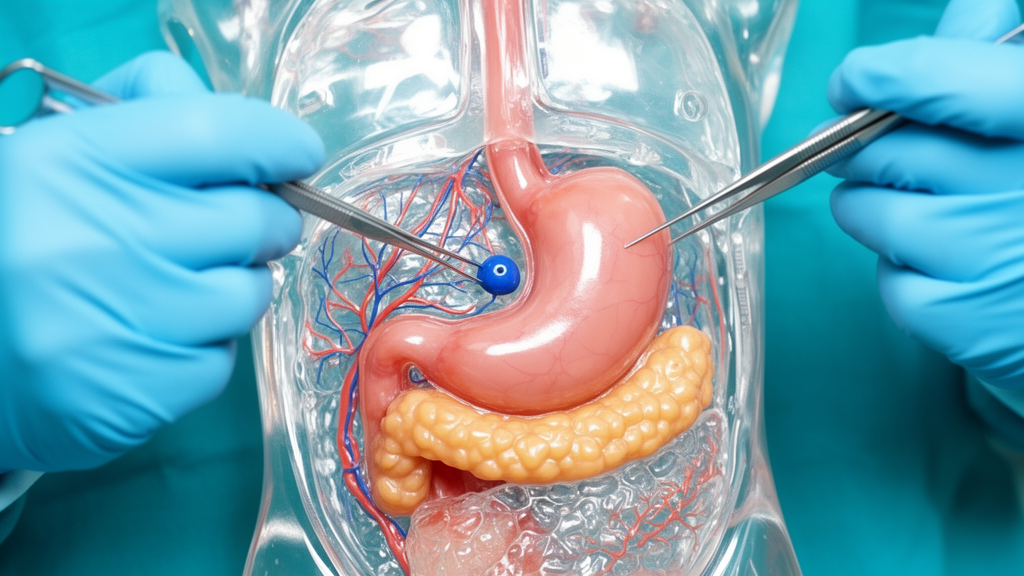
A multicenter retrospective study of 105 patients with stage I or II gastric cancer found that function-preserving gastrectomy based on sentinel node navigation was associated with less loss of pancreatic volume than total gastrectomy over five years. The study, reported in Scientific Reports , included 33 patients who underwent sentinel node navigation surgery and 72 who received total gastrectomy between 2002 and 2020; all were recurrence-free through five years. Researchers measured pancreatic volume with computed tomography-based volumetry before surgery and again one, three and five years afterward.
Their primary outcome was relative pancreatic volume, expressed as %PV. The median %PV was higher in the sentinel node navigation group at every follow-up point: 87.3% versus 77.4% at one year, 87.1% versus 76.2% at three years, and 89.5% versus 71.3% at five years for the sentinel node navigation and total gastrectomy groups, respectively. Each difference was statistically significant, with all reported P values below 0.001.
The surgical procedure was independently associated with %PV at five years in multivariate analysis, for which the reported P value was 0.002. The association remained significant in sensitivity analyses. A separate imaging measure, the relative duct-parenchymal ratio at five years, was greater in the total gastrectomy group, with P = 0.044.
Thus, the groups differed not only in the amount of pancreatic tissue retained but also in the relationship between the pancreatic duct and surrounding parenchyma. The results do not establish that sentinel node navigation surgery directly prevents pancreatic atrophy. Because the study was retrospective and observational, the groups may have differed in ways beyond the type of surgery.
The authors also note that the observed difference reflects the combined effects of the extent of gastric resection and lymphadenectomy, so the analysis cannot isolate which component produced the volume advantage. Prospective confirmation would be needed before stronger causal or clinical conclusions could be drawn. Pancreatic atrophy following gastrectomy has been linked to exocrine pancreatic insufficiency and nutritional decline.
Its supported conclusion is therefore limited: among the selected, recurrence-free patients studied, the procedure was associated with better pancreatic volume preservation than total gastrectomy over five years, while the relative duct-parenchymal ratio moved in the opposite direction.
Subject of Research: Five-year pancreatic volume after sentinel node navigation gastrectomy versus total gastrectomy for stage I or II gastric cancer
Article Title: Long-term pancreatic volume after function-preserving gastrectomy based on the sentinel node concept versus total gastrectomy for gastric cancer
Article References: Shirao, S., Arigami, T., Uenosono, Y., Yanagita, S., Hirase, Y., Sakoda, M., Hayashi, T., Kurahara, H., Tanabe, K., Tsuruda, Y., Matsushita, D., Shimonosono, M., Okubo, K., Noda, M., Sasaki, K., & Ohtsuka, T. (2026). Long-term pancreatic volume after function-preserving gastrectomy based on the sentinel node concept versus total gastrectomy for gastric cancer. Scientific Reports. https://doi.org/10.1038/s41598-026-76022-w
Image Credits: AI Generated
DOI: 10.1038/s41598-026-76022-w
Keywords: gastric cancer, sentinel node navigation, function-preserving gastrectomy, pancreatic atrophy, pancreatic volume, total gastrectomy, computed tomography volumetry, retrospective cohort, Long-term, pancreatic, volume, function-preserving
News Source: Denise Maddox. (October 26, 2026). Sentinel-node gastrectomy linked to better five-year pancreatic volume preservation. Scienmag.