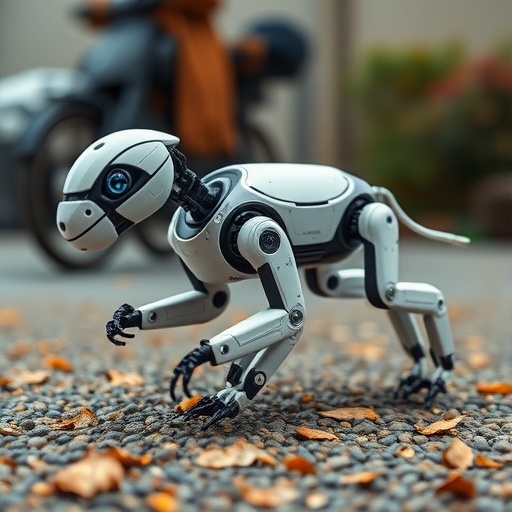
An era where robots can decide for themselves how to move outdoors is taking shape. KAIST has unveiled a quadrupedal robot control system that lets a single agent choose the most suitable locomotion mode—walking, running, jumping, and more—while conditions change in real time. Instead of following a fixed routine, the robot adapts gait as it encounters stairs, gaps, ledges, and uneven forest trails.
The core challenge is that “fast” is not enough in the wild. Real environments combine obstacles in unpredictable 3D configurations, making it difficult for conventional four-legged robots to maintain both speed and stability. Many existing systems still treat each gait as a separate control problem, limiting smooth transitions when terrain abruptly shifts.
To address this, the KAIST team introduced APT-RL (Action Pretrained Transformer-based Reinforcement Learning). The method is designed to first acquire a library of locomotion skills and then seamlessly blend and switch among them during deployment. The result is a controller capable of integrating multiple movement primitives into one continuous decision process.
Training did not rely on motion capture. Instead, the researchers generated 15.5 hours of simulated training data covering diverse gaits in only eight minutes. The robot learned from simulated physics using robot dynamics models and trajectory optimization, enabling efficient acquisition of basic movement capabilities without recording human or animal motion.
After pretraining, reinforcement learning shaped an autonomous policy that selects gaits appropriate for complex terrain. With perception inputs, the robot can respond to obstacles across stairs, ledges, and gaps, selecting actions that preserve balance while meeting target speed requirements.
The system combines a depth camera and LiDAR to obtain three-dimensional information about the surroundings. This sensor fusion supports real-time recognition of nearby structures and allows the controller to match locomotion strategy to both terrain geometry and desired velocity.
Experiments were conducted on the team’s robot, “KAIST HOUND.” Tests included indoor obstacle courses and real outdoor routes around KAIST campus and forest trails, where the robot navigated irregular surfaces such as roots, fallen branches, and leaf-covered paths.
Performance results highlight both agility and stability. In rugged terrain, KAIST HOUND achieved a peak instantaneous speed of about six meters per second (roughly 22 km/h) while adapting gait on the fly. The robot demonstrated autonomous transitions between trot and bound and integrated walking, running, jumping, and ledge-clearing within a unified controller.
The researchers describe the work as a foundational step toward physical-AI quadrupeds that can operate in rugged settings. They point to future impact in disaster response, defense missions, and industrial inspections where reliable locomotion under uncertainty is essential.
Subject of Research: Quadrupedal robot multi-skill locomotion control for real outdoor environments
Article Title: Agile perceptive multi-skill locomotion for quadrupedal robots in the wild
News Publication Date: 16-Jul (announced); published July 15, 2026 (U.S. Eastern time)
Web References: http://dx.doi.org/10.1126/scirobotics.adz7397
References: DOI: 10.1126/scirobotics.adz7397
Image Credits: KAIST
Keywords
quadrupedal robots, locomotion skills, reinforcement learning, perception, LiDAR, depth camera, real-world agility, gait switching, trajectory optimization, physical-AI
Tags: adaptive gait transitionAI-powered animal-like robotsautonomous outdoor mobilitymulti-gait robotic controlobstacle navigation in roboticsquadrupedal robot locomotionreal-time environment perceptionreinforcement learning for roboticsseamless movement controlsimulation-based robot trainingterrain adaptability in robotstransformer-based reinforcement learning