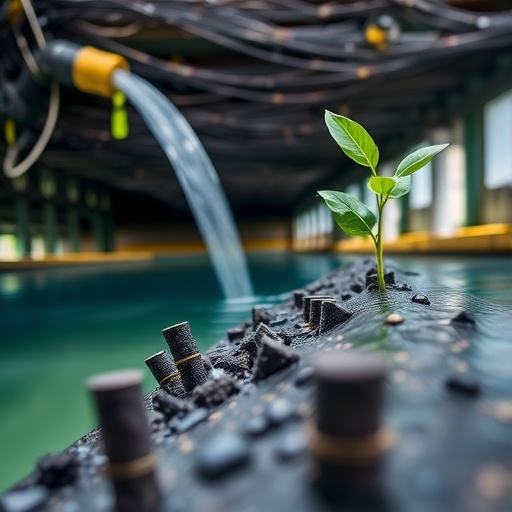
Biochar—carbon-rich material produced from agricultural and forestry residues, manure, sludge, and other biomass—has emerged as a low-cost candidate for wastewater purification. Its porous network and reactive surface chemistry can adsorb pollutants, turning waste-derived carbon into an environmental tool. Yet the leap from lab promise to dependable treatment is not automatic.
Unmodified biochar often underperforms in practice: it can have limited adsorption capacity, weak selectivity toward specific emerging contaminants, and a fine, powder-like form that is difficult to separate and reuse after treatment. These constraints matter when targeting substances beyond traditional heavy metals and dyes, including antibiotics, perfluorinated compounds, and microplastics.
A 2026 literature review in Sustainable Carbon Materials synthesizes how researchers are engineering biochar-based composites to overcome these barriers while addressing an overlooked question—what happens to the material and the captured contaminants over its full life cycle. The authors argue that performance gains should not be purchased through new environmental liabilities.
“Biochar composites should not be designed only to remove more pollutants,” corresponding author Cui Wang of Chang’an University says. The review proposes evaluation frameworks that combine treatment efficiency with stability, recoverability, energy use, and environmental safety.
The paper analyzes how biomass feedstock and carbonization conditions (temperature, atmosphere, and process choices) reshape pore structure and surface groups, while modification strategies tune electrical properties and reactivity. It also groups composite approaches by function, including magnetic biochar, metal oxide/hydroxide-modified biochar, and nanoparticle-coated biochar.
These engineered materials can improve removal via pore filling, electrostatic attraction, ion exchange, surface complexation, hydrogen bonding, and interactions among aromatic structures. Some systems also shift from simple capture toward catalytic degradation, potentially transforming pollutants rather than merely immobilizing them.
However, the same modifications that boost uptake can raise hidden costs: greater chemical and energy requirements, more complex manufacturing, nanoparticle or active-site leakage, pore blockage, and the risk of releasing accumulated contaminants if regeneration and disposal are inadequate.
The review urges moving beyond single-pollutant, ideal test conditions. Real wastewater contains salts, natural organic matter, competing ions, and shifting pH—factors that can change adsorption and catalytic outcomes.
Standardized assessment is recommended across adsorption/catalysis metrics, long-term stability, regeneration performance, leaching, ecotoxicity, and environmental footprint. Life-cycle analyses should cover everything from feedstock sourcing to end-of-life disposal.
Finally, the authors highlight “Safe and Sustainable by Design” as a pathway to align function with safety before scale-up. With careful composite engineering and rigorous risk accounting, biochar systems may become more reliable components of wastewater treatment.
Subject of Research: Biochar-based composite materials for wastewater pollutant removal, including mechanisms, sustainability, and risk evaluations.
Article Title: Preparation of biochar-based composites and application in removal of conventional and emerging pollutants from wastewater: performance enhancement, mechanisms, sustainability, and risk evaluations.
News Publication Date: 13-Apr-2026
Web References: https://doi.org/10.48130/scm-0026-0015
References: Wang C, Hou Q, Zhang X, Bai B. 2026. Sustainable Carbon Materials 2: e020. doi:10.48130/scm-0026-0015.
Image Credits: Cui Wang, Qichen Hou, Xinjun Zhang & Bo Bai
Keywords
Biochar composites; wastewater treatment; adsorption; catalysis; magnetic biochar; metal oxide modification; nanoparticle coating; emerging pollutants; life-cycle assessment; safe and sustainable by design.
Tags: biochar environmental safetybiochar for emerging contaminantsbiochar lifecycle analysisbiochar pore structure optimizationbiochar recoverability and reuseBiochar wastewater treatmentbiomass feedstock effectsbiomass waste conversionengineered biochar compositeshigh-temperature biochar productionpollutant adsorption in watersustainable wastewater purification