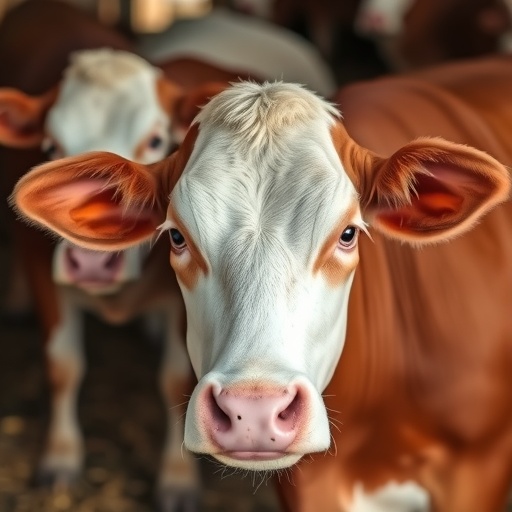
In a groundbreaking study that challenges longstanding assumptions about influenza transmission in livestock, researchers at The Ohio State University have uncovered critical insights into how the highly pathogenic H5N1 avian influenza virus infects dairy cattle. Contrary to traditional views that respiratory routes are the predominant means of influenza infection, this new research reveals a startlingly low infectious dose for bovine infection and highlights the mammary gland—not the respiratory system—as the key viral target. These findings illuminate the complexities behind the recent surge of H5N1 outbreaks in US dairy herds and pose critical questions about controlling the disease’s spread.
Since March 2024, the United States has grappled with over a thousand confirmed outbreaks of H5N1 influenza, specifically the clade 2.3.4.4b genotype, in dairy cattle across 17 states. This unprecedented spillover event from avian hosts like wild birds to mammals has confounded experts and industry stakeholders alike. The virus’s novel route of infection—colonizing the mammary gland—marks a significant paradigm shift from established influenza models grounded predominantly in respiratory transmission. Researchers have now demonstrated that as few as ten viral particles introduced directly into a cow’s teat can initiate a productive infection, a remarkably low threshold that underscores just how easily the virus might gain a foothold in herds.
Delving deeper, experimental inoculations were methodically performed at varying viral doses, consistently showing that even minimal viral exposure can result in infection and subsequent shedding of virus-laden milk. Intriguingly, animals exposed to lower doses exhibited fewer overt clinical symptoms yet still contributed to environmental viral loads through their milk. The biological architecture of the bovine udder, comprising four discrete mammary glands sharing a common blood supply, appears to influence infection severity. Observations suggest limited viral dissemination between glands within individual cows, which may modulate disease severity and clinical presentation.
Efforts to elucidate transmission dynamics have yielded unexpected results. Notably, protocols transferring contaminated milking equipment from infected to naïve cows over extended periods failed to propagate infection. This outcome challenges the prevailing hypothesis that milking machinery acts as a direct vector. Complementary studies assessing the infectivity potential of contaminated milk fed to calves demonstrated minimal viral transmission and associated inflammatory responses, indicating that milk consumption alone is unlikely to sustain transmission cycles robustly.
Further inquiry into respiratory transmission potential involved intranasal viral administration and cohabitation experiments with chickens. The absence of significant clinical illness or viral shedding in respiratory secretions among cows receiving intranasal doses—a technique designed to mimic airborne exposure—and the health of co-housed poultry reinforce the notion that airborne transmission pathways are minimal, if existent at all. Such findings complicate existing models and emphasize the uniqueness of H5N1’s infection profile in dairy cattle.
However, these experiments were conducted within highly controlled biocontainment facilities designed to prevent extraneous variables that might be present in farm environments. The sterile nature and strict airflow regulation inherent to Biosafety Level 3 environments may not fully replicate the complex interplay of factors influencing viral spread in operational dairy farms. Thus, the potential for milking equipment to function as a transmission conduit cannot be entirely discounted and requires further nuanced investigation under field conditions.
Another enigmatic aspect remains the initial spillover mechanism from waterfowl to bovine hosts. In avian species, H5N1 principally replicates in the gastrointestinal tract, facilitating fecal-oral transmission. The leap from a digestive pathogen in birds to an agent preferentially infecting mammary tissue in cows defies conventional infection pathways and biological expectations. This intriguing biological puzzle underscores gaps in our understanding of interspecies viral adaptation and host-pathogen interactions in agricultural ecosystems.
From a public health and agricultural perspective, the study’s findings have profound implications. The detection of high viral titers in milk from infected cows raises concerns about viral dissemination through dairy product supply chains. Although pasteurization effectively inactivates viral particles, the persistence of virus in raw or inadequately processed milk warrants vigilance. The implementation of national milk testing regimes and herd movement restrictions underscore the efforts underway to curb disease propagation, but their effectiveness hinges on a more comprehensive grasp of transmission dynamics.
Lead investigator Andrew Bowman emphasized the urgency of refining our understanding of cow-to-cow transmission routes. “Limiting transmission requires targeted interventions,” he noted, “but the unusual tropism for mammary glands demands that we rethink standard biosecurity practices.” The challenge lies in developing evidence-based mitigation strategies tailored to this unique mode of infection, considering both the biology of the virus and real-world milking and farm management practices.
The collaborative research effort, conducted in one of only six Biosafety Level 3 facilities nationwide capable of housing large animals safely, represents a significant step forward. Yet, the inherent complexity of working with live cattle and the limitations imposed by ethical and logistical considerations mean that sample sizes remain relatively small. Larger-scale in-field studies are crucial to validate these initial laboratory findings and translate them into actionable recommendations for farmers and regulators.
Funded by the National Institute of Allergy and Infectious Diseases through the Centers of Excellence for Influenza Research and Response, this work exemplifies the intersection of veterinary science, epidemiology, and agricultural biosecurity in addressing zoonotic disease threats. Continued surveillance and multidisciplinary collaboration will be essential as the threat of H5N1 persists, with spillover events expected to recur.
In summary, this research drastically reshapes the understanding of H5N1 infection in dairy cattle. It demonstrates that an extraordinarily low dose of viral particles targeted to the bovine mammary gland can result in infection, progressing independent of respiratory involvement. The classic modes of transmission—airborne spread, direct contact via milking equipment, or milk feeding—appear less effective than hypothesized, suggesting unknown mechanisms or multifactorial processes at play. This substantial knowledge gap accentuates the need for further experimental study, particularly within farmlike settings, to unravel the viral ecology underpinning this troubling and economically significant disease.
To effectively combat and control H5N1 in dairy herds, researchers urge the agricultural community to rethink biosecurity frameworks and milking protocols while advocating for enhanced diagnostic and monitoring tools. As this viral threat evolves, so too must scientific and practical approaches to safeguard animal health, dairy production, and ultimately human health through containment of zoonotic influenza risks.
Subject of Research: Animals
Article Title: Dairy cows infected with influenza A(H5N1) reveals low infectious dose and transmission barriers
News Publication Date: 24-May-2026
Web References:
Journal article DOI: 10.1038/s41467-026-73490-6
Research Lab: The Ohio State University Veterinary Preventive Medicine
Biosafety Level 3 Facility: Plant and Animal Agrosecurity Research Facility at Ohio State
References:
Nature Communications, DOI: 10.1038/s41467-026-73490-6
Keywords:
H5N1, avian influenza, dairy cattle, infectious dose, mammary gland infection, influenza transmission, zoonotic spillover, viral shedding, viral titers, biosafety level 3, epidemiology, veterinary preventive medicine
Tags: avian influenza spillover to mammalsclade 2.3.4.4b H5N1 genotypecontrolling H5N1 spread in cattledairy cattle H5N1 outbreaksH5N1 avian influenza in cattleH5N1 transmission pathwaysinfluenza transmission in livestocklow infectious dose H5N1mammary gland infection influenzanon-respiratory influenza infectionOhio State University influenza researchviral infection in dairy herds