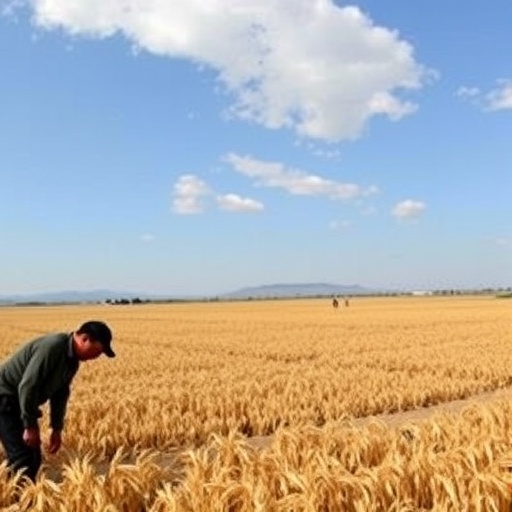
In a groundbreaking new study published in Nature Food, researchers have unveiled how China’s internal grain trade has profoundly reshaped the geographical landscape of agricultural production and its associated environmental impacts over the past four decades. By meticulously analyzing grain production, interprovincial trade volumes, and environmental footprints from 1980 to 2020, the study captures a dramatic northward shift in both grain cultivation and ecological burdens. This comprehensive assessment highlights the critical interplay between economic development, climatic factors, and environmental stewardship policies, painting a complex picture of China’s evolving agricultural dynamics amid climate change.
Between 1980 and 2020, China’s interprovincial grain trade expanded more than fivefold—from 22 million tonnes to a staggering 128 million tonnes—signifying an intensified flow of staple crops from southern to northern provinces. This redistribution of agricultural production has not been without consequence. The researchers report an approximate 196% surge in virtual cropland displacement, a 415% increase in virtual water consumption, and over 217% rise in nitrogen losses and greenhouse gas emissions embedded within traded grain. These environmental spillovers reveal a shifting burden that disproportionately impacts northern regions, posing challenges for regional sustainability and equitable resource management.
Mechanization and irrigation have emerged as dominant forces driving these spatial shifts, far outweighing the direct influence of climatic variables. The intensification of agricultural technology and infrastructure, coupled with accelerating urbanization trends, have incentivized grain production relocation to the north, where expansive arable lands and mechanizable terrain coexist with limited water availability. As irrigation demands strain northern water resources, the environmental costs associated with production intensification become increasingly pronounced, raising alarms for long-term ecological resilience in these regions.
The study’s integration of climate projections and socioeconomic pathways showcases the precarious nature of China’s grain production systems under future warming scenarios. Under the widely used Shared Socioeconomic Pathway 2–4.5, the study projects persistent reliance on northern grain exports may exacerbate environmental degradation. Simultaneously, climate-induced declines in crop yields threaten to contract the breadth of interprovincial trade networks. This dual dynamic suggests that without intervention, northern provinces could shoulder escalating ecological burdens, while southern regions may face increased food insecurity risks from shrinking grain inflows.
A novel facet of this research is its quantification of ecological compensation schemes necessary for redressing interregional imbalances. The authors estimate that by 2060, financial transfers from grain-importing southern regions to environmentally impacted northern provinces may need to reach up to US$12.5 billion annually. These payments would symbolize recognition of virtual resource use and pollution externalities embedded in traded goods, fostering a more equitable sharing of ecological costs and supporting sustainable agricultural transitions.
Methodologically, the team harnessed a unique dataset combining provincial-level grain yield statistics, trade flow records, water use metrics, nitrogen emissions data, and mechanization indices. Their bottom-up approach enables detailed tracing of ‘virtual’ resource displacements—water, land, nitrogen, and greenhouse gas emissions—embedded in traded grain quantities across provinces. This precision allows disaggregation of environmental pressures attributable to supply chain shifts, thereby unraveling the often-hidden effects of market-driven agricultural relocation.
The timing and magnitude of trade growth further underscore structural transformations in China’s food system. During the reform era from the 1980s onward, market liberalization and technological modernizations facilitated more dynamic grain movements, moving beyond self-sufficient provincial production models. Enhanced transport infrastructure and policy reforms have enabled provinces with comparative production advantages to specialize and export grain surpluses. This economic rationalization, however, has translated environmental pressures into new geographies, as production footprints diverge increasingly from consumption centers.
Urbanization emerges as another key driver in altering agricultural spatial patterns. Expanding city boundaries and industrial development in southern provinces have eroded cropland availability, constraining local grain output and necessitating increased import dependencies from the north. This land-use competition intensifies environmental burdens beyond agricultural zones, as resources are effectively ‘imported’ virtually through grain trade. The resultant spatial decoupling of production and consumption underscores the necessity of integrated policies addressing urban growth and agricultural sustainability cohesively.
Climate variability, while acknowledged, appears secondary relative to socioeconomic drivers in shaping the northward shift. Despite regional climate impacts on yields, the study finds technological progress, resource endowments, and demographic shifts exert stronger influences on production relocation. This insight challenges simplistic narratives attributing agricultural changes predominantly to climate change, emphasizing the importance of multidimensional analyses that capture economic and social factors.
The environmental ramifications of intensified northern grain production resonate across multiple ecological domains. The dramatic rise in virtual water consumption reflects localized water stress exacerbated by irrigation demands, threatening aquifer recharge and riverine health. Nitrogen fertilizer overuse contributes not only to air and water pollution but also to soil degradation and biodiversity loss. Elevated greenhouse gas emissions from mechanized farming compound China’s wider climate commitments, highlighting the need for targeted mitigation strategies sensitive to spatial production disparities.
Proactive policy responses must recognize the entwined nature of food security and environmental equity. The proposed ecological compensation mechanisms aim to incentivize sustainable practices in exporting provinces, while supporting resource conservation and pollution mitigation initiatives. Simultaneously, strategies fostering diversified production systems and improved water-use efficiency could alleviate concentrated pressures. Enhanced data sharing and interprovincial cooperation will be pivotal in designing coordinated governance frameworks that balance economic efficiency with ecological integrity.
Looking ahead, the study warns that continued dependence on northern grain exports without systemic reforms may deepen environmental injustices, threatening regional livelihoods and undermining national sustainability goals. Anticipated climate impacts compound vulnerabilities, likely shrinking trade options and raising food security concerns during adverse periods. Thus, flexible adaptive management combining technological innovation, policy instruments, and stakeholder engagement is crucial for navigating these intertwined challenges.
This research offers a compelling and timely reflection on how internal market dynamics and climate change intertwine to reshape agricultural landscapes and environmental outcomes at unprecedented scales. Its methodological rigor and integrative perspective provide crucial guidance for China’s agricultural planners, environmental managers, and policymakers aiming to foster resilient and equitable food systems under mounting global pressures.
Ultimately, the spatial decoupling and environmental spillovers documented here serve as a microcosm of broader global trends, where trade and climate intersect to redistribute ecological footprints. Lessons drawn from China’s experience can inform international efforts to reconcile food production with planetary boundaries, emphasizing the value of systemic and regionally attuned solutions in a rapidly changing world.
As the global demand for food intensifies and climate impacts accelerate, understanding and managing the full supply chain consequences of agricultural trade becomes ever more critical. This study showcases how innovative data integration and scenario analysis illuminate hidden environmental costs while pointing toward feasible mitigation pathways. It challenges stakeholders to rethink agricultural value chains—not only as economic networks but as intertwined ecological systems demanding coherent, forward-thinking stewardship.
The spotlight on China’s grain trade highlights the delicate balance between economic growth, social equity, and environmental sustainability—an equilibrium that many countries will increasingly grapple with in the decades to come. This pioneering work offers an indispensable foundation for crafting policies that are both economically savvy and ecologically responsible, advancing the global agenda for sustainable and just food systems.
Subject of Research: Environmental impacts and spatial dynamics of China’s interprovincial grain trade under climate change and socioeconomic transitions.
Article Title: Climate change and interprovincial trade move grain production and environmental burdens northwards in China.
Article References:
Wang, C., Zhang, X., Ren, C. et al. Climate change and interprovincial trade move grain production and environmental burdens northwards in China. Nat Food (2026). https://doi.org/10.1038/s43016-026-01373-6
Image Credits: AI Generated
DOI: https://doi.org/10.1038/s43016-026-01373-6
Tags: China’s interprovincial grain trade growthclimate change impact on grain productioneconomic development and environmental policy Chinaenvironmental impacts of grain trade Chinagreenhouse gas emissions in Chinese agricultureincrease in virtual water consumption agricultureirrigation influence on crop distributionmechanization effects on grain cultivationnitrogen losses from grain production Chinanorthward shift in agricultural production Chinaregional sustainability challenges China agriculturevirtual cropland displacement in China