The story of how birds learned to fly has long been told as one of nature’s great triumphs, a steady march from feathered dinosaur ancestors toward the refined aerial machines that dominate modern skies. A spectacular new fossil from southern China is now forcing paleontologists to rewrite that narrative. A study published in Nature describes Yuezhuornis yangyuanensis, a crow-sized bird that lived roughly 150 to 148 million years ago during the Late Jurassic, and whose anatomy indicates that it had already lost the ability to fly. The specimen, unearthed in Fujian Province, represents the earliest known example of flight loss anywhere in the evolutionary history of birds, a finding that upends the assumption that the earliest chapters of avian evolution were driven overwhelmingly by the demands of aerial locomotion.
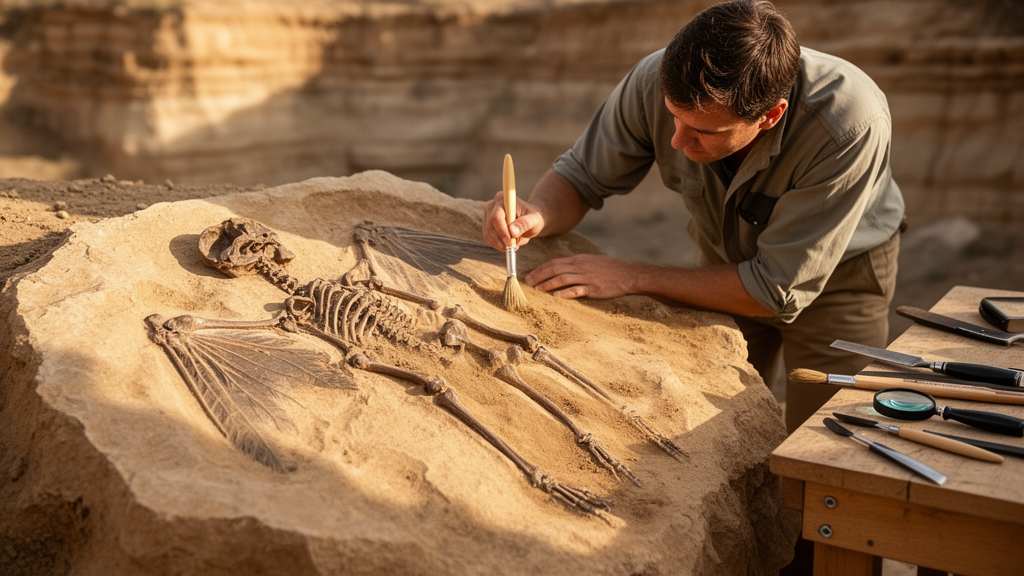
The fossil was discovered in the recently recognized Zhenghe Fauna of southeastern China by researchers from the Institute of Vertebrate Paleontology and Paleoanthropology of the Chinese Academy of Sciences and the Fujian Institute of Geological Sciences. The Zhenghe Fauna has quickly become one of the most significant windows into a poorly documented stage of Jurassic bird evolution, yielding a growing roster of early avialans that are helping fill the gap between the famous Archaeopteryx of Europe and the diverse bird communities of the Cretaceous. The exceptional preservation of the new specimen, captured in a photograph released with the study, allows nearly every region of the skeleton to be examined in fine detail, which is precisely what makes its strange combination of traits so consequential.
What strikes researchers most about Yuezhuornis is its mosaic anatomy, a patchwork of features that belong to very different corners of the dinosaur family tree. On one hand, the animal displays characteristic avian traits, including bird-like pelvic and hindlimb structures that place it squarely within Avialae, the group that contains modern birds and their closest extinct relatives. On the other hand, it retains features inherited from its predatory dinosaur forebears that are normally absent in birds. The jaws are lined with closely packed, serrated teeth, a condition typically found in deinonychosaurs rather than in avialans. Even more striking is the animal’s foot: Yuezhuornis possessed a hyperextensible second toe tipped with a sickle-shaped claw, the signature predatory adaptation of dromaeosaurids and troodontids, the swift, claw-footed carnivores popularly associated with Velociraptor.
That combination of traits left a deep impression on the team that described the fossil. When we examined Yuezhuornis, we were struck by its extraordinary mix of features, said Dr. Wang Min of the Institute of Vertebrate Paleontology and Paleoanthropology, the corresponding author of the study. It possesses bird-like pelvic and hindlimb structures yet retains the specialized predatory foot and teeth of a small meat-eating dinosaur. It shows us that early bird evolution was far more complicated than we previously realized. The remark captures the central puzzle posed by the specimen: an animal that is unambiguously a bird by ancestry, yet one whose body was being shaped by forces other than the pursuit of flight.
To resolve where this enigmatic species belongs on the evolutionary tree, the research team subjected the specimen to comprehensive phylogenetic analyses using two independent analytical frameworks, maximum parsimony and Bayesian tip-dating methods. These approaches differ in how they weigh character distributions and incorporate geological time, so agreement between them carries considerable weight. The results consistently placed Yuezhuornis firmly within Avialae, positioned just crownward of Archaeopteryx and as a sister taxon to Zhengheornis, another bird from the same fauna. The results consistently placed Yuezhuornis firmly within Avialae, just crownward of Archaeopteryx and as a sister taxon to Zhengheornis, said Dr. Zhou Zhonghe, a co-author of the study. In practical terms, this means Yuezhuornis sits near the very base of the bird lineage, close to the point where birds first split from their deinonychosaur relatives, yet it had already departed from the flight-centered body plan that its position on the tree might have predicted.
Determining how such an animal actually lived required a different toolkit. The team turned to ecomorphometric and multivariate statistical analyses, techniques that compare the proportions of limbs across a broad sample of living and extinct species to infer ecological roles. Living birds with particular limb proportions tend to move through the world in characteristic ways, and those correlations can be projected onto fossils. In the case of Yuezhuornis, the analyses revealed that its limb proportions were similar to those of living terrestrial birds and some non-avialan paravians, the close dinosaurian relatives of birds. The implication is that Yuezhuornis was a ground-dwelling animal that had given up flight altogether, walking and running through its Late Jurassic ecosystem rather than taking to the air.
The ecological picture that emerges is one of remarkable experimentation at the dawn of bird evolution. Rather than a single lineage refining the flight apparatus generation after generation, the earliest avialans appear to have been exploring a range of ecological niches, some of which did not require flight at all. Yuezhuornis suggests that within just a few million years of the origin of birds, at least one lineage had traded the sky for the ground, retaining and even elaborating the predatory equipment of its dinosaurian ancestors, from the serrated teeth to the killing claw. This is a lifestyle choice, in the evolutionary sense, that no one expected to find so close to the root of the bird family tree.
The discovery directly challenges the notion that aerodynamic selection was the dominant force shaping early avialan evolution. For decades, the anatomy of the earliest birds has been read almost exclusively through the lens of flight: the elongated forelimbs, the fused skeletal elements, the feathers arranged as airfoils. Yuezhuornis demonstrates that the avian body plan could evolve along paths that did not favor flight, and that some of the most distinctive avian features could persist or arise in animals that never used them to fly. It also highlights the remarkable ecological and morphological diversity that emerged during the early evolution of birds, diversity that the fossil record is only now beginning to reveal as sites like the Zhenghe Fauna are systematically explored.
For paleontologists, the broader lesson is that evolution is not a ladder but a branching exploration of possibilities, and the earliest birds were exploring more of those possibilities than anyone suspected. The ongoing discovery of early avialans in southeastern China underscores the potential of the Zhenghe Fauna to illuminate a poorly documented stage of Jurassic bird evolution, and each new specimen has the capacity to rearrange long-held ideas about what the first birds were and how they lived. Yuezhuornis yangyuanensis, with its bird-like hips and dinosaur-killing claw, its flightless limbs and serrated teeth, stands as proof that the road to modern birds was not a single highway toward better flight, but a tangled network of evolutionary experiments, some of which led away from the sky entirely.
Subject of Research: Flight loss and ecological diversification in a Late Jurassic early bird from China
Article Title: Not all early birds evolved toward better flight, Jurassic fossil suggests
Article References: Not all early birds evolved toward better flight, Jurassic fossil suggests. (n.d.). Original publication
Image Credits: AI Generated
DOI: Not provided
Keywords: Yuezhuornis yangyuanensis, Late Jurassic, early bird evolution, flight loss, Avialae, Archaeopteryx, deinonychosaurs, Zhenghe Fauna, Fujian Province, paleontology, Nature, ecomorphometrics
News Source: Gavin Prescott. (October 15, 2026). Jurassic fossil reveals early birds that abandoned flight entirely. Scienmag.