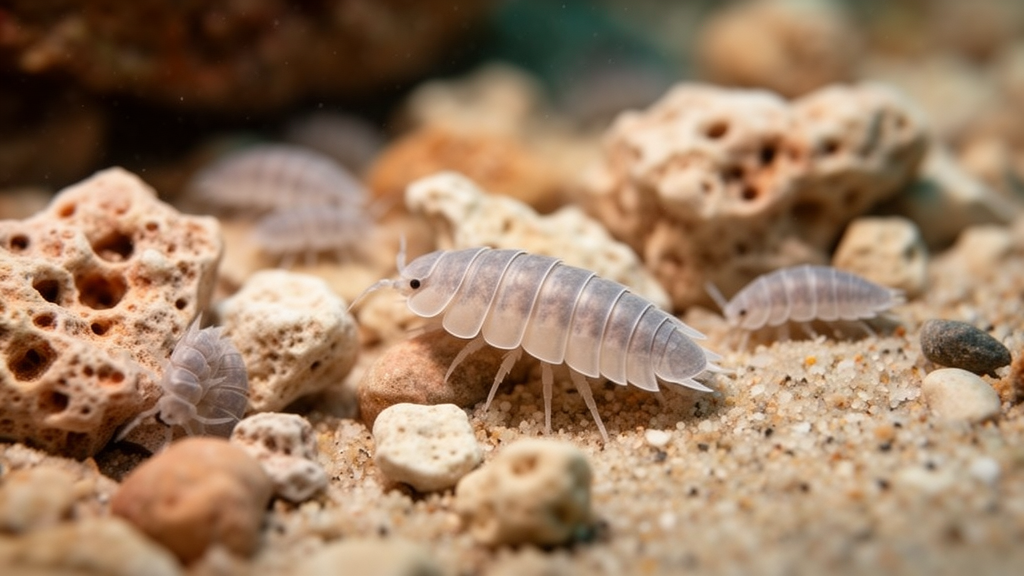
Beneath the jetty of a small marine research resort on Bangka Island, in the shallow waters of Northern Sulawesi, scientists have uncovered a hidden world of minute crustaceans. A new study published in the journal Evolutionary Systematics describes eight previously unknown species of anthuroid isopods, small flattened relatives of the familiar woodlouse, that live among coral rubble and mangrove sediments in one of the most biodiverse marine regions on Earth. The work, led by veteran taxonomist J.W. Wägele in collaboration with researchers at Sam Ratulangi University in Manado, also delivers a sweeping revision of the classification of two major species groups, reshuffling genera that have confused specialists for more than a century.
The Coral Triangle, the vast marine region encompassing Indonesia, the Philippines, and surrounding waters, is famous for its reefs, but its smallest invertebrates remain largely unknown. Collecting and sorting these animals is painstaking, many species are extremely small and rare, and only a handful of taxonomists worldwide are familiar with the groups involved. The researchers warn that with near-shore habitats deteriorating under human pressure and global warming, species may vanish before their existence has ever been recorded. Their new descriptions are therefore not just an academic exercise but a fundamental basis for any future ecological study of these reefs, most of which in Northern Sulawesi are still in good condition.
The team gathered material during field trips to Bangka Island, partly with participants of Sam Ratulangi University. Using SCUBA diving and snorkelling, they collected coral rubble in buckets and brushed the epifauna of mangrove roots into small nets, all in shallow water between zero and five metres deep. After washing the samples and sieving the wash water through 0.2 millimetre meshes, specimens were sorted alive under a Zeiss stereomicroscope at the Coral Eye resort on Bangka Island and fixed in 80 percent ethanol. Among the small crustaceans, isopods proved much less abundant than tanaidaceans or amphipods, and only a few specimens of each anthurid species were found, underscoring how easily these animals escape notice.
The eight new species span several genera. Eisothistos minahasaensis, a unpigmented creature barely 2.1 millimetres long, was named after the Minahasa Peninsula and is distinguished by a characteristic tail fan with a precise arrangement of teeth and plumose setae. Two new Mesanthura species were also described: Mesanthura ratulangii, named for Samuel Jacob Ratulangi, a native of Northern Sulawesi who fought for Indonesian independence, and Mesanthura heliolatra, whose name derives from the Greek words for sun and worship, a nod to its preference for sunlit shallow water. The latter species shows remarkable sexual dimorphism, with males possessing atrophic mouthparts and an unusually modified first leg bearing a brush of hook-like setae.
Haliophasma annaclericiae, the first species of its genus found in Indonesia, honours Anna Clerici, who organizes the collection of plastic trash from beaches in North Sulawesi under the No Trash Triangle initiative. This isopod stands out with unusually large eyes, nearly half as long as its head, a strongly calcified cuticle with visible carbonate incrustations, and a long, spade-like telson with parallel lateral margins and a dorsal keel. Three further new species belong to the Apanthura group: Apanthuretta markuslasuti, named for Professor Markus Lasut of Sam Ratulangi University, Apanthuretta pinchans, whose name derives from the Latin word for to prick and whose first leg forms true pincers between propodus and dactylus, Amakusanthura mamuajae, named for marine ecologist Jane Mamuaja, and Apanthurella cuspidobtusa, the first representative of a newly erected genus.
Beyond the new species, the study resolves long-standing taxonomic tangles in the Haliophasma and Malacanthura groups. Species have been moved back and forth between these genera for decades, and the current assignment of species was inconsistent. The researchers identified reliable distinguishing characters: the maxilliped carries two palp articles in Haliophasma but three in Malacanthura, the mandibular molar process is absent or weak in Haliophasma but strong and well sclerotized in Malacanthura, and the telson of Haliophasma is generally linguiform with lateral flanges, often with a dorsal keel. Using these criteria, several species were reassigned, including Haliophasma hermani, H. pseudocarinata, and H. mombasa, which now belong to Malacanthura.
Perhaps the most striking discovery concerns a peculiar large hook on the first article of the first antenna, which arches over the cephalon in three species hitherto placed in Haliophasma and in the only species of the genus Nemanthura. This feature is unique within the entire suborder of Isopoda and provides a powerful argument for reinstating the old genus Exanthura Barnard, 1914 to accommodate all species with this hook. Haliophasma macrurum, originally described as Exanthura macrura in 1914 and later moved to Haliophasma, now returns to Exanthura as its type species. Nemanthura Wägele, 1981 is synonymized with Exanthura, and its type species Nemanthura valeriae is transferred accordingly. The revised genus now contains four species from South Africa, Western Australia, and off Venezuela.
The Apanthura group, comprising the genera Apanthura, Apanthuretta, Apanthuropsis, and Amakusanthura, contains 92 described species, some of which remain indistinguishable due to incomplete descriptions. The researchers found that many species show a mix of characters that do not fit available diagnoses. By comparing all published descriptions, they distinguished five groups sharing derived characters, proposed to be placed in different genera. A key character visible at first sight is the structure of the pleon, the posterior body region: Apanthura species have unfused pleonites in both sexes, Apanthuretta species show dorsal fusion of only pleonites four and five, Apanthuropsis species have a pleon wider than long, Amakusanthura species possess a pleon as long as wide or longer with narrow uropodal exopods, and the newly erected genus Apanthurella, diagnosed for the first time in this paper, combines dorsally fused pleonites with leaf-shaped uropodal exopods bearing a distodorsal sinuosity and a relatively short male first antenna.
The synonymy of Apanthuretta with Amakusanthura proposed by earlier authors is rejected. The type species of Amakusanthura, A. longiantennata, was described from a single sexually dimorphic blind male with all pleonites dorsally fused and a very long pleon, sharing no specific similarity with the type species of Apanthuretta. Moreover, all known males of species assigned to Apanthuretta that possess free anterior pleonites and fused pleonites four and five also show this character in maturity, a consistency that supports a monophyletic origin for the genus. The new classification allows more precise diagnoses of potentially monophyletic groups and makes the genera more coherent, though the authors caution that many species were described fragmentarily and that numerous redescriptions will be needed.
All type material is deposited in the Museum Zoologicum Bogoriense in Bogor, Indonesia, and in the Crustacea collection of the Leibniz Institute for the Analysis of Biodiversity Change in Hamburg, Germany. Specimens were collected under Indonesian research permit 275/SIP/IV/FR/4/2024 issued by BRIN, with a Letter of Agreement between Sam Ratulangi University and the German institute. The authors emphasize that DNA data for these species would be extremely useful for phylogenetic classification, but because the animals are rare and small, available material is usually just sufficient for morphological description and too valuable to be shredded. With advancing habitat deterioration in the Coral Triangle, the race is on to document these minute crustaceans before they disappear unnoticed.
Subject of Research: Taxonomy and biodiversity of marine isopod crustaceans in the Coral Triangle
Article Title: New Anthuroidea ( Crustacea , Isopoda ) from Northern Sulawesi (Indonesia) and a revised classification of the Haliophasma and Apanthura groups
Article References: Wägele, J. W., Undap, N. I. J., & Papu, A. (2026). New Anthuroidea (Crustacea, Isopoda) from Northern Sulawesi (Indonesia) and a revised classification of the Haliophasma and Apanthura groups. Evolutionary Systematics, 10(2), 409-467. https://doi.org/10.3897/evolsyst.10.204153
Image Credits: AI Generated
DOI: 10.3897/evolsyst.10.204153
Keywords: isopods, crustaceans, taxonomy, Coral Triangle, Indonesia, marine biology, biodiversity, new species, Evolutionary Systematics, Northern Sulawesi, Anthuroidea, Crustacea
News Source: Margaret Porter. (October 15, 2026). Tiny Isopod Treasures: Eight New Crustacean Species Emerge from Sulawesi’s Coral Rubble. Scienmag.